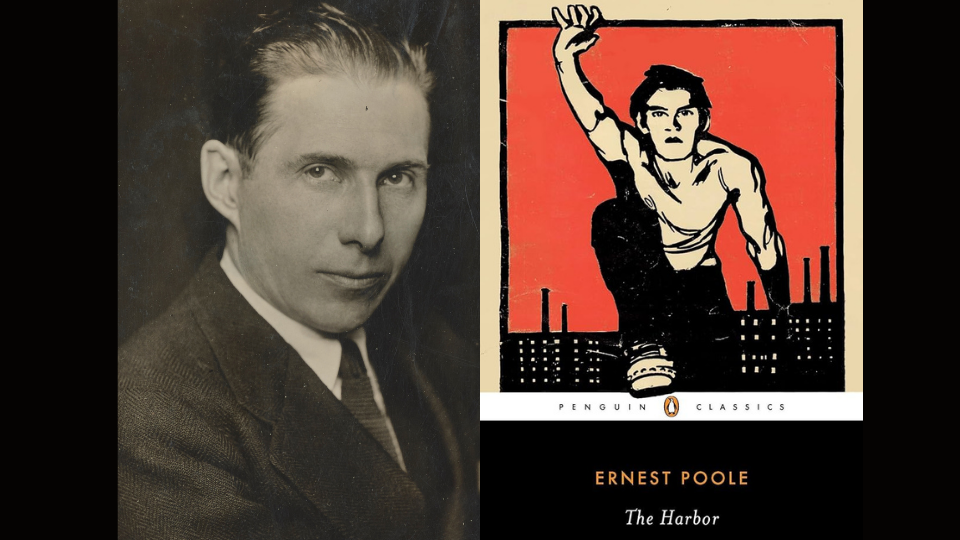
While Ernest Poole earned the first Pulitzer Prize for fiction in 1918, with the novel His Family, it is Poole’s first novel, The Harbor, which is sometimes thought to be the reason he won the award. Perhaps no book better captures the zeitgeist of the pre-war 1910s—the seeming zenith of U.S. socialism, when muckraking journalism was exposing economic injustices that gave energy and rise to the collectivist labor movement throughout the country. Though highly controversial at the time, the work of muckrakers opened the eyes of the American people to the struggles of immigrants and the working poor.
Essentially, The Harbor does for the ship and dock workers of New York what Upton Sinclair’s The Jungle did for the immigrants working in the meatpacking industry in Chicago. Poole’s novel takes readers into the tenements, saloons, warehouses, textile mills, skyscrapers, and most importantly, into the ranks of the struggling proletariat striving to secure workers’ rights in an ever-changing industrialized world.
In constructing his plot and the character of his protagonist, Billy, Poole relied heavily on the exploits of the IWW and his own interviews with labor leader “Big Bill” Haywood. The Harbor also reaps major benefits from Poole’s direct participation in the 1913 Paterson Silk Workers’ Strike and Paterson Strike Pageant. In addition, the Colorado coalfield wars of 1913-1914 provided Poole with material that heightened the violence and shock value of the book’s main labor action. Poole’s extensive coverage and knowledge of the labor movement placed The Harbor directly into the cultural conversation, making it the eighth bestseller of 1915. As Patrick Chura’s introduction to the Penguin Classics edition of the novel points out, The Harbor went through 78,000 copies and 22 printings in a matter of months. If it was Poole’s intent to shine a light on harsh labor conditions and the callous norms of capitalism, he succeeded.
However, the main character’s support for the novel’s stand-in for Haywood, Jim Marsh, is not the author’s sole focus. Billy’s turbulent lifelong relationship with New York Harbor shifts multiple times in the novel, from childhood to marriage, most directly influenced by the people prominent in his life at any given time. His internal struggle to understand himself and his harbor directly mirrors the American sociopolitical landscape of the early twentieth century, demonstrating the nation’s challenge to adapt to a globalizing world with the Great War approaching. As the country confronts modernity, Billy places himself squarely in a middle ground between labor and capital; he must decide between the “Giants” of industry pulling the strings and the stokers in the bellies of ships, whose labor literally powers the future.
As a child, Billy is both fascinated and repelled by the harbor. Growing up in the heights just out of reach of the bustling commerce, he looks down upon a world that is “strange and terrible.” His father ignores him, focusing instead on the business affairs of his waterfront warehouse. His mother is appalled by the harsh lives of the sprawling city’s ethnic newcomers and the commercial world that keeps her husband alienated from his family.
Billy’s youthful curiosity gets the better of him, and against his mother’s wishes, he sneaks down to the waterfront to experience the life force that keeps his father entangled and his mother fearful. He quickly joins a group of street youths led by a boy named Sam who embodies Billy’s notions of harbor life as brutish, drunken, violent, and unpredictable.
Through Billy’s adolescent perspective, Poole demonstrates the uninformed bourgeois prejudices of the time. Unaware of the nuances and struggles of the workers, Billy (and the upper classes of New York) are unable to sympathize with polyglot peoples from “heathen lands.” Early in the novel, the reader’s only view of this multicultural microcosm comes through outsiders who refuse to understand it. In this way, Poole makes the harbor an enigmatic character. Billy interacts with it, but the harbor is just as equipped to interact with those who attempt to engage it.
This dynamic runs throughout the text, forcing Billy to change as much as the harbor itself. At one point, the youthful protagonist appears to make up his mind about the docks: “When I saw or even thought of the harbor, I felt the taste of foul, greasy water in my mouth and in my soul.” He intends to leave this world behind indefinitely, traveling to Paris after finishing college to pursue a career as a poet and novelist. But after two years in Paris, he returns to the Brooklyn shipyards after being informed of his mother’s death, only to find a drastically altered world. His father’s business is crumbling, and the only personal solace he can find is in the changing harbor and the kid sister he left behind, Sue.
Prior to Billy’s sojourn in Paris, Poole does not fully utilize Sue’s character, drawing her mostly as the father’s “favorite” child and therefore a foil to Billy. But Sue becomes the driving force behind Billy’s awakening to the social activism then surging through New York. She represents the New Woman and the young radicals attempting to break down barriers: “Nothing was too wild or new for these friends of Sue’s to jump into. ‘Votes for Women’ was just starting up, and one of this group had been in the first small parade.”
While Poole introduces progressive themes, he seems keenly aware of his middle-class audience, not forcing ideas on readers. Billy, for example, is initially dismissive of Sue and her friends, mirroring the skepticism that Poole’s contemporaries may have had toward women’s rights. But after spending time with Sue’s friends, Billy compares New York progressivism to that of the artists who surrounded him in Paris, stating:
We, too, had thrown old creeds to the winds, but with how much more finesse and art… this crude crowd… kept all its attention on this one mammoth town… they had posed themselves so absurdly close to the world of things as they are.
Using Billy, Poole intentionally muddies the ambitions of the local activists and allows the reader to grow along with the protagonist. Not surprisingly, Sue is the first central character in the novel to damage Billy’s illusions of the harbor and draw him closer to revolutionary thinking.
Billy had previously treated Sue and her radical friends with condescension, but his perspective shifts as Sue’s suffragette march moves through the city. He thinks to himself, “I was rather in favor of suffrage… The great thing was to keep your mind open.” Billy’s open-mindedness is only a first step. Out among the marchers, he muses, “Here for the first time in my life I felt the power of mass action.” Sue’s attempts to win Billy over finally make an impression. She ignites her brother’s first recognition of the proletariat. Importantly, Poole suggests that the labor movement represents spiritual growth rather than degradation of tradition.
No character in The Harbor elicits a more fervent response from Billy than his adversarial friend, Joe Kramer. Close during their college years, they are ever afterward pitted against each other in the arena of social goals and ideals. While all the primary characters in the novel interact with the working class and labor movement, none is as deeply embedded as Kramer, who actually becomes one with the workers. It is Kramer who pushes Billy to become a muckraker. While Billy can never seem to find the perfect class perspective for his writing, Kramer slowly but firmly pushes him leftward. As Nathan Cradle writes in the essay “The Jungle, The Harbor, and the Left’s Early Reception of Radical Sentimentalism,” Billy “must be radicalized politically and must accept the revolutionary power of solidarity and group action before he can write effectively about his chosen subject, the New York port district that is ‘the harbor’ of the novel’s title.”
No moment in the novel traumatizes Billy more than when Joe leads him downward into the stokehole of an ocean liner to witness the monstrously brutalized, coal-blackened stokers at work. Billy’s rude awakening to life in the hellish stokehole is the novel’s most successful scene, an image of empathy-prompting working-class desperation. Billy finally fathoms what Kramer had suffered when he voluntarily worked as a stoker for two years, nearly dying from sickness and exhaustion.
Poole masterfully utilizes the stokehole to literally and metaphorically take the reader to the bottom of things, writing, “We were soon climbing down oily ladders through the intricate parts of the engines… then climbing down more ladders until we were… within ten feet of the keel of the ship, we came into the stokers’ quarters.” This is where Billy, Kramer, and the reader face the naked and downtrodden in a claustral chamber reeking with the stench of human bodies. While the images are shocking, Poole’s dialogue is equally supercharged, and Billy is forever changed. The scene marks a turning point, leading Billy eventually to write the truth about the harbor.
While Billy’s political development is gradual, with several backslides, his wife Eleanore’s recognition of working-class struggles is quicker, yet subtle. Though she begins as a diehard supporter of her urban engineer father, by the end of the novel, she is in a way more deeply involved in the movement than Billy. Through Eleanore’s character, Poole makes an early feminist statement. Without her husband’s consent, she leaves her bourgeois domestic world and rents a flat close to the tenements, where she can assist struggling women and families. When Billy confronts her about her decision, she informs him that it’s “settled” and “we move this week.” Both she and Kramer urge Billy to write about the harbor from a pro-labor perspective.
Poole finished drafting The Harbor in early 1914. But with the onset of the Great War that summer, he asked his publisher to return the manuscript and then spent a month rewriting the final chapters. The impact of the bloodbath in Europe, along with wartime persecutions of socialists and union organizers at home, left Poole and countless others uncertain about the future of the movement. Changing attitudes in a postwar America seeking a “return to normalcy” meant hard times and retrenchment for the collectivist dreams Poole envisioned in The Harbor. Nevertheless, the novel stands undoubtedly as a testament to the power and possibilities of working-class unity.
We hope you appreciated this article. At People’s World, we believe news and information should be free and accessible to all, but we need your help. Our journalism is free of corporate influence and paywalls because we are totally reader-supported. Only you, our readers and supporters, make this possible. If you enjoy reading People’s World and the stories we bring you, please support our work by donating or becoming a monthly sustainer today. Thank you!
CONTRIBUTOR