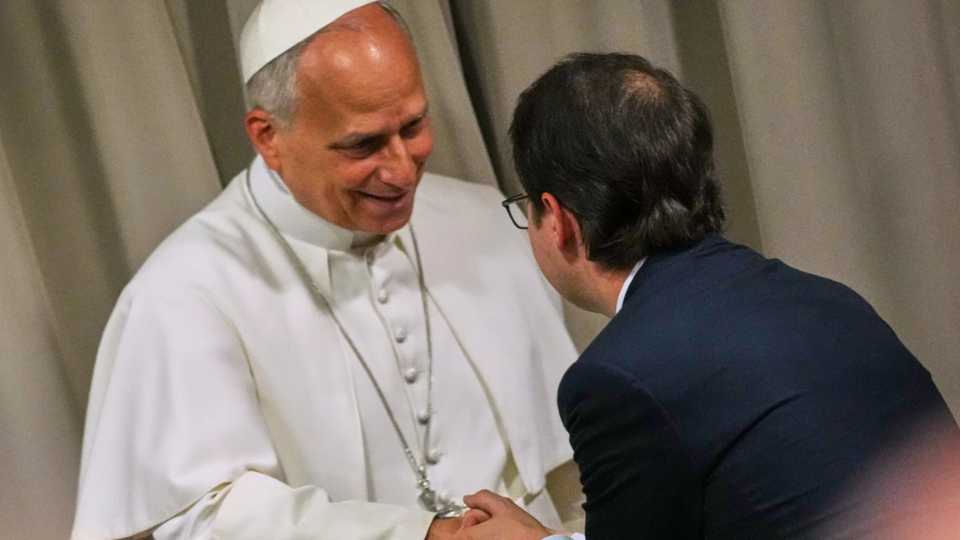
WASHINGTON—The AFL-CIO strongly praised Pope Leo XIV’s encyclical denouncing and warning about the dangers to workers, jobs, and humanity in general of artificial intelligence.
In a 42,300-word encyclical, Magnifica Humanitas, the highest form of Catholic teaching, the Pope, a native of Chicago’s south suburbs who also spent years in Peru, declared human intelligence, and humanity in general, including the value of working at jobs that provide decent living, must always take precedence over machine-made AI.
“Solidarity, then, is the concrete recognition that the future of each individual is connected to the future of all,” the Pope wrote, a statement AFL-CIO President Liz Shuler quoted, with approval.
And while Leo enlisted the leader of one high-tech AI firm, Christopher Olah of Anthropic, to the cause, the other tech leaders in the audience at the Vatican remained silent. In the U.S., with the aid of the pro-corporate GOP Donald Trump regime, they’ve been lobbying against any government regulation—state or federal, labor or otherwise—over AI.
Congress has dithered on regulating AI. Several states and cities are either regulating or rejecting the huge data centers AI demands, including their monstrous electricity demands, which drive local power prices up, and water demands, which drain aquifers.
“Pope Leo’s choice to issue his first encyclical on the threat of unregulated AI is a testament to the urgency of this issue for working people,” Shuler said after Leo unveiled the encyclical on May 25.
“Workers are being surveilled, fired, hurt, and have even died in workplaces that recklessly use AI without guardrails and worker input. It’s clear that if we don’t harness it properly, AI is the single biggest threat to working people of our lifetime.”
“This is what Pope Leo recognizes, echoing the same things I hear from working people around the U.S. and globally. He names the ‘culture of power’ driving the AI arms race, the corporate greed that puts profit over people, and dehumanization working people feel every time they are told to trust untested AI technology over their own experience and skill—even when lives are on the line.”
“The guardrails he calls for—responsible planning, the assessment of human and social impact, the inclusion of the most vulnerable’–are the same principles for which the labor movement has advocated.” Shuler pledged the federation and its member unions “will continue to answer his call and defend working people.”
Various commentators, including Shuler, say AI is so revolutionary that it could either benefit workers by making jobs easier or cost millions of workers their jobs. Leo said the same thing.
AI leaves most people as passive bystanders, he said, “watching and waiting and observing from afar and hoping for the best.”
The current net result of AI, at least as crafted by tech giants, leads to “various kinds of job insecurity, fragmented career paths and automation,” which “must be evaluated not solely in the terms of efficiency, but in relation to the dignity of the human worker.”
Analysts interviewed by various Catholic media noted this encyclical on the future of work and the threat of technological change comes on the 125th anniversary of the most comprehensive prior encyclical on the same issue, issued by Pope Leo XIII in response to the corporate greed and exploitation of the Gilded Age and the Industrial Revolution.
That encyclical, now incorporated in Catholic Social Teaching, explicitly endorsed unionization as a top response for workers to protect themselves. They need that same protection now, Shuler said.
A survey of other unions showed no other statements yet, after the encyclical, but it disclosed one related pre-encyclical reaction: Some 2,100 information technology workers at the University of California system announced they filed with the National Labor Relations Board for union recognition with Communications Workers Local 9119.
Their reasons, including dehumanization and a threat to jobs, were among those Leo warned about.
“The value of persons does not depend on what they achieve or produce,” the Pope wrote. “There are rights that apply to everyone simply by virtue of being human.”
AI condemns young people in developed nations to “new forms of slavery” in menial jobs like data labeling, the Pope said. And youngsters in developing nations are in danger of being put into dangerous work mining for the rare earth minerals social media technology requires, Leo added.
“The bodies of these people are scarred, injured, and worn down so that computational flow may continue uninterruptedly.”
Social media, and particularly its physical, psychological, and mental health threat to young people—the future workforce—was a secondary target of Leo’s encyclical.
Youngsters become so attached to social media and influenced by its algorithms that addiction, bullying, sexual exploitation, depression, and isolation are among the results. There are lawsuits pending in U.S. courts from parents of youngsters driven to suicide by the algorithms of social media configured to encourage such outcomes.
“Psychological and psychiatric literature has documented…how early and unsupervised exposure to digital devices and social media can negatively impact sleep, attention span, control of emotions and relationships, especially during the most vulnerable stages of life, at times with tragic consequences,” the Pope wrote.
“Humanity, in all its grandeur and woundedness, must never be replaced or surpassed.”
We hope you appreciated this article. At People’s World, we believe news and information should be free and accessible to all, but we need your help. Our journalism is free of corporate influence and paywalls because we are totally reader-supported. Only you, our readers and supporters, make this possible. If you enjoy reading People’s World and the stories we bring you, please support our work by donating or becoming a monthly sustainer today. Thank you!
CONTRIBUTOR