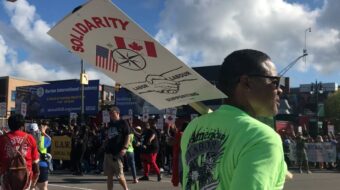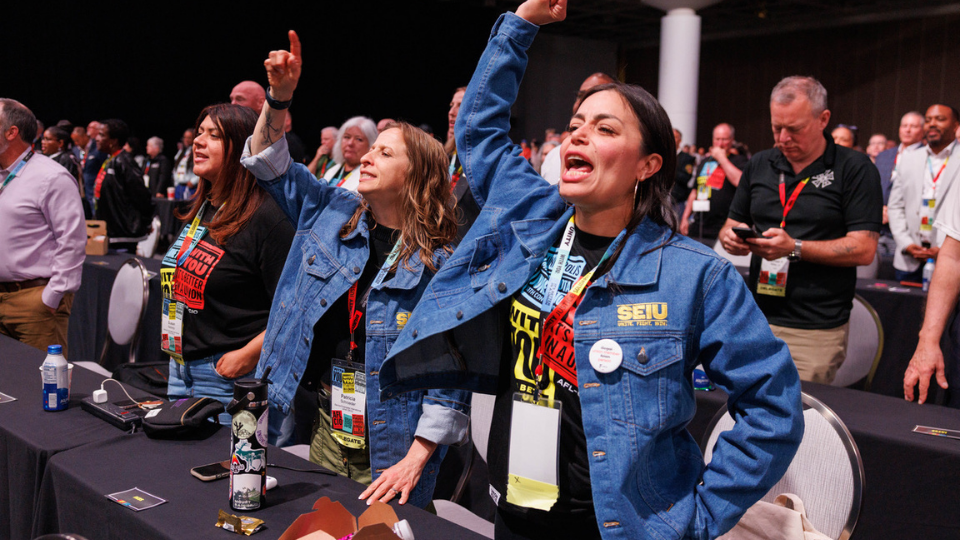
MINNEAPOLIS—The AFL-CIO has set a target of 22,500 people by July 3, eight times that number by Labor Day, and even more after that, to pound the pavements for pro-worker candidates and issues this fall.
The federation’s convention delegates, meeting on June 8 in Minneapolis, approved the mobilization plan President Liz Shuler announced. The mobilization figures were the sole ones she offered.
Not immediately available were figures on how much money the federation would spend on other communication methods this fall, notably over-the-air and social media advertising
In past campaigns, before the rise of social media, the federation spent on ads for pro-worker causes without specifically saying a particular candidate supports or opposes them, but urging voters to put the candidates on the record.
The mobilization is important because, as Shuler and other speakers at the conclave noted, the labor movement is a trusted source of information for both its members and for swing voters whom its organizers contact.
Opinion polls back that up. Some 70% of U.S. workers say they would join a union if they could. Even more notable was a survey earlier this year, which showed unions as the only institution with a positive view from voters. All the others—Congress, the presidency, the Supreme Court, corporations and the mass media among them—were underwater.
The political organizing target complements a separate target the federation set the day before: To add two million new voters from union households to the 14 million who cast ballots in the last off-year election, in 2022. Shuler called that “a very tangible goal.”
The first stage of the political organizing aims to mobilize 1,500 people by July 2-3, and Shuler set a goal for each of those people to recruit 15 more, for a total of 22,500.
“If they recruit eight more people by Labor Day, we’ll have an army,” Shuler said.
On top of that, Shuler wants every state federation and Central Labor Council to recruit 5% more.
They’ll need to. Organized labor’s target this year is to retake control of Congress from the right wing of the GOP, led by President Donald Trump. Shuler and other speakers called Trump the biggest union-buster in U.S. history. He has fired 317,000 federal workers and erased the contracts covering an estimated one million more.
He also launched a nationwide congressional redistricting campaign with the aim of switching five Democratic-held U.S. House seats in Texas to the GOP, thus increasing his party’s slim 217-212 margin there, plus one GOP-leaning independent in California.
That campaign, followed by remaps in Ohio, Florida, North Carolina, Tennessee, Louisiana, and Alabama—the last three following a pro-GOP U.S. Supreme Court ruling—could sharply cut into the number of Black and other elected officials of color at all levels of government.
Estimates say the Congressional Black Caucus could lose 20% of its 62 members and Latinos could lose 11% of their 42 House members as a result. “And those members have a 97% [pro-union] voting score” with the AFL-CIO on issues it lists yearly.
The GOP undertook its redistricting campaign, Shuler and others, in and out of the AFL-CIO, have said, because the party knows its policies—such as cutting Medicare, Medicaid, and food stamps to help pay for another tax cut for the rich and backing Trump’s war on Iran. The president’s approval ratings are now in the tank, except among his MAGA backers.
“So if they can’t win, they cheat,” Shuler said of the GOP.
The political losses of officeholders of color would hurt not just organized labor, but everyone, speakers said.
“When you’re born into a Jim Crow era” where white supremacists “want to suppress the vote…you’re always very cautious” because of “the color of your skin,” said retired AFL-CIO Executive Vice President Arlene Holt-Baker, a long-time AFSCME member and great-granddaughter of enslaved African-Americans.
“Some may ask why should labor care? This [redistricting] impacts our pro-worker agenda for every American,” she stated. “We will all fight together, or we will all drown.”
Referring to the South, which is where most of the impact would occur, Service Employees President April Verrett said, “There’s always been something broken” in U.S. history, “starting with the stealing of land” from indigenous people “and the enslavement of Black people. It was systemic exploitation by private greed.”
And she added, “poverty wages exist because we never fixed what was broke…Hate continues to flourish.”
Auto Workers President Shawn Fain warned, though, that mobilizing on politics does not mean reflexive support for the Democrats.
“If we want to build the working class, we have to change the politics,” Fain stated. “We have to get behind union people running for office,” including smokejumper Sam Forstag, a National Federation of Federal Employees Local 60 member in Montana, and Bob Brooks, the Pennsylvania Fire Fighters president. Both seek U.S. House seats in swing districts.
“We’ve gotta quit throwing our money to the DGA (Democratic Governors Association) and the DSCC (Democratic Senatorial Campaign Committee,” said Fain, and “put our money” where it counts.
We hope you appreciated this article. At People’s World, we believe news and information should be free and accessible to all, but we need your help. Our journalism is free of corporate influence and paywalls because we are totally reader-supported. Only you, our readers and supporters, make this possible. If you enjoy reading People’s World and the stories we bring you, please support our work by donating or becoming a monthly sustainer today. Thank you!
CONTRIBUTOR