SAN DIEGO—This town was the latest burg to be visited by the opera Fellow Travelers. It played its Southern California premiere July 10, 11, and 12 at the historic Balboa Theatre in San Diego’s downtown Gaslamp Quarter. We attended the Saturday night show on July 11.
Based on the 2007 best-selling novel by Thomas Mallon, the opera Fellow Travelers is a poignant, provocative story that explores the intersection of love, politics, and identity during the McCarthy era in 1950s Washington, D.C. It was the time of the Red Scare—and of the Lavender Scare: Thousands of suspected Communists and homosexuals were thrown out of military and government service as threats to national security because, after all, they could be blackmailed. Many summarily lost seniority and the benefits they’d worked their whole careers to acquire. (In the interest of full disclosure, it should be noted that the CPUSA, along with school boards and many other employers, had a similar view of homosexuals during that time.)
American composer Gregory Spears gives the opera a subtly communicative score to an affecting libretto by Greg Pierce. It’s often said that of the many contributing arts and media that go into the creation of an opera, ultimately it’s about the music—otherwise, why not just stage the story as a play? The answer to that question is somewhat more nuanced in this case. Yes, almost the whole libretto is sung, but to this listener’s ears, it was the tight, inescapable synthesis of text and music that conveyed the emotional impact of the characters’ thoughts and voices. The music underscored the action without fighting to come out on top.
Interestingly, the debut of the opera in Cincinnati took place 10 years ago, and then was followed by a popular Showtime miniseries adaptation starring Matt Bomer and Jonathan Bailey. So now we have novel, opera, and miniseries on this heartrending story. There are thoughts of filming the production. Can a crossover Broadway musical be far behind? Or could it survive as the opera that it is on the Great Starry Way?
The hawk is a predatory bird
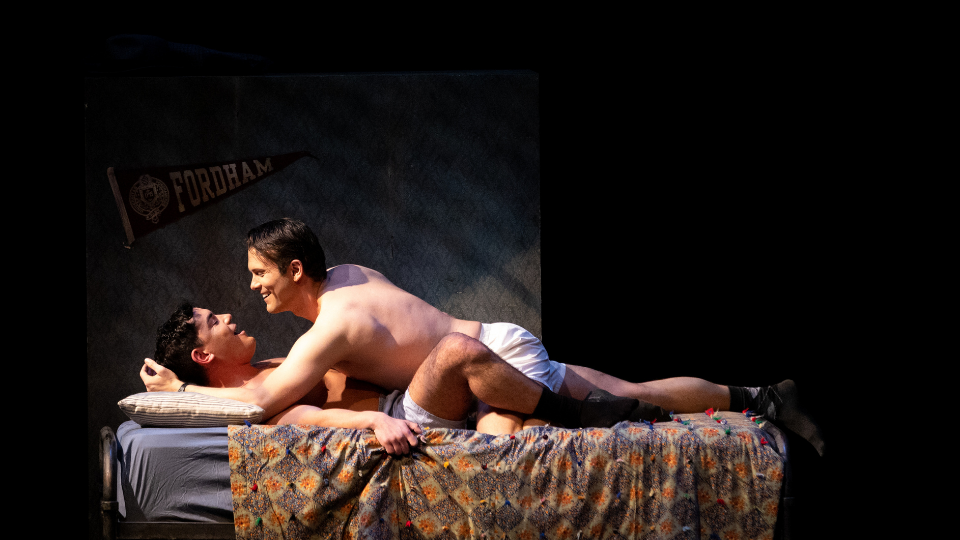
Fellow Travelers tells of Hawkins Fuller (Joseph Lattanzi) and Timothy Laughlin (Andy Acosta) and how they navigate a secret romance in a time of intense scrutiny and fear, all while leaving clues that others pick up on. Tim is a newbie in D.C., a budding reporter, a believing Catholic, and a recent Fordham graduate bent on fighting communism, who might be useful as a speechwriter to Sen. Charles Potter (Kyle Pfortmiller). Hawk, an ambitious government staffer in the State Department, writes a recommendation that lands Tim the job. In gratitude, Tim buys a new biography of Henry Cabot Lodge, writing in his inscription, “You’re wonderful” to his new friend, and leaving it in his office. “Wonderful?” Hawk’s office mates read. Is that the way a heterosexual writes to another? We soon see what Hawk is attracted to: a full moon of Tim’s rotund, succulent, uh, “assets”—which, in a lifetime of attending the opera, I’ve never seen (although there is frontal nudity in Philip Glass’s Akhnaten).
That piece of direction actually is central to the plot: Hawk—his namesake is a predatory bird—is obviously a top, masculine, and commanding in demeanor. He asks Tim to agree that Hawk “owns” him now, his “Irish cub tiger.” But his inability to remain exclusive with Tim—“I can’t be your husband”—clashes with Tim’s ideal of monogamy. Although Tim drifts from his strict Catholicism, he nevertheless imagines his admittedly sinful identity is still ruled by the dictum “until death do us part.” At confession, Tim’s priest (Jeremy Weiss) presses for more and more detail about Tim’s transgressions—how many kisses? How many hours? How many nights in his arms? Titillated minds want to know!
When Hawk is summoned to Room M304 for an investigatory session that will determine if he is homosexual or not, he is asked to walk back and forth (to see if he “swishes,” of course), to read some passages of text (to see if he sibilates his esses), and he is interrogated closely, with a lie detector, as to whether or not he has ever had sex with men, accepted or given gifts to men, frequented certain watering holes, etc. Hawk aces the test, but at what cost to his wholeness and identity? It seems not so incredible that later on, to advance his own career toward an ambassadorship, he will “name names” on Tim, thus denying him his dream job while serving to enhance Hawk’s own creds.
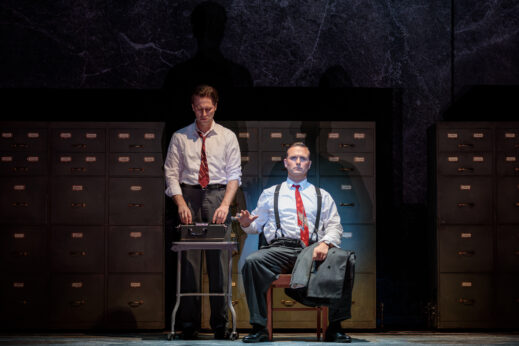
Although the lawyer Roy Cohn does not appear as a character in the opera, he is referenced often as the commie-hunter Sen. Joe McCarthy’s right-hand man. As is well known, Cohn went on to mentor the young Donald Trump.
Evolution of an opera
“I saw Fellow Travelers about ten years ago,” says David Bennett, General Director and CEO of San Diego Opera, “and I’ve been looking for an opportunity to bring it to our audience ever since.” In his introductory remarks, Bennett identified himself as a member of the LGBTQ community.
Director Kevin Newbury directed the work’s premiere and subsequent productions, including this one. “As we prepare to bring Fellow Travelers across the country in celebration of the opera’s tenth anniversary, I have been reflecting a lot on my values as an artist, especially as a Queer artist making work during these uncertain times. I believe in the power of history. I believe in the power of art to build community. And I believe in the power of a good love story. And Fellow Travelers is, first and foremost, a good love story.”
San Diego’s house conductor Bruce Stasyna led a chamber-sized band of musicians from the San Diego Symphony Orchestra that fit snugly into the Balboa Theatre pit.
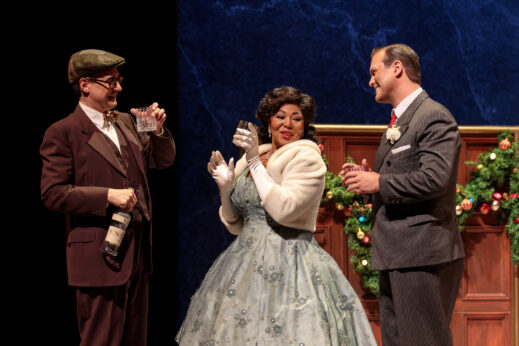
Tenor Andy Acosta, acclaimed at home and abroad for his soaring vocalism, and now a San Diego resident, reprised the role of Timothy, which he has performed in three different productions. Baritone Joseph Lattanzi starred as Hawkins Fuller in the Fellow Travelers world premiere and many subsequent productions. Soprano Vanessa Becerra brought to life the gossipy role of Miss Lightfoot, as she did in Seattle and Portland, and soprano Amber R. Monroe, apparently new to this opera, sang the role of Hawk’s wise aide, New Orleans-born Mary Johnson. The cast also included Marcus DeLoach in the roles of the blustering Sen. Joseph McCarthy, Frank, an anti-Soviet Estonian lobbyist, and Interrogator. Elisa Sunshine portrayed Lucy, Hawk’s unsuspecting cover wife. Randell McGee played the role of Tommy McIntyre, an office worker. Kyle Pfortmiller sang the roles of Sen. Potter, a general, and a bartender at a gay-friendly club. Baritone Jeremy Weiss played a number of small roles, including the priest with whom Tim seeks confession.
A new model for opera
Since its world premiere in 2016 at Cincinnati Opera, Fellow Travelers has earned national acclaim with performances at major opera houses around the country, including Chicago, San Francisco, Boston and Arizona. San Diego Opera’s production marked the only California performances of the work this year.
This Tenth Anniversary Tour of Fellow Travelers is co-produced by the Up Until Now Collective, led by Jecca Barry and the director Kevin Newbury. The concept of the tour is to make this opera accessible to communities across the nation as a package of sets, creatives, and cast. Aside from San Diego, this production was staged in Seattle and Portland (Ore.), and was headed out to the Glimmerglass Festival in central New York State (the latter venue with for the most part its own casting) for several August dates, and Austin, Tex., February 6-7, 2027. Up Until Now aims for a Washington, D.C., production in 2028.
The advantages of this new model for opera production are similar to those of a touring Broadway show. A whole new cast does not have to be hired, and in whatever house the cast will appear, perhaps the only issues will be the size of the stage, which may determine certain adaptations in their movements. There’s no chorus, either to travel with the show or to be recruited locally. The sets should be in the same relative spaces. Rehearsals can be pared down to maybe two or three over as many days so that the local orchestra and conductor can perfect their performance of the score and ensure that the technical cues work properly. In short, this is a collaborative model that’s becoming increasingly more attractive for contemporary opera, helping to bring new works to more audiences while sharing production resources.
“In addition to the 10th anniversary tour,” Up Until Now states on its website, “Fellow Travelers broadens its impact through the Lavender Names Project, a collaboration with the American LGBTQ+ Museum, shedding light on LGBTQ+ history and building community around the country. This nationwide, grassroots archival research and community outreach initiative will galvanize libraries, universities, and LGBTQ+ organizations in each city. The Lavender Names Project will collect photos and stories of members of the LGBTQ+ community who were systematically discriminated against, fired, and mistreated by federal and local governments in the United States, including the military, from the ‘Lavender Scare’ in 1953, to ‘Don’t Ask, Don’t Tell’ in the 1990s, to today. The tour includes curated lobby installations for each performance venue which will feature these collected stories and exhibits detailing the history of the Lavender Scare.”
At the post-performance talkback with the audience (about 150 stayed for it), several people who had been caught in the anti-gay net came forward with their stories. One man was completing his tour of duty in a matter of days: “We’re all losing our careers because of this Administration,” he reminded us. Another audience member admitted this was the first opera he’d ever seen, and he got it completely. And we were introduced to G. Sterling Zinsmeyer, the one person most responsible for the creation of the opera: He had read the novel, and then enlisted his friend Kevin Newbury to create a chamber opera with Gregory Spears as composer and Greg Pierce as librettist. After the Cincinnati premiere in 2016, The New York Times named it among the ten best classical music events of the year. Another speaker informed us of a global initiative to address the criminalization of being queer, up to the penalty of execution in some places.
My companion at the performance told me that for most of the operas we’d seen together (quite a few by now), it took her some time, considering the orchestral overture, the choruses, the arias, and ensembles, to get into the story and allow it to take over. Fellow Travelers, to the contrary, gripped her from the outset: The quick changes in the settings, with just a few objects quietly moved around, allowed one scene to seamlessly transition to the next. It was an astute and honest observation, and no doubt accounts for the success of the work, especially to younger and less forgiving, operatically inexperienced audiences. May other creators of opera learn and go forward.
We hope you appreciated this article. At People’s World, we believe news and information should be free and accessible to all, but we need your help. Our journalism is free of corporate influence and paywalls because we are totally reader-supported. Only you, our readers and supporters, make this possible. If you enjoy reading People’s World and the stories we bring you, please support our work by donating or becoming a monthly sustainer today. Thank you!
CONTRIBUTOR