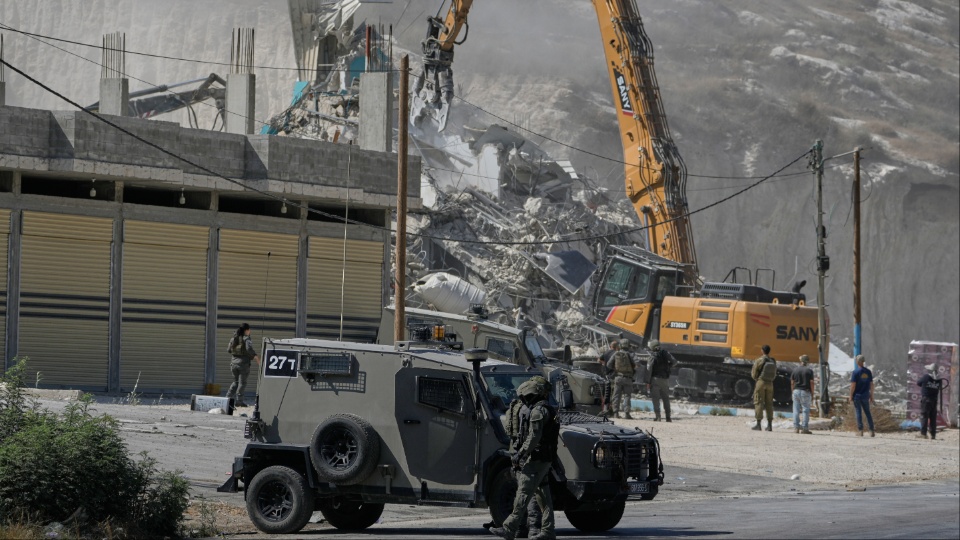
TEL AVIV—Israeli authorities have torn down or forced the demolition of dozens of Palestinian-owned buildings across the occupied West Bank and East Jerusalem in recent weeks, part of a year that has already brought a record 870 demolitions since January, according to a new report from the United Nations Office for the Coordination of Humanitarian Affairs (OCHA). The pace has more than doubled the annual average recorded in the 15 years before 2024.
Among the buildings destroyed over just the last few days were 15 residential structures and 24 others used for livelihoods, agriculture, water, and sanitation. Five households totaling 22 people, including five children, were left homeless in the East Jerusalem neighborhoods of Ras al-Amud and Sur Baher, in the West Bank village of Khirbet Jamrura near Hebron, and in the Jordan Valley community of Ein al-Hilweh. Nineteen more households, comprising over 100 people, were otherwise harmed by the demolitions, OCHA found.
On July 26, Israeli forces forcibly evicted five Palestinian families from a three-story, six-apartment building in Jerusalem’s Old City where they had lived since the 1930s. The eviction followed a lawsuit filed in 2018 by the state’s Custodian General after Israeli courts upheld a challenge to the families’ ownership of the property. Once the families were removed, settlers affiliated with Ateret Cohanim, an organization that works to establish illegal Jewish settlement inside Palestinian neighborhoods of the Old City and East Jerusalem, took over the building.
That eviction is part of a wider pattern. Since the start of 2026, Israeli courts have ordered the forcible removal of 22 Palestinian households—85 people, including 30 children—mostly from the East Jerusalem neighborhood of Silwan. OCHA estimates roughly 200 more Palestinian households across East Jerusalem now face the threat of eviction through ongoing lawsuits in Israeli courts, most of them filed by Israeli settler organizations.
All these new seizures come on top of the Palestinian homes that have already been taken and destroyed.
State-settler collusion
Israel’s restrictive planning regime in the West Bank’s “Area C”—the roughly 60% of the territory under full Israeli military and civil control—makes it nearly impossible for Palestinians to obtain building permits. This leaves their homes, water systems, and even schools perpetually exposed to demolition orders. OCHA counts 84 schools serving nearly 13,000 students currently under such orders.
A similar dynamic is playing out inside Israel itself. More than 70 Arab families in the al-Mahatta, or “Train,” neighborhood of Lod—a mixed Jewish-Arab city near Tel Aviv—received eviction and demolition orders last week. They were accused of “trespassing on public land,” and some were given as little as a week to leave. Many of these families have lived in the neighborhood, which grew up around Lod’s historic railway junction during the British Mandate era, for generations, well before Israel’s founding.

Residents say they are refusing to leave and warn that the orders are designed to clear the way for land takeover by religious-nationalist settler groups. The eviction push coincides with a state-backed urban renewal plan, opposed by residents and the planning-rights group Bimkom, that would demolish 865 existing housing units in southern Lod to make way for more than 6,000 new ones.
In the West Bank, settlers have escalated attacks on Palestinian property alongside the legal and bureaucratic pressure that’s being applied by courts and the government. On June 12, settlers cut and vandalized water pipelines supplying Bedouin communities near the town of Khan al-Ahmar, a community that itself faces the threat of demolition.
Hundreds of Israelis and Palestinians marched nearby in a “Freedom March” protesting the planned expulsion. The Bedouin rights group Al-Bader said the sabotage worsened already severe hardship for communities that depend on the pipelines for their basic water supply. The same day, settlers attacked homes and vehicles in the village of Yasuf, smashing windows before fleeing toward a nearby settlement, according to the local council.
OCHA has recorded more than 1,000 settler attacks causing casualties or property damage across over 230 West Bank communities since January, displacing more than 2,200 Palestinians.
Bringing in the police and army
As settlers and the courts squeeze Palestinian communities out of their homes, Israeli military forces have moved just as forcefully against the Israeli and Palestinian activists protesting that same violence.
On July 28, occupation forces raided a memorial service in the West Bank village of Umm al-Khair for Odeh Hathaleen, a peace activist killed the previous year by an Israeli settler who remains free. Knesset members Ayman Odeh and Ofer Cassif of the Democratic Front for Peace and Equality (Hadash), the left-wing electoral coalition, attended the memorial.

During the raid, an officer threatened that Border Police would violently evict participants if they did not disperse within five minutes, and Cassif himself was attacked by the officers.
“A quiet and respectful event in Umm al-Khair in memory of Odeh Hathaleen—a peace activist murdered a year ago by a settler who continues to walk free and armed—was disrupted by dozens of Border Police officers,” Cassif said. “They declared the area a closed military zone and even violently assaulted me during the memorial service.”
He said he no longer expected accountability from Israel’s police watchdog, noting it had already closed a previous investigation into an assault against him in the East Jerusalem neighborhood of Sheikh Jarrah despite video evidence.
“The main issue is the cruel reality of the occupation, the ethnic cleansing, and the murder that Palestinians endure daily,” Cassif said. “Settlers carry out pogroms while the occupation forces enable it, protect them, and sometimes even take an active part.”
That evening, hundreds demonstrated against settler violence at Habima Square in central Tel Aviv, in a protest organized by a coalition called the Peace Partnership that included the Democratic Front for Peace and Equality (Hadash) and the groups Looking the Occupation in the Eye and Standing Together.
Police declared the gathering unlawful, pushed protesters back into the square, and later seized demonstrators’ sound equipment by force. Similar protests that same weekend led to nine arrests near Israel’s military headquarters on Tel Aviv’s Kaplan Street and three arrests in the Arab town of Umm al-Fahm, where police likewise declared the assembly unlawful.
Ceaseless repression of anti-occupation groups
Weeks earlier, on June 6, a joint Jewish-Arab demonstration in Haifa marked 59 years of Israeli occupation of the Palestinian territories. Speakers included High Follow-Up Committee chairman Jamal Zahalka, Yousef Jabareen, head of the Democratic Front for Peace and Equality list, journalist Israel Frey, Palestinian People’s Party official Fadwa Khader, Israeli military refuser Eyna Gerstman, Israeli Communist Party Secretary General Adel Amer, former High Follow-Up Committee chairman Muhammad Barakeh, and Cassif.
Police arrested a 49-year-old activist from Shefa-Amr for raising a banner bearing the Palestinian flag. Jabareen told the crowd that a “subjugation and transfer plan” had become the working policy of the Netanyahu-Smotrich-Ben Gvir government, calling 59 years of occupation the product of deliberate, long-term land theft, displacement and settlement expansion, and urging voters to back a unified Arab-Jewish democratic camp in upcoming elections.
Taken together, the demolitions in East Jerusalem and Lod, the settler attacks in the West Bank, and the police crackdowns on peace demonstrators describe a single, mutually reinforcing process: As courts and settler organizations strip Palestinian families of their homes, the Israeli state has moved to silence the Israelis and Palestinians who organize against it.
This article features reporting from several dispatches by Zo Haderekh which were edited and combined by People’s World for our audience.
We hope you appreciated this article. At People’s World, we believe news and information should be free and accessible to all, but we need your help. Our journalism is free of corporate influence and paywalls because we are totally reader-supported. Only you, our readers and supporters, make this possible. If you enjoy reading People’s World and the stories we bring you, please support our work by donating or becoming a monthly sustainer today. Thank you!
CONTRIBUTOR