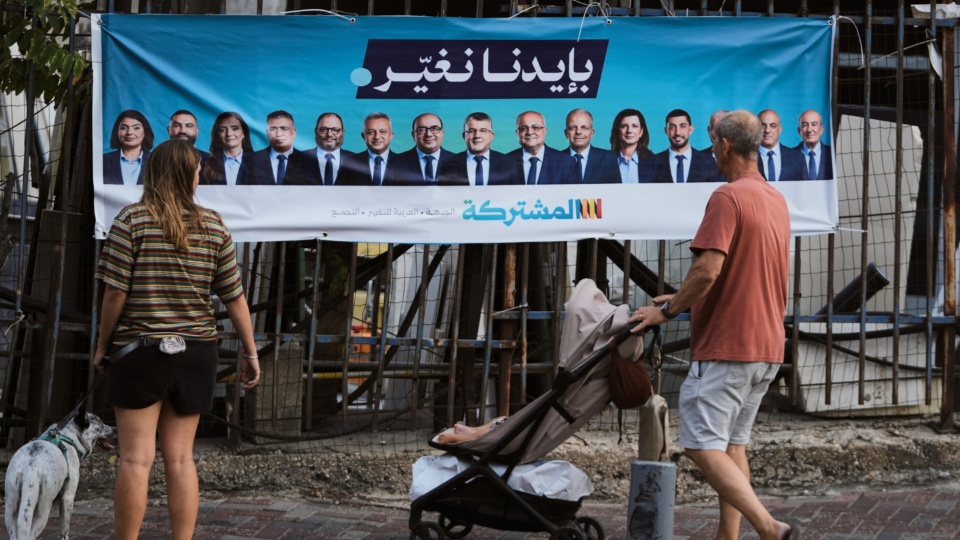
Israel’s Oct. 27 election left Prime Minister Benjamin Netanyahu’s far-right coalition and the main Zionist opposition bloc in a stalemate. But one result stood out above all others: Palestinian citizens of Israel turned out in force and handed the Arab-majority parties more seats than ever before—enough to decide who governs, if the opposition is willing to let them.
With about 86% of ballots counted as of Wednesday, Netanyahu’s bloc held 53 seats in the 120-seat Knesset, Israel’s parliament. The bloc led by former military chief of staff Gadi Eisenkot had 48. A government needs 61. Election-night exit polls had shown the two camps roughly tied; final results are expected Friday.
The remaining 19 seats went to the two Palestinian-led lists: 13 for the Joint List and six for Ra’am. That beats the previous record of 15 set in 2020 and is redrawing Israel’s political landscape.
The math to remove Netanyahu is simple: Eisenkot’s bloc plus the Arab parties equals 67 seats, enough to end the Trump-allied prime minister’s long rule. Yair Golan, leader of the center-left Democrats, made exactly that point Wednesday, urging the opposition to drop its campaign pledges and form a government “in partnership with Israel’s Arab citizens.”
If Eisenkot refuses negotiation with the Palestinian-led coalitions, Netanyahu may well be able to continue on with a minority government. Regardless, he stays put as prime minister for now in a caretaker role while the wrangling among the parties continues.
The scattered party landscape
Netanyahu’s Likud, the largest party, currently governs alongside the extreme-right settler parties of Itamar Ben-Gvir and Bezalel Smotrich and the ultra-Orthodox parties Shas and United Torah Judaism.
The opposition “Change Bloc” is anchored by Eisenkot’s centrist Yashar! party and includes former Prime Minister Naftali Bennett’s B’Yachad, Avigdor Lieberman’s militarist Yisrael Beytenu, and Golan’s Democrats, a merger of the old Labor and Meretz parties. All are Zionist parties committed to Israel as a Jewish ethnostate.
The Joint List is an alliance of three parties: Hadash, Ta’al, and Balad. Its leading force, Hadash—the Democratic Front for Peace and Equality—is a Jewish-Arab coalition led by the Communist Party of Israel.
It has long fought for an end to the occupation, a Palestinian state alongside Israel on the 1967 borders, and full equality for Arab citizens, who make up about a fifth of Israel’s population.
The Joint List is headed by Yousef Jabareen, a Hadash leader and law professor, and its slate includes Jewish Communist lawmaker Ofer Cassif.

Ra’am, the United Arab List, is a socially conservative party rooted in the Islamic Movement and led by Mansour Abbas. In 2021, it became the first Arab party ever to join an Israeli governing coalition.
Both lists overcame efforts to keep them off the ballot. In September, the government-controlled Central Elections Committee disqualified them, but the Supreme Court unanimously reversed that decision on Oct. 2. The suppression effort didn’t stop there, however. On election day, the legal center Adalah reported police delaying voters at polling stations in Arab towns and shortages of Arabic-language ballots.
Pave the way for Netanyahu’s removal
On Wednesday, Jabareen signaled the Joint List will use its new strength.
“It is either continued racism, continued exclusion, and continued supremacy—or real Jewish-Arab partnership,” he said. “Whoever wants to offer a real alternative to Netanyahu’s government of blood will have to talk to us…. Yes, we are ready to pave the way for Netanyahu’s removal.”
Before the vote, Jabareen laid out first steps: replacing Likud’s Knesset speaker, Amir Ohana, and passing a law barring an indicted politician—Netanyahu is on trial for corruption—from forming a government.
The Joint List would then negotiate support for a new government in exchange for action against organized crime in Arab communities, a halt to home demolitions, and a serious plan for the future of the Palestinian people recognizing their sovereignty.
Jabareen wants more than just a new face at the top. “We are not interested only in replacing the head and leaving the policy in place,” he wrote on election morning. “We are seeking real change.”
The obstacle is Eisenkot. During the campaign, he required any coalition partner to recognize Israel as a Jewish state, back mandatory military service, and pledge to destroy Hamas—terms widely seen as built to exclude Arab parties. Partnering with them, he said, was “against my principles.” Bennett and Lieberman made similar vows.
Large sections of the public disagree with their stances. Some 35,000 Israelis have signed a petition demanding the opposition end its boycott of the Arab parties.
A Jewish-Arab constituency for peace
Zo Haderekh, the Hebrew-language newspaper of the Communist Party of Israel, argued before the vote that polls never showed the Change Bloc reaching 61 alone, so any path to a new government ran through the Joint List and Ra’am.

The real question, it said, was whether opposition leaders would break their “racist boycott” of the Arab parties.
The paper’s editor, Asaf Talgam, wrote that rather than courting the mainstream, the Joint List offered a principled alternative grounded in Jewish-Arab partnership—“not as a technical bloc or a tool for obtaining budgets, but as a moral compass for peace, equality, and social justice.”
Noa Levy, Hadash deputy chair and director of the Joint List’s Hebrew-language campaign, told Talgam the list was winning over Jewish voters shaken by the destruction of Gaza. “We are fighting for real Jewish-Arab partnership,” she said, “not a partnership of horse and rider.”
No end to the wars
Even if Netanyahu falls, the Gaza war won’t end. Eisenkot pledged on Oct. 15 that within 18 months of taking office, Hamas would no longer rule Gaza and its military wing would be destroyed. Israel still controls more than 60% of the Strip, and a UN-sponsored inquiry this month accused Israel of an ongoing genocide.
Zo Haderekh noted that Bennett’s platform calls for attacking Iran again and that even Golan rejects a Palestinian state.
Netanyahu is already eyeing the next war. Israeli and U.S. military planners are drawing up renewed joint strikes on Iran, which sources say will almost certainly come after the U.S. midterm elections on Nov. 3. Netanyahu reportedly pressed Trump to attack again before both countries voted but that Trump, worried about causing another shock to oil markets before American voters cast ballots in the midterms, refused.
Whether Eisenkot will drop his conditions is unclear. But voters have already sent a message: A growing share of Israel’s electorate, Arab and Jewish alike, backed parties offering a shared democratic future over endless war. A vote for the Joint List, Jabareen said on election day, was “a choice for a life of peace, equality, and partnership.”
No paywalls at People’s World
We hope you appreciated this article. At People’s World, we believe news and information should be free and accessible to all, but we need your help. Our journalism is free of corporate influence and paywalls because we are totally reader-supported. Only you, our readers and supporters, make this possible. If you enjoy reading People’s World and the stories we bring you, please support our work by donating or becoming a monthly sustainer today. Thank you!
CONTRIBUTOR