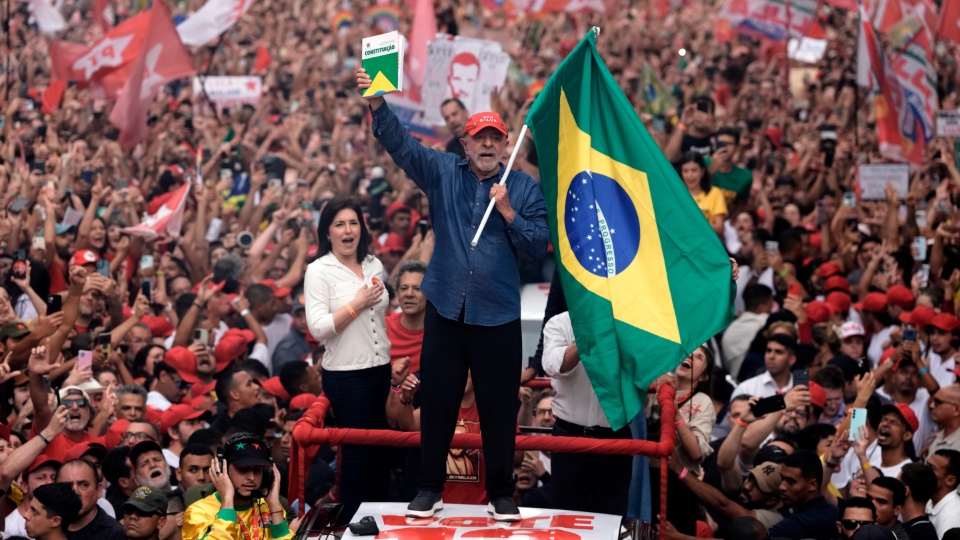
SÃO PAULO—Brazilian President Luiz Inácio Lula da Silva has won a fourth term, coming from behind on Sunday to defeat far-right Sen. Flávio Bolsonaro, eldest son of former President Jair Bolsonaro, in one of the most bitterly fought elections in the country’s history. When the result became certain at 9:09 p.m. local time, Lula led 51.75% to 48.25%, a margin of more than 4.5 million votes.
Lula, 80, becomes the first person ever elected president of Brazil four times. It is the left’s sixth victory in the last seven presidential races, and easily its hardest.
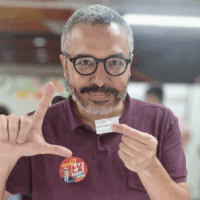
Brazil holds a runoff when no candidate wins a majority in the first round. Three weeks ago, Flávio Bolsonaro finished first with 47.03% to Lula’s 45.16%. But the dire situation was reversed, with Lula gaining some 11 million votes between the two rounds, driven by a surge in turnout. “We had the lowest abstention rate in the history of this country,” he told supporters Sunday night.
A defeat for Trump, too
The win reaches far beyond Brazil’s borders. The Trump administration openly championed Bolsonaro’s son, and Flávio’s brother Eduardo, a congressman who has been living in the United States, said before the vote that Flávio might face arrest and should consider fleeing to the U.S. if he lost.
In an editorial Sunday night, the editors of Vermelho, the news outlet associated with the Communist Party of Brazil (PCdoB), wrote that “the neofascist government of Donald Trump, which shamelessly backed Flávio Bolsonaro, suffered a hard defeat.”
A far-right wave pushed by Trump had been sweeping from the Caribbean to South America, they noted, and the White House was already celebrating Brazil as its next conquest.
Lula made national sovereignty a central theme of his campaign. At a packed rally on Copacabana Beach in Rio de Janeiro days before the vote, he framed the choice as one between “a candidate who kisses Brazil’s flag and one who kisses the American flag.”
The results showed that a broad coalition anchored by organized workers and young people can beat a Trump-backed far right even when the odds look grim.
Students lit the spark
After a lackluster first round, students took the lead in the second week of October. The National Union of Students launched a nationwide calendar of actions under the banner “Students with Lula in the streets and online,” and the Union of Socialist Youth, a youth group allied with the PCdoB, became a backbone of the effort.
Labor federations, social movements, artists, and intellectuals followed. More than 15 million people joined demonstrations during the runoff, and Lula’s closing rally on São Paulo’s main avenue drew an estimated two million supporters.

The fight online mattered just as much. Congressman André Janones built a WhatsApp channel called “Lula’s Army” that grew to more than 10.8 million followers and became a hub for videos, audio clips, and organizing instructions. The campaign also had to contend with Meta, the owner of Facebook, Instagram, and WhatsApp, which restricted Lula’s campaign accounts and pro-Lula content while favoring his opponent.
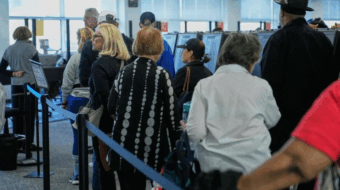
On Election Day itself, working-class voters faced major obstacles meant to depress turnout.
In Brazil, many people rely on public buses to reach the polls, and courts had ordered cities to run their full fleets so that people could cast their ballots. But the right-wing mayors of São Paulo and Salvador, a major city in the northeast, failed to comply.
In Salvador, more than 900 buses sat in garages, and a regional election court ordered the arrest of the city’s transportation director. The Supreme Court extended voting hours to 7 p.m., but by then most polling places had closed.
None of it was enough to stop Lula.
A program for working people
In his victory speech in São Paulo, Lula credited voters rather than himself and his running mate, Vice President Geraldo Alckmin. “It wasn’t Alckmin and me who won this election,” he said. “It was decency, patriotism, democracy, and the future you want for your children.”
Lula laid out an agenda aimed squarely at working families: full-day public schooling for every child through high school; expansion of a program that pays low-income teenagers to stay in school, along with a new version for college students; continued growth of Brazil’s universal public health system, including expanded cancer treatment; and stronger policies for older people and women.
He also pledged a bigger federal role in fighting crime. “For working people, we will provide protection,” he said. “For criminals, we will provide prison.”
Lula then called for regulating the tech giants. “We cannot have monstrously large companies, earning billions and billions, paying no taxes to this country and trying to steer the result of our elections,” Lula said. He also pushed for technological independence: “I don’t want to depend on Chinese or American artificial intelligence. I want to create a Brazilian one.”
He closed on a note of unity. “No one is obliged to like the president-elect,” he said, “but he was elected to govern for everyone.”
Alckmin, a former center-right governor who helped bring moderates and business leaders into Lula’s coalition, turned to the president and said, “For the second time, you have saved Brazilian democracy.”
Communists on the front line
The Vermelho editors called the result “a victory of the Brazilian people,” with youth playing a leading role, over far-right forces that sought to subordinate the country to “the greed of U.S. imperialism.” They called Lula the decisive leader, citing his refusal to bow to Trump.

The PCdoB, they wrote, with its activists and leaders, “was on the front line of this confrontation,” which they called decisive for Brazil’s present and near future.
The editors also warned that the hardest work lies ahead. The right and far right gained ground in the new congress and won governorships in several major states. To carry out his program of reindustrialization, better jobs, and expanded rights, they argued, Lula will need a broad governing alliance and continued mass mobilization in the streets and online.
But Sunday belonged to the people who said no. As the editors put it, the Brazilian people, with youth as the driving force, shouted loud and clear: “Not here!”
This article combines and adapts reporting originally published in Portuguese by Vermelho.
No paywalls at People’s World
We hope you appreciated this article. At People’s World, we believe news and information should be free and accessible to all, but we need your help. Our journalism is free of corporate influence and paywalls because we are totally reader-supported. Only you, our readers and supporters, make this possible. If you enjoy reading People’s World and the stories we bring you, please support our work by donating or becoming a monthly sustainer today. Thank you!
CONTRIBUTOR