Speaking to supporters Sunday night, Brazilian Sen. Flavio Bolsonaro—son of the country’s imprisoned former head of state, Jair Bolsonaro—declared the “end of the era” of President Luiz Inácio da Silva’s Workers’ Party (PT).
Bolsonaro junior’s boisterous claim was made after his far-right Liberal Party (PL) scored a significant victory in Sunday’s general election, with Bolsonaro finishing ahead of Lula in the first round of presidential voting. The PL also emerged as the largest force in both houses of Congress. The presidential race now goes to a runoff on Oct. 25.
With all ballots counted, Bolsonaro took 47.03% of valid votes to Lula’s 45.16%, a margin of roughly 2.2 million votes, according to Agência Brasil. Neither candidate cleared the 50% needed to win outright, but the result came as a shock, as surveys on the eve of the vote had Lula ahead, 45% to 42%.
Flavio Bolsonaro is running essentially as the stand-in candidate for his father, who is barred from the ballot and currently sits in prison serving a 27-year sentence for leading a Jan. 6th-style Trump-inspired coup to overturn the 2022 election in Brazil.
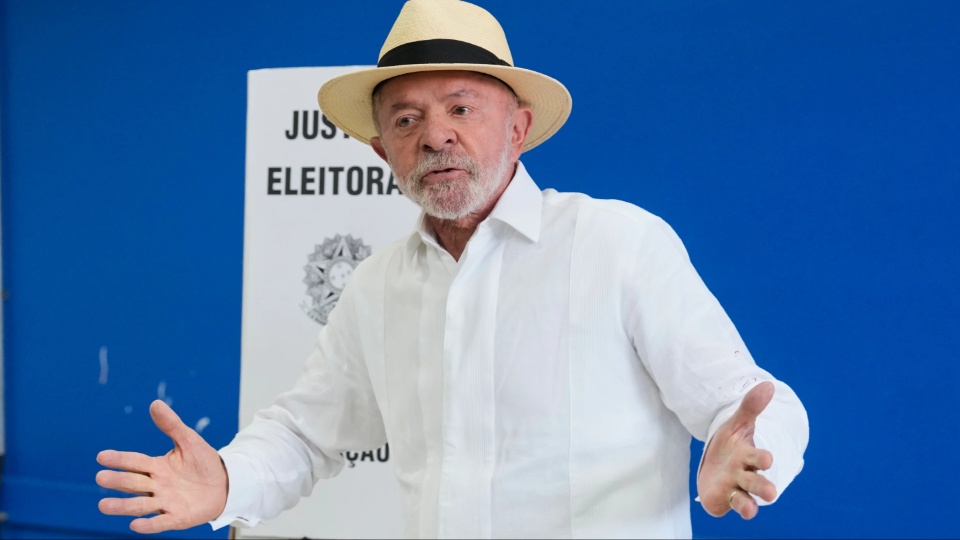
Lula ready for next battle
Lula, for his part, said the second round would let voters compare two starkly different projects and urged people not to conclude too quickly that the Workers’ Party cannot win the presidency.
“A new campaign is about to begin,” he announced in a statement. “The second round is the moment of truth. It’s time for us to show the true picture of Brazil today and the Brazil we want.
“Starting tomorrow, we begin a new campaign. A campaign in which, between only two candidates, we will be able to show the difference between the proposals that exist for Brazil.
“On the other side, we have only uncertainty, with the biography of a dark past,” he said, while pledging a direct appeal to the roughly 28 million Brazilians who didn’t vote on Sunday.
Lula said he intends to focus his campaign on defending social inclusion programs and investments in education, health, science, and industry.
Among the proposals mentioned are the expansion of full-time schools, the universalization of social welfare programs, the strengthening of the country’s public health program and the “Farmácia Popular” (a government-sponsored pharmacy program), and the resources allocated to the “Nova Indústria Brasil” (New Industry Brazil) initiative.
“We will show what has been done…. No one, more than us, can offer Brazilian society a future,” he said.
A family affair
While the presidential race is still to be decided, the numbers are already in for the legislature. Generally, the outcome was a bad one for the working-class coalition led by Lula and the PT, with bright spots few and far between.
Bolsonaro’s PL won 121 of the 513 seats in the Chamber of Deputies—the most for any party since Brazil’s 1988 constitution—and is projected to hold 28 of 81 Senate seats when the new Congress convenes in February. The PT-led federation, which includes the Communist Party of Brazil (PCdoB) and the Green Party, won 88 Chamber seats.

The Bolsonaro family dynasty grew, too. Former first lady Michelle Bolsonaro won a Senate seat, and Jair’s son Carlos was also elected as a senator. Another son, Jair Renan, won a seat in the Chamber of Deputies, as did the former president’s brother, Renato.
Even if Lula wins on Oct. 25, he will have to face the PL as the largest opposition bloc in both houses. PL leaders are already maneuvering with right-wing allies to take the presidency of the Senate.
Washington’s biggest prize
No election in the hemisphere this year mattered more to the Trump administration. Brazil is Latin America’s largest economy, a founder of BRICS, and a country whose trade with China hit a record $171 billion last year. Under Lula, it has refused to bow to the tariff dictates of the current White House occupant.
The U.S. pressure campaign has been relentless. As People’s World has reported, it includes tariffs of up to 50% (justified by Jair Bolsonaro’s supposedly “unjust prosecution”), terrorist designations of Brazilian criminal gangs reportedly requested by Flavio himself, and suspicions that Rockbridge, a donor network in the orbit of Vice President JD Vance, funneled money toward Bolsonaro’s campaign.
Brazil’s own intelligence agency rated U.S. interference at a “critical level.”
In the campaign’s final days, the State Department earmarked $1 million for a project targeting Brazil’s Supreme Court, and Washington abruptly closed its embassy and every consulate in the country two days before the vote, citing unspecified security threats, the PCdoB-aligned newspaper Vermelho reported.
Communists: Sovereignty on the ballot
The PCdoB, a member of Lula’s governing coalition and part of the PT electoral alliance, has framed the race as a fight for national sovereignty against U.S. imperialism. In June, the party warned of a Trump offensive against Brazil and put forward proposals for a sovereign development path under Lula.

On the eve of the vote, interim party President Nádia Campeão called Flavio Bolsonaro’s candidacy a threat to democracy and sovereignty, saying Lula’s re-election was vital because of his commitments “to national sovereignty, to democracy, and to the rights of the people.”
The editors of Vermelho warned that the presidency of Bolsonaro junior would mean “total vassalage to the White House.”
After the count, the Communist Party pointed to wins for its candidates in the legislature, despite the tough night the left coalition had as a whole. The PCdoB expanded its representation in the Chamber of Deputies, electing 11 candidates, seven of whom are women.
Among them are veteran Deputy Jandira Feghali and economist Elias Jabbour in Rio de Janeiro and Deputy Daiana Santos, re-elected in Rio Grande do Sul.
The result was the party’s best in the last four elections and consolidated a female majority among representatives in the Chamber starting in 2027.
The celebrations were short, though, as the PCdoB turned immediately to mobilizing for the runoff.

Lessons for the U.S.
Brazil’s runoff is three weeks away, and the U.S. midterm elections follow just days later. Communist Party USA Co-chair Joe Sims says there are lessons to take from what happened this weekend in South America.
Quoting Marxist Antonio Gramsci, who fought Benito Mussolini and Italian fascism in the 1930s, Sims said, “The old won’t die, and the new cannot be born. This is the time of monsters.”
Sims pointed to pre-election surveys in Brazil that showed Lula comfortably defeating Bolsonaro and compared them to current polls in the U.S. that predict the Republicans will lose control of one or even both houses of Congress.
“We’re fighting the most powerful ruling class in history. Therefore, don’t take anything for granted in our midterms,” he said. “We can’t afford to sit this one out. Register. Vote!”
The outcome in the U.S. also holds consequences for the countries of Central and South America and elsewhere. Ending MAGA Republican domination of Congress can have an impact on U.S. foreign policy and open the possibility for legally blocking some of the White House’s intervention in other nations’ internal affairs. A loss for the GOP won’t come in time to reduce the imperial pressure on Brazil in this election, though.
In 2022, Lula defeated Jair Bolsonaro by less than two percentage points. This time, with the Bolsonaro machine strengthened in Congress and Washington’s thumb still on the scale, the margin for error may be even thinner.
No paywalls at People’s World
We hope you appreciated this article. At People’s World, we believe news and information should be free and accessible to all, but we need your help. Our journalism is free of corporate influence and paywalls because we are totally reader-supported. Only you, our readers and supporters, make this possible. If you enjoy reading People’s World and the stories we bring you, please support our work by donating or becoming a monthly sustainer today. Thank you!
CONTRIBUTOR