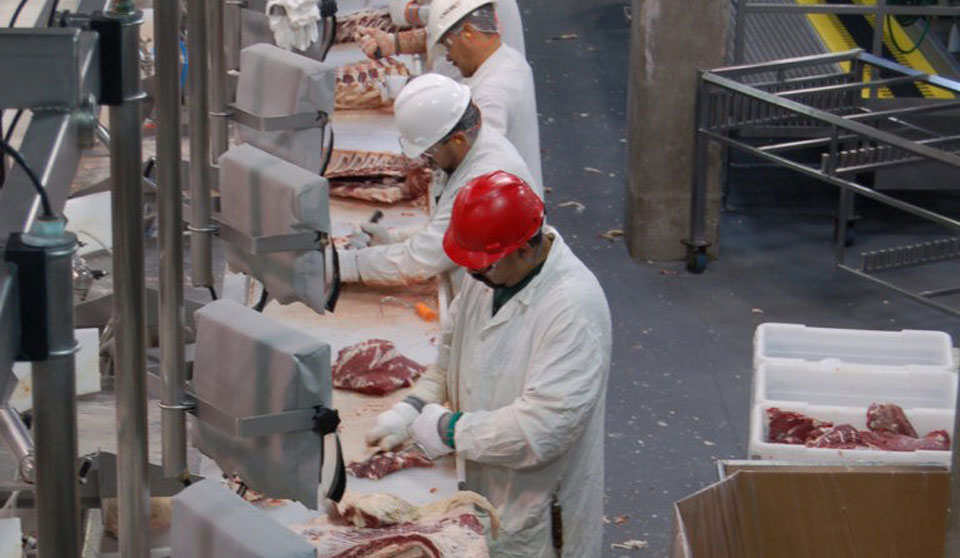
When The Jungle was published in 1906, writer and journalist Upton Sinclair hoped his novel would advance socialism by exposing the plight of the wage slave, dangerous working conditions, and the general hopelessness that undermined the working class’s struggle. Sinclair exposed the Chicago meatpacking industry and the workers who struggled within it, giving a voice to the voiceless while also exposing the corruption of those in positions of power.
The struggle of an immigrant family from Lithuania drives the plot, and Sinclair touches on working-class poverty, lack of social support, and poor living and working conditions. Cynicism and distrust run rampant, leading to cruelty and violence, while new life is contrasted with death and despair. Fellow writer Jack London called Sinclair’s novel “the Uncle Tom’s Cabin of wage slavery.” It is a phenomenal book, and Sinclair prepared by spending seven weeks in the meatpacking district of the Union Stock Yards in Chicago, talking with workers and gathering information.
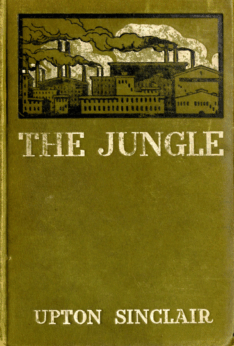
While The Jungle perhaps did advance socialism to a degree, its more immediate impact was public horror and outcry over sanitation and public health. Sinclair intended to expose “the inferno of exploitation,” but later stated that his novel became popular “not because the public cared anything about the workers, but simply because the public did not want to eat tubercular beef.” Exploitation of mostly immigrant workers was fine with the American public at large, but rat droppings in the hamburger meat? Something has to be done.
Factory work was notoriously hazardous, leading to many injured and maimed workers, and the federal government’s response to Sinclair’s accusations did little to mitigate the exploitation of immigrant workers and to alleviate dangerous working conditions. President Theodore Roosevelt called Sinclair a “crackpot” for his socialist leanings, once writing to a journalist, “I have an utter contempt for him.” However, after reading an advance copy of The Jungle, Roosevelt agreed with Sinclair, writing, “Radical action must be taken to do away with the efforts of arrogant and selfish greed on the part of the capitalist.”
Roosevelt sent Labor Commissioner Charles Neill and social worker James Reynolds to investigate Chicago’s meatpacking facilities. Even though the factory owners heard about the impending visit and had the workers clean the factories, Neill and Reynolds were still disgusted by what they saw, with Neill testifying before Congress that what he saw “showed the necessity for legislation.” Reforms to the meatpacking industry met opposition from prominent Republicans who thought they would be too costly for factory owners. The public insisted on legislation, and Congress passed the Meat Inspection Act and the Pure Food and Drug Act. This led to the creation of the Food and Drug Administration (FDA) that we know today.
Sinclair was not impressed, saying the legislation helped large meatpacking facilities by forcing the government and taxpayers to bear the cost of inspections while largely ignoring workers’ conditions. During an interview for Cosmopolitan Magazine, Sinclair complained about the public misunderstanding the point of his book, saying, “I aimed at the public’s heart, and by accident I hit it in the stomach.”
This year, it is hard to miss the news that the FDA has recalled another food or medicine. From blueberries and peppers to dog food and eye drops, from Salmonella to E. Coli to pieces of glass. Darin Detwiler, professor emeritus at Northeastern and adjunct professor at Michigan State University College of Law, says that available data from the FDA suggests that “recall activity has indeed been elevated.” However, it is “too early to know” whether this year’s recalls will be greater than last year’s. “What we can say is that recall activity in 2026 appears elevated, and some individual recalls are affecting extraordinarily large quantities of food,” Detwiler says. “A handful of very large recalls can expose far more consumers than dozens of smaller ones.”
The U.S. Public Interest Research Group says the Cyclospora outbreak linked to lettuce from Taylor Farms contributed to more than 11,000 people falling ill, the third largest recorded outbreak of foodborne illness. This should not be surprising, since the Centers for Disease Control scaled back its foodborne illness program last year, tracking just two pathogens from its usual eight. Under the Trump administration, the CDC has lost over a quarter of its workforce, leading to understaffing and burnout for the workers who remain. The specialized parasitic lab that monitored Cyclospora outbreaks saw its staffing reduced from eleven to three people.
The FDA was supposed to comply with the new Traceability Rule, a law requiring businesses that manufacture, process, pack, or hold certain foods to adhere to record-keeping requirements. This law is supposed to make it easier to track and remove contaminated food, but the FDA has delayed it until 2028. The FDA is also facing staffing and budget cuts, with over 3,500 positions eliminated and an almost 4% budget reduction.
With such a drastic reduction in staff and funding, it’s easy to see why foodborne illnesses are becoming more common and affecting a broader percentage of the public. By eliminating Cyclospora tracking from the CDC foodborne tracking system and reducing the number of people tasked with monitoring it when it eventually happens, it’s no wonder thousands of people are violently ill. After the Cyclospora outbreak was traced to Taylor Farms, it was also discovered that the CEO, Bruce Taylor, not only donated millions of dollars to President Trump but also met with him privately at the White House the night the FDA identified Taylor Farms’ lettuce as the source of the outbreak. Rep. Robert Garcia, ranking member of the House Oversight Committee, is investigating whether Taylor Farms used its ties to Trump to influence the federal response to the outbreak.
If the food industry is left to regulate itself, we know that they will place profits over people, just as we know the factory owners don’t care about their workers. Upton Sinclair deserved better from us.
As with all op-eds published by People’s World, the views reflected here are those of the author.
We hope you appreciated this article. At People’s World, we believe news and information should be free and accessible to all, but we need your help. Our journalism is free of corporate influence and paywalls because we are totally reader-supported. Only you, our readers and supporters, make this possible. If you enjoy reading People’s World and the stories we bring you, please support our work by donating or becoming a monthly sustainer today. Thank you!
CONTRIBUTOR