
This book is worth a look, and a good place to start, but it’s also in danger of being done for deceptive packaging.
Joseph Daher traces the history of Palestine within a context of Zionism and Middle East politics. Despite the book’s title, Daher contributes little to Marxist theory. His class analysis is brief, providing little engagement with racial capitalism, labor process theory, or settler-colonial Marxism, ideas developed by other scholars.
Rather than a deep Marxist analysis, regional politics is seen through what the author sees as a “left” lens but is not seen as fully reflective of a class perspective. It is largely a synthesis of existing literature rather than presenting any substantial new material or arguments.
Daher’s central argument is that Palestine must be understood as a settler-colonial society embedded within global capitalism. He combines a historical overview of Palestinian liberation within the broader struggles against imperialism and for neoliberalism.
Daher argues that since 1967, governments in the Middle East have emphasized adopting neoliberalism rather than anti-imperialism. This is true as far as it goes – neoliberalism was on the way well before Frances Fukuyama’s famous declaration that the U.S. liberal-capitalist way of doing things was so universal that it represented “the end of history.”
It’s also true that the U.S. put serious resources into undermining and defeating secular anti-imperialist movements in the Middle East and elsewhere.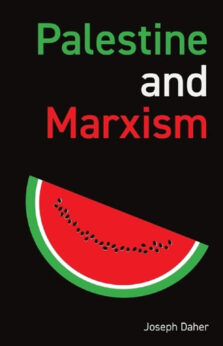
Daher’s is a very broad-brush assessment of Palestinian resistance and politics. He ends with the position that Palestinian liberation depends upon democratic and working-class struggles across the Middle East rather than nationalism.
Daher is dismissive of the role played by the so-called “Axis of Resistance,” an informal coalition of Iran, the Houthis, and Shia militias in Lebanon and Iraq. His analysis of regional powers neglects the constraints imposed by U.S. and Israeli military dominance. He obscures the differences between authoritarian governments resisting Western influence and Western-backed regimes.
Many Marxists will find Daher too dismissive of the importance of national liberation in regional politics. Daher is very critical of Iran and the former Syrian Arab Republic. He writes them off as “authoritarian” and minimizes the context of their anti-imperialist struggle.
There’s a somewhat idealistic call for “struggle from below,” without engaging with how those “below” should deal with existing states and groups engaged in anti-imperialist struggles.
It’s not all bad news. There’s some quality information here about the politics of Arab nationalism and Islamism, both topics that don’t get the close look they deserve.
This book is interesting if you’re starting on understanding Palestine, but Ilan Pappé, and Norman Finkelstein, and Adam Hanieh hold deeper analyses.
The Guardian (Australia)
No paywalls at People’s World
We hope you appreciated this article. At People’s World, we believe news and information should be free and accessible to all, but we need your help. Our journalism is free of corporate influence and paywalls because we are totally reader-supported. Only you, our readers and supporters, make this possible. If you enjoy reading People’s World and the stories we bring you, please support our work by donating or becoming a monthly sustainer today. Thank you!
CONTRIBUTOR