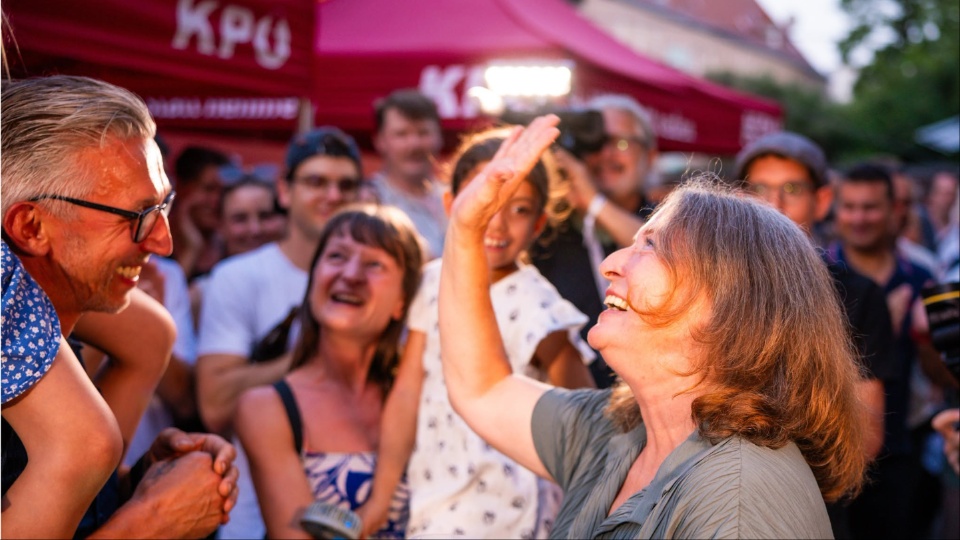
In the city of Graz, Austria, a city of about 300,000 people, the Communist Party of Austria (KPÖ) has been the dominant force in local government since the 1990s. Elke Kahr, the party’s leading figure, became mayor in 2021, the first Communist to lead an Austrian state capital since World War II. She was re-elected this past June. In the interview below, conducted by Zo Haderekh, newspaper of the Israeli Communist Party, veteran left activist Leo Kühberger, who ran on the KPÖ ticket in Graz, discusses why the party has been so successful. Read earlier People’s World coverage of Graz here.
Your party won another strong result in Graz’s city council elections at the end of June. What did the campaign look like?
The campaign centered on Elke Kahr, the mayoral candidate. That made sense, since she’s genuinely popular here. Alongside her, we made the case based on our record: gains in housing, transit, and health care. No single knockout achievement in any one area, but steady, visible progress year after year.
Part of Kahr’s popularity, I think, comes from a governing style that’s calm rather than combative. We hash out disagreements in meetings instead of turning every disagreement into a public brawl.
From the outside, Graz gets held up as a success story for the left. Is there really a “Graz model”?

Leo Kühberger of the Communist Party of Austria.
I always push back a little on that. Nothing the KPÖ does here is actually new. These are things left and labor movements have been doing for a hundred, a hundred and fifty years. What’s different is how consistently we’ve stuck with certain priorities.
Housing is the clearest example. It’s been our central issue since the early 1990s, and we never dropped it for the next hot topic. If housing matters to you as a voter, you know exactly where the KPÖ stands, and you’ve known for three decades.
The KPÖ was a marginal party in Austria for years. What changed in Graz specifically?
After 1945, the party lost most of its national relevance. It was nothing close to the mass Communist Parties of Italy or France. But Graz always kept at least one Communist on the city council.
Then, in the early 1990s, right when Communist Parties were collapsing across Europe, something different started here. We decided the party had to prove its usefulness in people’s daily lives, not just make arguments.
We put housing policy and direct, concrete help at the center of everything. That’s where the slogan “Help instead of talk” comes from.
In 1993, we unexpectedly won a second council seat, and Elke Kahr joined the council. By 1998, we had a seat on the city’s executive board with responsibility for housing. In 2003, the KPÖ broke 20% of the vote for the first time.
What has the city government actually delivered in recent years?
On housing, several hundred new municipal apartments have been built or handed over to tenants. On transit, we’ve pushed bigger projects, especially expanding the tram network. In health care, the city runs a highly accessible service where people can get initial treatment and counseling in multiple languages—a big deal in a city with a large immigrant population.
There are municipal programs that give residents a basic layer of social security, and a standing commitment to keep core infrastructure—water, transit, housing—in public hands rather than privatizing it. None of this sounds dramatic on its own, but it adds up in people’s everyday lives.
The party also talks about an “open-door policy.” What does that mean in practice?
From the district level up through the city council, the city government, and the mayor’s office, the goal is to always be reachable. Send an email tonight about a real problem, and you’ll typically have a reply or a meeting scheduled by morning.

Elke Kahr personally holds a huge number of these meetings throughout the year, and so does the rest of our elected leadership. On top of that, there are neighborhood events, community kitchens, book bazaars—all of it building a direct, ongoing relationship with residents that doesn’t switch on only during election season.
Despite the KPÖ’s electoral strength, it isn’t a mass membership party in Graz. Isn’t that a contradiction?
It’s a fair point, and an important one. Graz has roughly 300,000 residents, and the party itself has only a few hundred members. So, our success shows up overwhelmingly at the ballot box, not in the size of our organization.
From a Communist or broader left standpoint, that’s a real limitation. We should also be building people’s own organizing capacity and self-determination, not just winning their votes.
That’s happening more than it used to, but it’s still modest compared to what our electoral results might suggest.
Is the weakness of Austria’s far-right Freedom Party in Graz connected to the KPÖ’s strength there?
I genuinely see that as one of our biggest achievements, even with fair criticisms of how we’ve done it. Over the years, we’ve managed to offer a credible alternative to people who feel shut out of the political system. In most other places, those are exactly the voters the far right picks up.
For a long time, even the Austrian left dismissed what you’d built in Graz. Has that changed?
Completely. For years, the line was something like: “That’s just Graz’s do-gooder, charity-style politics, propped up by a couple of unusually popular candidates.”
Today, plenty of party branches around the country are deliberately borrowing pieces of the approach. Salzburg is the clearest example, but you’ll see other cities experimenting with open-door constituent service, concrete social policy, neighborhood organizing, or capping elected officials’ salaries [a longstanding KPÖ practice, in which officials donate income above a set threshold]. In some places, it’s working really well.
Could this be scaled up to national politics in Austria?
Not straightforwardly. What works in Graz clearly works very well at the municipal level, but you can’t just transplant it to the national stage. That’s actually what makes Graz worth studying—not as a turnkey playbook for the left, but as proof of what’s possible when you apply the same principles consistently for decades instead of chasing the news cycle.
We hope you appreciated this article. At People’s World, we believe news and information should be free and accessible to all, but we need your help. Our journalism is free of corporate influence and paywalls because we are totally reader-supported. Only you, our readers and supporters, make this possible. If you enjoy reading People’s World and the stories we bring you, please support our work by donating or becoming a monthly sustainer today. Thank you!
CONTRIBUTOR