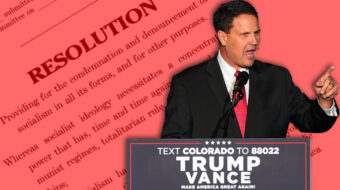
“We need to reject socialism whether it comes from the left or the right,” The Hill declared on Thursday, Aug. 27, in an op-ed by economist Benjamin Powell arguing that socialism has failed everywhere it has been tried. Powell trained his fire on New York City Mayor Zohran Mamdani’s proposal for city-owned grocery stores, which he equated to the Trump administration taking equity stakes in semiconductor companies like Intel, dismissing both as “creeping socialism.”
The words “socialism,” “communism,” and “Marxism” get thrown around like this every day now, usually as slurs. Trump has cast the Marxist left as an enemy for years. Last September, that rhetoric became policy: The administration formally designated “antifa” a “domestic terrorist organization,” part of a broader campaign to brand the American left, Marxists included, as enemies of the state.
But socialism is not simply the government buying a stake in a private industry for the sake of profit or leverage. It is better understood, at least from an economic standpoint, as the collective ownership of the tools, resources, and enterprises of production—by the workers who run them or by the public at large.
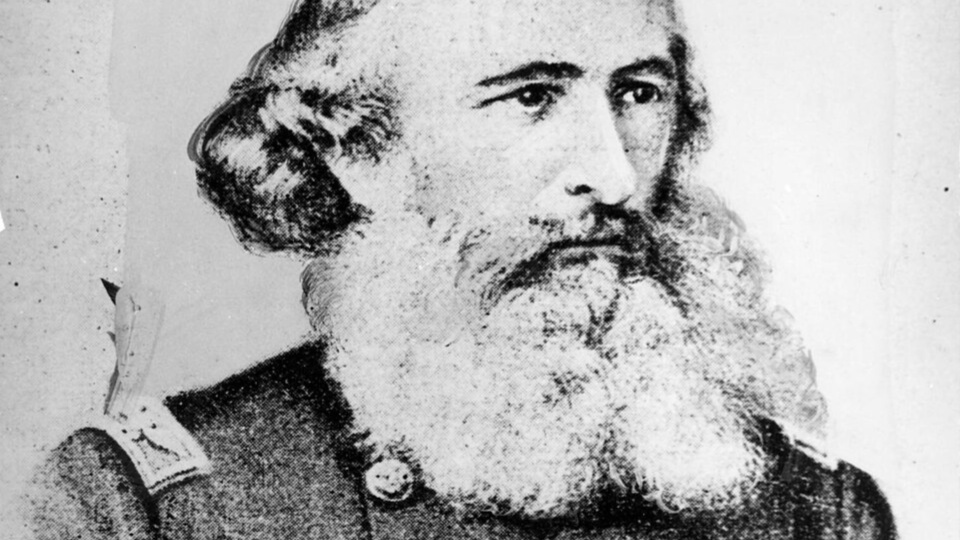
Reactionaries have always been eager to dismiss freedom fighters as dangerous radicals. The “dangerous” part is usually off-base. But sometimes, like during the U.S. Civil War, the label “radical” sometimes fit. Take Joseph Weydemeyer, an American Marxist and Union Army colonel who took up arms to fight the Southern slaveowners.
The Confederacy’s leading theologian, James Henley Thornwell, cast the fight against slavery as an example of such dangerous radicalism in his 1850 sermon, “The Rights and Duties of Masters.” The parties in the conflict over slavery, he warned, “are not merely abolitionists and slaveholders—they are atheists, socialists, communists, red republicans, jacobins, on the one side, and the friends of order and regulated freedom on the other.”
Thornwell wasn’t wrong that some of his opponents actually were socialists and communists; men like Weydemeyer never hid it. He was a friend of Karl Marx, and the two exchanged many letters about the nature of socialism and the future working-class state.
What Thornwell got wrong, however, was his claim that radicals like Weydemeyer are a danger to freedom. Communists and antislavery Republicans, for instance, marched shoulder to shoulder in the fight for abolition, to free enslaved Black people, and to defend the Union.
Weydemeyer was more than a Union Army colonel. As an officer, he commanded the 41st Missouri Volunteer Infantry and oversaw the fort-building that helped keep Missouri in the Union. He was also Marx and Engels’s chief publisher and literary champion in the United States, serializing Marx’s “The Eighteenth Brumaire of Louis Bonaparte” in his own magazine, Die Revolution, in 1852.
That same year, he and a fellow Marxist, Adolf Cluss, co-founded the Proletarierbund (League of Proletarians)—America’s first Marxist organization—followed by the American Workers League in 1853.
Weydemeyer did more than found communist organizations and help defeat the Confederacy, though. He also worked to organize German American support for the fledgling Republican Party, campaigned for Abraham Lincoln in 1860, and held Republican Party membership himself, seeing no contradiction between his Marxism and the antislavery coalition he was helping build.
In January 1866, months after Appomattox, he was elected auditor of St. Louis County on the Radical Union ticket—making him perhaps the first communist ever elected to public office in the United States, even though he ran under no socialist or communist party label. He died of cholera that August, having served less than a year.
As for Cluss, he corresponded with Marx and Engels through the 1850s even as he built a career as one of Washington’s most well-known architects. In the late 1860s, he designed the U.S. Department of Agriculture’s original headquarters on the National Mall and later worked on the U.S. Arsenal—the same military complex where four of the Lincoln assassination conspirators had been imprisoned and hanged in 1865.
In 1872, President Ulysses S. Grant appointed him to D.C.’s Board of Public Works, where his engineering shaped much of the capital’s late-19th-century built environment. His communist past, combined with his signature use of red brick, earned him a nickname: “The Red Architect.”
Marxism’s American story didn’t end with the Civil War generation, of course. Simon Wing ran as the nation’s first socialist presidential candidate in 1892, on the Socialist Labor Party of America ticket, nearly a decade before Eugene V. Debs entered the scene with the Socialist Party of America, helped launch the Industrial Workers of the World, and ran for president five times.
Debs’s most famous campaign, in 1920, was waged from a cell in the Atlanta Federal Penitentiary, where he was serving a 10-year sentence for opposing the First World War—imprisoned under the Wilson administration’s Espionage Act after a 1918 speech. His conviction helped set the stage for the Palmer Raids of 1919 and 1920, the country’s first organized Red Scare, carried out by Attorney General A. Mitchell Palmer and a young Justice Department aide named J. Edgar Hoover.
The Communist Party USA, founded in Chicago on Sept. 1, 1919, was born straight into that repression: The Palmer Raids that same winter targeted its founding members by name, jailing and deporting hundreds. The harassment never really let up. In 1949, federal prosecutors put party leaders Eugene Dennis, William Z. Foster, and ten others on trial under the 1940 Smith Act for supposedly advocating the government’s overthrow.
By the height of McCarthyism in the mid-1950s, a law called the Communist Control Act seeking to outlaw the party outright was accompanied by congressional witch hunts and relentless FBI harassment.
None of this is ancient history dredged up just to argue against The Hill. It is an ongoing storyline connecting Thornwell’s pro-Confederate red-baiting accusations to the Palmer Raids to last September’s antifa designation to Trump’s anti-socialist campaign today. Every movement that has raised questions about who gets to own the wealth this country produces has been met with the same charge: that they are foreign, godless, and un-American.
The record says otherwise. Marxists helped organize support for the party of Lincoln, kept Union troops in the field, built the buildings that still house the federal government, and won elected office under their own names before most Americans had ever heard the word “progressive.”
Mamdani’s grocery stores and Trump’s Intel stake are not the same thing, whatever The Hill would have readers believe. One puts ownership and control in public hands, the other bails out a private company while leaving its shareholders in charge. But the reflex to call both “socialism” and mean it as an insult belongs to an old reactionary tradition.
No paywalls at People’s World
We hope you appreciated this article. At People’s World, we believe news and information should be free and accessible to all, but we need your help. Our journalism is free of corporate influence and paywalls because we are totally reader-supported. Only you, our readers and supporters, make this possible. If you enjoy reading People’s World and the stories we bring you, please support our work by donating or becoming a monthly sustainer today. Thank you!
CONTRIBUTOR