

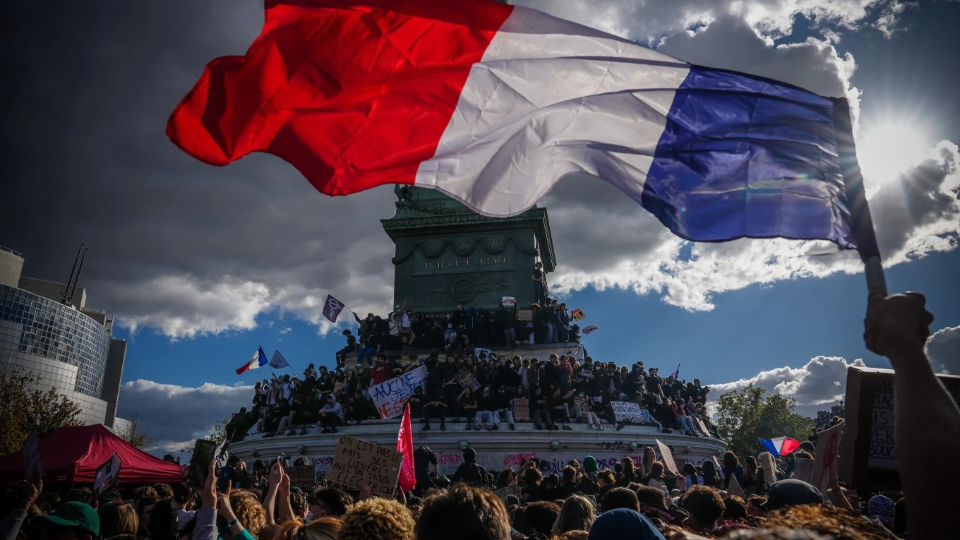
The high-school student protest here in France, whose epicenter is the region’s second-largest and most diverse city, Saint-Denis, is every day gathering steam and sometimes forcing the Western corporate media to course-correct after their initial slandering of the event.
Rather than depicting crowds of students taking to the new barracks—the blockades around their schools—The New York Times initially gleefully ran a video of a burning trash can as the symbol of this mobilization, implying the demonstrators were violent terrorists. The protests in the high schools have now spread to universities, and engulf not just the students but also unions, teachers, and their parents and grandparents, all come not only to support the protests but also to protect their children and grandchildren from what are the actual terrorists, Macron’s police.
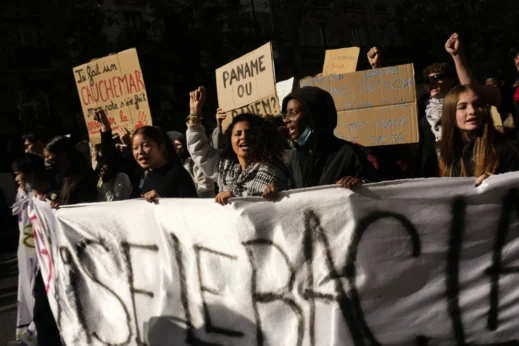
The omnipresent banners tell the story about what the students want and what they are reacting to: overcrowding in the schools with teachers who retire or can no longer take the strain, not followed by new teachers— “My mother replaces some teachers in burnout but who will replace my mother?”; the call for the state to deal with the problem of underfunding by means other than repressing demonstrators, that is, those who call attention to the problem— “fric not flic,” that is money for education not police; and the unevenness of money spent where those outside Paris and the central cities are more highly underfunded— “Equality does not stop at the gates of the city.”
The images of burning garbage, widespread on American social and corporate media, are the mainstream representation of students’ protest as their future is torn away by years of Macron’s austerity budgets, which also reward the richest with major tax breaks. The disparity between the actual protests and how they are covered also echoes how the original French Revolution was portrayed in bourgeois media: not as a first attempt at a people’s liberation, but as degenerating into what was called “The Terror.”
These emblems, emblazoned in young minds in Charles Dickens’ A Tale of Two Cities, are regurgitated in today’s bourgeois media where property, even garbage cans, is sacred while the protesters are returning to the French writer Proudhon’s retort, “Property is theft.”
And indeed, the largest protest with leagues of students swarming the square occurred this week at the Bastille, the site of the beginning of the 1789 Revolution.
Later in the week, with the protests creating an inexorable movement, The Times covered them with a degree of fairness but inserted above their coverage another story about overwhelming French debt hastening an increase in the price of French bonds and making borrowing more difficult for the state. The statement being that there really is no choice other than austerity, no matter what the street may say.
On Tuesday afternoon, Marine Le Pen, who leads in the presidential polls to be held next April, unveiled her own proposed budget, a complete sop to the wealthiest corporations, as she proposes to cut approximately $154 billion from the French state. This is as opposed to the other alternative, which is frequently advanced and just as quickly dropped, of a two percent tax on the wealthiest to maintain France’s social services.
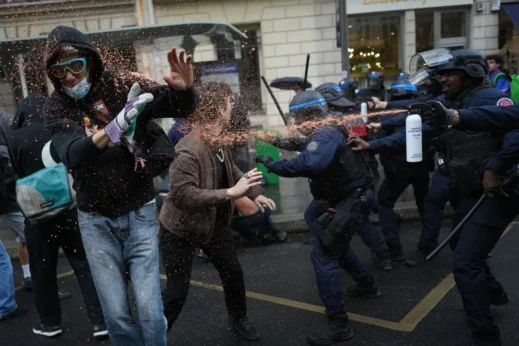
The protesters, since they are still mostly high school students, have also called much-needed attention to the Macron government’s standard tactic for dealing with the unrest caused by his government’s transfer of wealth upward, and that is with fierce police violence. A 15-year-old’s hand was blown off, and a 16-year-old is now blinded in one eye, most likely struck by an LBD riot gun. Over 5000 mostly high-school students have been arrested and many then held in detention.
Students are also upset about another Macron “efficiency innovation,” and that is the installation of an Elon Musk-type computer application titled Parcoursup, which now handles and supposedly systematizes university applications. The system is slow in getting back to students about whether they have been accepted or rejected while also being accused of favoring those from the wealthiest and best-connected schools. The problem is accentuated by the opaqueness of the system. Nobody knows what criteria it uses in a selection that in France is absolutely crucial in determining the future course of a student’s life.
The protests have also been the occasion for accusations against the most popular left party, LFI, claiming that the party and its leader and presidential candidate Jean-Luc Mélenchon instigated the rebellion. A popular accusation on the right and center-right, fearful that the second round of the next election could pit the far-right’s Marine Le Pen against LFI’s Mélenchon. The charge has been refuted, even by the centrist Le Monde, no friend of Mélenchon, which claimed in an article on its origins that this was a spontaneous uprising.
Where the LFI has been important and where it might make significant gains come next April, when many of these students will have reached voting age, is in safeguarding the protestors.
A local hero of this revolution is the LFI mayor of Saint Denis, Bally Bagoyoko, who showed up on the picket lines and put himself in between the police and the demonstrators. Bagayoko is of Malian ancestry and a strong supporter of that country’s, along with Burkina Faso and Niger’s, assertion of sovereignty in kicking out French troops. He is also a critic of French attempts to recolonize the country, an indication that the revolution on the streets of Paris, its environs, and across the country has a global resonance.
No paywalls at People’s World
We hope you appreciated this article. At People’s World, we believe news and information should be free and accessible to all, but we need your help. Our journalism is free of corporate influence and paywalls because we are totally reader-supported. Only you, our readers and supporters, make this possible. If you enjoy reading People’s World and the stories we bring you, please support our work by donating or becoming a monthly sustainer today. Thank you!
CONTRIBUTOR


MOST POPULAR TODAY

Credible sources say Trump readies to steal the midterm elections

Leonard Peltier, longest serving U.S. political prisoner, should be free
How the bad science of AI doomerism is good for big business

Dark day for Hollywood labor: Paramount-Warner Bros. mega merger approved

Controversial ‘God made Trump’ campaign ad produces bipartisan uproar