

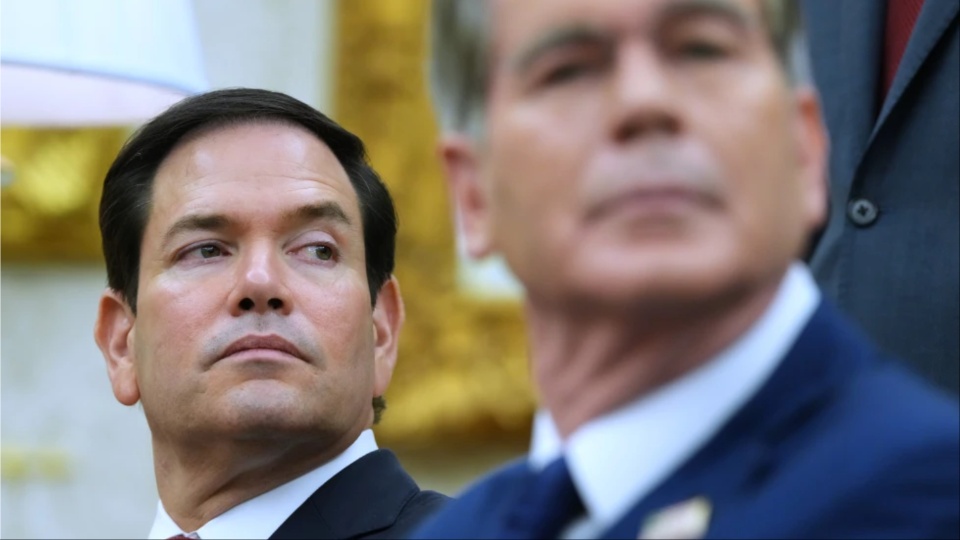
U.S. Secretary of State Marco Rubio’s swing through Europe last week was meant to shore up support for MAGA’s military and energy agenda. Instead, it ran into a wall of opposition from communists, trade unions, and peace organizations determined to keep their countries out of U.S.-NATO war plans.
Rubio’s tour, which ran Oct. 5–8, aimed to advance U.S. and NATO military cooperation, renew agreements on U.S.-NATO bases, and deepen Europe’s integration into Washington’s confrontation with Iran and its rivalry with China.
The World Federation of Democratic Youth (WFDY), in a statement from its Europe and North America Commission, said Rubio’s hand “is stained with the blood of the peoples of Palestine, Iran, Lebanon and the wider Middle East.”
In Greece, the Communist Party of Greece (KKE) led a nationwide mobilization against Rubio’s visit, culminating in a major demonstration in Athens on Oct. 6.
The All Workers’ Militant Front (PAME), the Greek Committee for International Detente and Peace (EEDYE), and other mass organizations called the rally at Syntagma Square. KKE General Secretary Dimitris Koutsoumbas addressed the crowd, condemning the U.S.-Greek strategic relationship and Greece’s deepening involvement in U.S. imperialism’s military plans.
He noted that working people are already paying the price through higher energy costs, poverty, and military spending, and criticized the proposed Vertical Energy Corridor, warning that importing U.S. liquefied natural gas would raise energy costs and deepen Greece’s entanglement in regional geopolitical competition.
Demonstrators then marched to the U.S. Embassy carrying banners and chanting against U.S. and NATO military presence in Greece. The KKE called for no Greek involvement in the ongoing wars, the closure of U.S. and NATO bases on Greek soil, and the return of Greek troops from bases abroad. They also criticized the strengthening of the Greece-Israel strategic relationship during the ongoing genocide in Gaza.
In Portugal, the Portuguese Communist Party (PCP) rallied against Rubio’s visit, and protesters gathered at Largo de São Domingos in Lisbon under the slogan “Marco Rubio is not welcome in Portugal!” The demonstration was organized by the Portuguese Council for Peace and Cooperation (CPPC), with participation from the PCP, the General Confederation of Portuguese Workers (CGTP-IN), and peace organizations supporting Palestine and Cuba.
The PCP emphasized that Rubio’s visit exposed the “alignment and subordination” of Portugal’s governing PSD/CDS coalition to Washington, and singled out the authorization of U.S. use of Lajes as a platform for military action against Iran. It called for more solidarity with people resisting U.S. bullying, opposition to militarism and war, the dissolution of NATO, rejection of the militarization of the E.U., and the establishment of a system of collective security in Europe.
The CPPC called the demonstration days before Rubio’s arrival, criticizing the Portuguese government’s decision to allow U.S. forces to use the Lajes Air Base in the Azores for military operations against Iran. The PCP described Rubio as one of the principal figures behind U.S. imperialism’s policy of confrontation, aggression, and war. They connected U.S. policy to support for Israel’s occupation of Palestine, the war against Iran, the blockade on Cuba, illegal military action against Venezuela, and the escalation of NATO and E.U. confrontation with Russia.
The PCP had also raised the Lajes issue in the European Parliament. On Oct. 5, PCP MEP João Oliveira challenged Portuguese Prime Minister Luís Montenegro over the government’s authorization of U.S. use of the base for military action against Iran. Oliveira also criticized rising fuel prices associated with the war and called for measures to protect wages, pensions, and household living standards for working people.
The World Federation of Democratic Youth added its voice to the opposition, declaring that Rubio’s “warmongering policy benefits big capital, which do not hesitate to plunge the peoples into bloodshed for the sake of the capitalists’ profits.
“We declare loud and clear that the butcher Rubio is not welcome in our countries,” it said. “We do not accept the war plans of the U.S., nor are we available to fight in their wars!”
The WFDY called for intensified struggle against war plans, against European participation in the war economy, the removal of foreign military bases, and for improved living conditions for young people, including better wages, education, and healthcare.
While Rubio’s tour was intended to project U.S. power and lock in military cooperation across Europe, it instead revealed the depth of opposition to that agenda among workers, youth, and peace organizations. All over Europe, demonstrators made clear that they will not be conscripted into U.S. wars, will not pay for the weapons manufacturers’ profits with their wages and public services, and will not accept the transformation of their countries into staging grounds for war and aggression.
No paywalls at People’s World
We hope you appreciated this article. At People’s World, we believe news and information should be free and accessible to all, but we need your help. Our journalism is free of corporate influence and paywalls because we are totally reader-supported. Only you, our readers and supporters, make this possible. If you enjoy reading People’s World and the stories we bring you, please support our work by donating or becoming a monthly sustainer today. Thank you!
CONTRIBUTOR


MOST POPULAR TODAY
Credible sources say Trump readies to steal the midterm elections
Leonard Peltier, longest serving U.S. political prisoner, should be free
How the bad science of AI doomerism is good for big business

Dark day for Hollywood labor: Paramount-Warner Bros. mega merger approved

Controversial ‘God made Trump’ campaign ad produces bipartisan uproar