
NEW YORK—The MAGA movement was dealt a major blow in this month’s midterm elections, but the fascist right is far from finished. That was the message from the National Committee of the Communist Party USA, which met Nov. 15 for its first session since Election Day.
Party leaders spent the day taking stock of the results, gauging how deeply the working class was mobilized in producing them, and laying out the tasks ahead for the party and the broader labor and progressive movements. Black voters, and Black women leaders in the South in particular, were credited with carrying a lot of the weight in the effort.
In his keynote, CPUSA Co-Chair Joe Sims said the defeat reached well beyond Congress. Republicans lost ground in state legislatures, governor’s offices, and city halls, which he called a “victory for democracy and a serious setback for the fascist right.” Turnout was the second highest in more than a century, topped only by 2018, and Sims credited Black, Latino, women, young, and LGBTQ voters, along with the labor movement, which the AFL-CIO says powered the wave.
MAGA down but not out
“The executive branch and the Supreme Court are still in the hands of MAGA,” though, Sims said, and President Donald Trump’s choice of Stephen Miller as chief of staff shows how the administration intends to govern for the next two years. Sims pointed to Miller’s declaration at a Charlie Kirk tribute that MAGA is “the storm,” which he read as a nod to storm troopers, and called the movement’s leaders fascist-minded counterrevolutionaries.
“The fascist danger, y’all, while down, is by no means out,” Sims said.
He urged vigilance during the lame-duck period, pointing to threatened executive moves against progressive nonprofits and the Homeland Security raid at the home of Rep. Ilhan Omar.

In the new Congress, Sims noted, Democrats will be able to pass legislation but lack the two-thirds needed to override vetoes from Trump, and progressives do not yet constitute a majority in the Democratic House caucus.
“Let’s remember that the Democratic coalition in the House is politically mixed and that a large number of moderates were elected from swing districts. Among them are corporate Dems, or Blue Dogs, or ‘center forces’ (or whatever you want to call them), who outnumber progressives,” Sims said. “How they vote will depend on the issue, pressure from below, and the degree to which unity can be forged.”
That pressure has a growing socialist edge. Sims cited an August Gallup poll finding 43% of Americans favor socialism, an NBC exit poll showing roughly a third of midterm voters agreeing, and an Axios survey in which 68% of 18- to 30-year-olds viewed socialism positively or neutrally, compared to 47% for capitalism. Six members of the Democratic Socialists of America won House seats, and perhaps more than 100 other socialists won state and local offices.
Sims said it all shows that the “socialist moment” he first pointed to in 2019 has returned.
On the fight over Democratic leadership in Congress, Sims said the Communist Party should not take public sides. But he asked the left to weigh the sentiment in Black communities about Hakeem Jeffries’ bid to become the first African American Speaker of the House and what opposing him could mean for unity.
“This…national consciousness in the Black community is a material force,” Sims said. “We saw it in the Obama campaigns; it was present in Kamala Harris’ bid; and it’s an issue, and a big one, now with Jeffries, except this time around it comes after MAGA’s effort not only to ethnically cleanse the federal government but to whitewash us out of U.S. history.”
Video of remarks by Joe Sims at the CPUSA National Committee meeting.
Demands for the period ahead
Looking ahead to what’s next, Sims laid out an expanded platform of demands: a constitutional amendment protecting the right to vote, abolition of ICE, passing the PRO Act, a $25 minimum wage, Medicare for All, proportional representation, and a Green New Deal, among others. He also called for ending the war on Iran and the genocide in Palestine, opposing any move against Cuba, and firing Miller.

Joelle Fishman, who chairs the party’s Political Action Commission, said the movement is now in a position to go on the offensive. “This is an organizing moment like never before,” she told the committee.
Her report pointed to the fight against the Supreme Court’s assault on voting rights and representation as central to the outcome. The party’s strategy, she said, combined mass action in the streets with weekly pressure on Congress and support for labor’s “Workers Over Billionaires” campaign.
“From the start, we saw the task as delivering the largest voter turnout ever to repudiate MAGA and change the balance of forces,” she said of the CPUSA’s approach. “The broad people’s front saw the same.”
The job now, Fishman argued, is to build on the multiracial unity that won the election. She singled out newly flipped legislatures and governorships, where people will look for relief from MAGA cuts, and called for more neighborhood, community, and workplace CPUSA clubs.
The party’s African American Equality Commission tallied the election’s historic gains. Scott Colom became Mississippi’s first African American U.S. senator since Reconstruction, and Keisha Lance Bottoms became the first African American woman elected governor in the country’s history, in Georgia. Socialist Janeese Lewis George is set to become mayor of Washington, D.C. The commission said Southern gerrymandering seemed to spur turnout, with HBCU students walking long distances after nearby polling places were closed.
Reporting for the Labor Commission, Cameron Harrison said union households backed Democrats by more than 21 points, up from 9 in 2024, and made up 15% of the electorate. UNITE HERE members alone knocked on 1.6 million doors. Some union members still voted Republican, however, and the report warned that the fight against racism, sexism, and far-right ideas inside the unions “is far from won.”

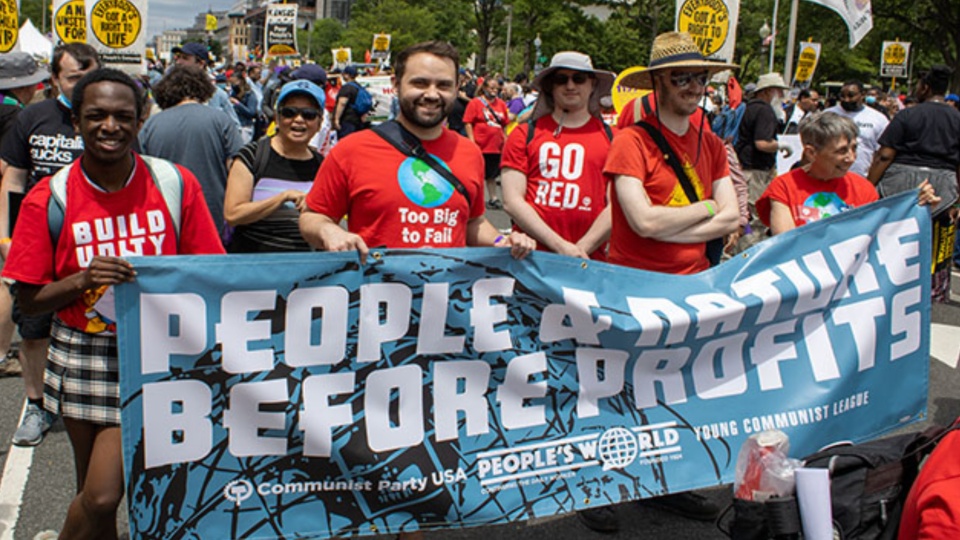
Collin Kawan-Hemler of the Young Communist League described rising turnout among young voters of color, including a shift among young Latinos from the “No Sabo” generation to the “Sí Votan” generation. The YCL is aiming for a formal re-establishment convention in 2027.
Building the CPUSA
Anita Waters, presenting the Organization Department’s report, proposed a national membership drive for 2027, arguing that working-class voters did not succumb to MAGA’s red-baiting, white supremacy, or Islamophobia this year. She also urged members to sign up for the People’s World phone-a-thon. Brooklyn Crawford of the party’s social media collective reported gains of more than 10,000 Instagram followers, 5,000 TikTok followers, and 2,000 YouTube subscribers since last fall.

The editors of People’s World reported on the publication’s election work and emphasized the increasing diversity of its national pool of writers, with growing numbers of women, people of color, and LGBTQ persons appearing on its pages as authors.
They also pointed out that the organized labor movement has been recognizing the value of People’s World coverage as of late, with the national AFL-CIO, the United Auto Workers, and several state-level federations distributing and sharing People’s World articles to their members.
All the various reports and the discussion among National Committee members came back to the question Sims posed at the start of the day: whether the right’s defeat can be turned into an opening for socialism. The Communists’ answer is that it can, but only if the left organizes to make it happen before MAGA regroups.
CPUSA Co-Chair Rossana Cambron closed the meeting. She congratulated the party’s candidates who ran in this year’s elections, calling them “pioneers who are making history for the Communist Party,” and then sent National Committee members back to their political work with some questions to think about.
“We are at a critical moment. If we want to seize the socialist moment we are living in, we must make an objective analysis,” Cambron said. That means asking hard questions, she explained: “What forces does the working class support? What is the concrete evidence to support that decision? Why did the Republicans not expect to lose so much?” And, she added, were the conclusions arrived at collectively, so that they reflect current reality?
“This may seem like a lot of work,” Cambron acknowledged, “but these questions are necessary if you want to contribute to advancing the movement in a way that has an impact and not simply a feel-good action.”
No paywalls at People’s World
At People’s World, we believe news and information should be free and accessible to all, but we need your help. Our journalism is free of corporate influence and paywalls because we are totally reader-supported. Only you, our readers and supporters, make this possible. If you enjoy reading People’s World and the stories we bring you, please support our work by donating or becoming a monthly sustainer today. Thank you!
CONTRIBUTOR