A “humanistic outburst against fascism and capitalism in its genocidal phase” has broken out in Colombia, according to academic Manuel Humberto Restrepo Domínguez.
The wave of demonstrations that has been filling streets in major cities across Europe and Latin America in recent days washed over Colombia on Oct. 14.
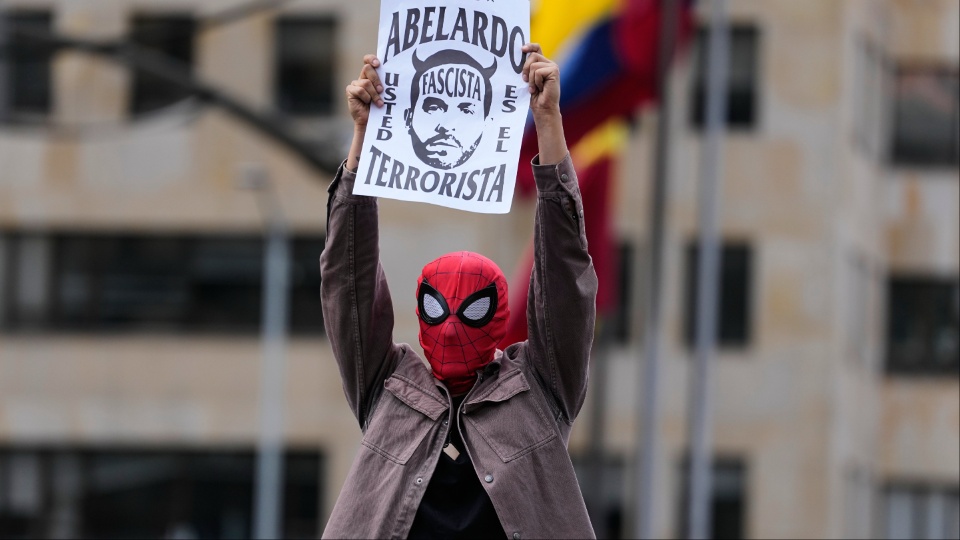
Anti-government protests erupted that day against new President Abelardo de la Espriella, who took office on Aug. 7, and U.S. intervention in the country’s affairs on his behalf. The framework surrounding the uprising is complex.
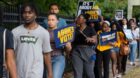
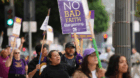
Demonstrations took place in 62 locations and the capital cities of all 31 departments. Marshalled against the far-right De la Espriella, a novice politician, were thousands of trade unionists, workers, students, teachers, feminists, indigenous people, past office holders, and veteran activists of all stripes. The outpouring of dissent was extraordinary.
De la Espriella succeeded Gustavo Petro, president of Colombia’s only progressive government, ever. Petro accompanied marchers in Bogota, as did Senator Iván Cepeda, the defeated presidential candidate of the Historic Pact Party, founded by Petro. The margin by which Cepeda lost was less than one percent. A U.S.-facilitated social-media storm contributed to his defeat.
On the day prior to Oct. 14, de la Espriella fired up opposition forces by issuing his repressive Decree 1525. The measure stipulates that dialogue with protesters not “condition, suspend, or postpone enforcement actions directed individually against those who commit acts of violence.” In general, presidential decrees and slogans are setting the new government’s course, not legislation.
Nelson Lombana Silva, blogger and Communist Party activist, characterizes the protests as a “national strike” and harbinger of an eventual general strike. Reporting from Ibagué, capital of Tolima Department, he condemns “the criminal ESMAD [riot control police]…[for] violently attacking artists and cultural activists, beating young people, children, and veteran [activists].
“They had been chanting slogans against the nefarious government of death and despair. Tear gas flooded the park, spreading panic and state-sponsored terror.”
Elsewhere, the police assaulted reporters and human rights defenders, arrested demonstrators, and employed tear gas, stun guns, and rubber bullets. In Medellín, tanks were used.
A BBC report catalogued specific actions and interests of Colombia’s new government that are likely to be provoking opposition:
- The government is preparing for cuts to the minimum wage and pensions. Concrete proposals are still lacking.
- The government will no longer implement its 2016 Peace Agreement with former FARC leftist insurgents. Nor will it cooperate with the Special Jurisdiction for Peace, part of that agreement.
- It prioritizes military action against armed groups and henceforth will not negotiate with the remaining leftist insurgencies and dissident FARC groups.
- The government broke diplomatic relations with Nicaragua and Cuba and restored relations with Israel, whose influence in Colombia grows.
- Colombia’s government is entering “a ‘cultural battle’…[in favor of] traditional family values and Christian morality.”
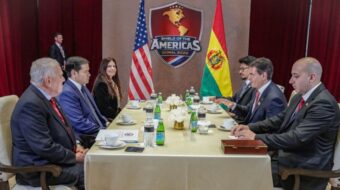
- The new government joined the U.S.-initiated Shield of the Americas, vehicle for U.S. military intervention in the entire region.
- The report states that de la Espriella “does not dismiss [the idea] of Colombia withdrawing…from in the United Nations, the Organization of American States, and the Inter-American Court of Human Rights.”
A recent flurry of “extrajudicial executions” accompanying police and military actions has also outraged many Colombians.
The BBC offered few details about Colombia’s tightened relationship with the U.S. government, other than that it has re-committed to a joint U.S.-Colombian war on drug traffickers. The U.S. government, however, has long regarded its “drug war” as pretext for engaging leftist insurgents militarily and for providing support generally to Colombia’s military.
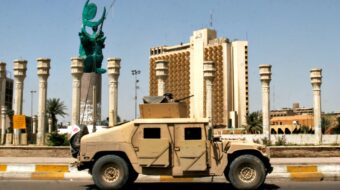
As reported by the New York Times on Oct. 14, 600 U.S. troops will be heading soon to Colombia where they will carry out training exercises with the Colombian military. De la Espriella’s government has resurrected the failed approach of fumigating coca fields with carcinogenic glyphosate. His government’s military alignment with the U.S. signals complicity with deadly U.S. attacks on small coastal vessels supposedly carrying drugs.
Colombia’s new government will likely grant free rein to U.S. corporations, including extractive industries. The plundering that results would aggravate damage already visited upon Colombian land and the environment. Nelson Lombana Silva sounds the alarm:
“In a short time, the illegal and mafia-like government of Abelardo de la Espriella has done so much harm…. [I]n addition to surrendering national sovereignty, it has been giving away natural resources left and right, exposing the nation’s land to the risk of being turned into a vast desert.… Oil and precious metals have fallen into the hands of imperialism thanks to the treacherous, sell-out policies of that clown of a president…. He speaks Spanish but thinks in English.”

This last remark is shorthand for identifying the president as a U.S. citizen, longtime Miami resident, and wealthy lawyer. He made big money defending extradited Colombian narcotraffickers and top-level paramilitary chieftains in U.S. courts.
Silva resumes: “Counter-reform marches on with increased fracking, lay-offs of 700,000 workers, the highlands and water reservoirs being devastated, ecosystems destroyed, public education privatized, and dumbing down of students with religious indoctrination so they will no longer be thinking, critical individuals but will remain submissive to Uncle Sam’s dictates.”
Looking at the larger context, Professor Restrepo suggests that demonstrations in Colombia and Europe “represent the historical antagonism between capital…as led by government officials subordinate to the club of multi-billionaires allied with colonialist states, on one side, and on the other, the common people who…suffer exploitation, inequality, injustice, discrimination, exclusion, alienation, and repression.”
He adds that, “Out of that resistance arose the right to rebellion (to take up arms…and the right to social, civil, and unarmed protest.” Restrepo finds affirmation in, of all places, the United States, specifically in Henry David Thoreau’s Civil Disobedience (1849).
He quotes: “All men recognize the right of revolution; that is, the right to refuse allegiance to, and to resist, the government, when its tyranny or its inefficiency are great and unendurable.”
No paywalls at People’s World
We hope you appreciated this article. At People’s World, we believe news and information should be free and accessible to all, but we need your help. Our journalism is free of corporate influence and paywalls because we are totally reader-supported. Only you, our readers and supporters, make this possible. If you enjoy reading People’s World and the stories we bring you, please support our work by donating or becoming a monthly sustainer today. Thank you!
CONTRIBUTOR