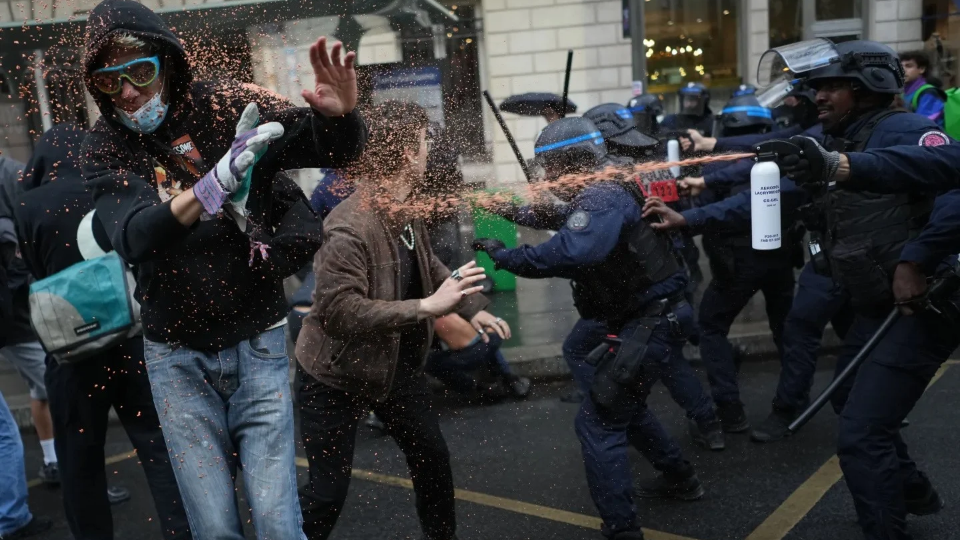
The Monday after a series of often violent confrontations between high school and university students, pensioners and unions on the one side and police on the other, the foreign press was ablaze with graphic descriptions of “burning cars…and shattered shop windows” as The New York Times photo caption put it over a photo of a “burned-out vehicle.” The Murdoch press was even more graphic with The New York Post claiming the “riots in France” were an “attack on civilization” led by “Muslim communities.” While Murdoch’s Wall Street Journal lead headline blared that “Rioting Sweeps Country,” then returned to commercial oblivion right next to it with “How Coke Beat Pepsi To Supply Beverages at KFC.”
The New York Times’ more “reasonable” approach sounded the alarm as across Europe, following the French, “young people and workers” were tempted by “promises of radical change.”
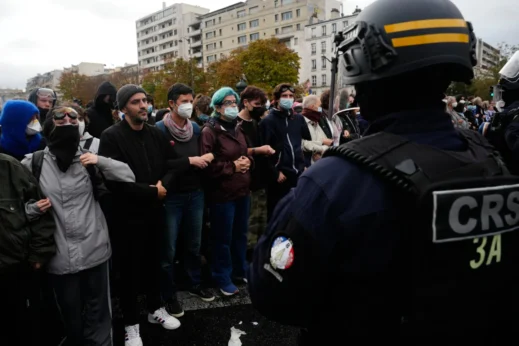
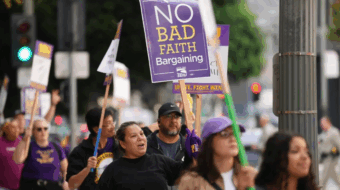
Yes there was violence and some looting but the resort to portraying these demonstrations as a pure eruption of violence is the last resort of a government and a media which has lost control of the narrative. The protests have now moved beyond high school and university students to a reemergence of the rural and periurban (or urban fringe) disenfranchised and pensioners with October 17 marking the convergence of “le jaune et le jeune,” the Yellow (Vests) and the Youth.
The protests have now spurred the unions as well who will be staging a mass action that may turn into a general strike on November 5, occasioning even in the mainstream press here in France a description of the moment as “the end of Macronisme,” that is, of nearly a decade of neoliberal “reforms” which his administration has wrought including a vast redistribution of wealth upwards, declining medical and education infrastructure and an increasingly more repressive police presence to squash dissent at these “reforms.”
The government has responded to these protests not with the Five Stages of Grief, but with Three Stages of Control. The first response was to deny their importance, a response that had to be abandoned as the protests grew in strength and frequency and as the claims of a disintegrating education system and lack of promise for the future gained credence with the rest of society. Then came slight acknowledgment and placating. President Macron has mostly been absent from the political stage during this entire period, since his latest approval rating of 15 percent means he would only be adding fuel to the fire. In his place, the Prime Minister Sébastien Lecornu proposed adding 3,000 substitute teachers to the high school system, which was immediately understood for what it was: a measure to stop the demonstrations, with the temporary teachers then let go when tensions decreased.
The third stage, though, is open violence on the part of the police, who have arrested 8,000 demonstrators, largely minors, in a repression that has been described even in the mainstream press here as “historic in its scale.”
The demonstrators know that when they take to the streets they will be met with tear gas and billy clubs, and they now know that they must respond in kind, in a pitched battle for control of the streets, defending their right to protest. One of the most common placards in the corteges is “ACAB,” All Cops Are Bastards.” On October 17, police quickly barricaded the area around the main protest staging ground at Republique, not allowing protesters to enter and, when they tried to surmount the barriers, met with tear gas grenades whizzing over their heads and the young people frantically running in one direction or another to avoid the canisters.
The LFI, France Unbowed, the main party favoring the peaceful part of these protests, noted that “Confrontation seems to be the goal of this law enforcement strategy,” accusing the police of having “organized the disorder.”
The mainstream media focus on demonstrators’ violence—street violence portrayed as flashy and graphic—is at the expense of the slower and more deadly structural violence that the protestors are attempting to call attention to. The economist Thomas Piketty points out that what Macron has presided over in the area of education is a 20 percent drop in funding per student when adjusted for inflation, with teachers’ pay outside the elite universities, which Macron’s policies of entrepreneurship have promoted, falling by 50 percent. This has resulted in universities and high schools with collapsing ceilings, in school facilities with little or no heating or cooling, and in administrative offices deserted because of declining salaries. This is in a country, as Piketty points out, where in the last decades private wealth has risen from 300 to 600 percent of the total and where, for example, the wealthiest companies grow richer, as the oil and gas company TotalEnergies reported an 11.2 billion euro profit this year.
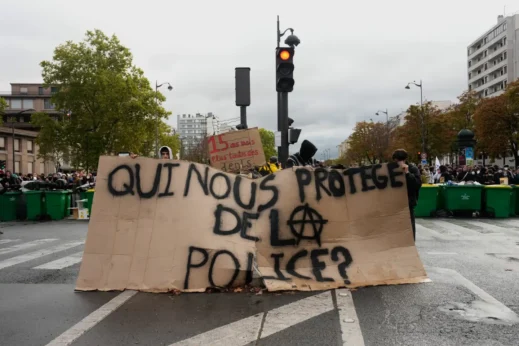
Across Europe, as in France, these protests now also constitute a convergence of struggles. In Italy, in another linking of the jaune and the jeune, pro-Palestinian eruptions as well as protests against Meloni’s far-right repression and austerity from students and activists in the North are joined by road haulers, farmers and fishermen in the South whose living is threatened by the high price of energy. Likewise, students in Belgium have taken to the streets as well as in Spain whose squares are being occupied in a protest against tenant expulsions and the high price of rents not only in Madrid but now throughout the country.
Yes there was violence on October 17 but part of that violence followed a global pattern of peaceful protest being succeeded, often in the evening after the protests, by gangs of armed hoodlums, with the most notorious of these the Black Block often accused of being police provocateurs. The global pattern of peaceful protests followed by violence also characterized protests against inadequate housing in Hong Kong in 2020 and against corruption in Indonesia in 2025. The violence then allows both the governments and the media to ignore the very real grievances of the protestors and focus instead on what The New York Times always terms “chaos” which for that paper is the inevitable result of any questioning of the bourgeois order.
Two stark moments characterize these protests. One is that Le Monde mourned the fact that the Socialist candidate for president Raphaël Glucksmann, who won what that party quaintly terms a “primary” by getting only 70 percent of 144,000 votes, could not visit the protests because he would be booed and laughed off the barricades. This represents not the “ultra-left” position of the protestors but rather their understanding that the centrist parties, even those that call themselves left, represent only a “college-educated elite.”
The other symbol mourned in the press was the toppling in Marseille of a statue of Marianne, signifier of the French Revolution. This is not a descent into anarchy. It is a recognition that after four Revolutions in under 75 years—1789, 1830, 1848 and 1871—to finally rid the country of the aristocracy, the bourgeois republic that was installed now no longer represents the interests of the majority of its people. As one protestor put it, “We’re following in the tradition of May ‘68,” and in that tradition these protestors will find their own Marianne.
As with all opinion and news-analysis articles published by People’s World, the views expressed here are those of the author.
No paywalls at People’s World
We hope you appreciated this article. At People’s World, we believe news and information should be free and accessible to all, but we need your help. Our journalism is free of corporate influence and paywalls because we are totally reader-supported. Only you, our readers and supporters, make this possible. If you enjoy reading People’s World and the stories we bring you, please support our work by donating or becoming a monthly sustainer today. Thank you!
CONTRIBUTOR