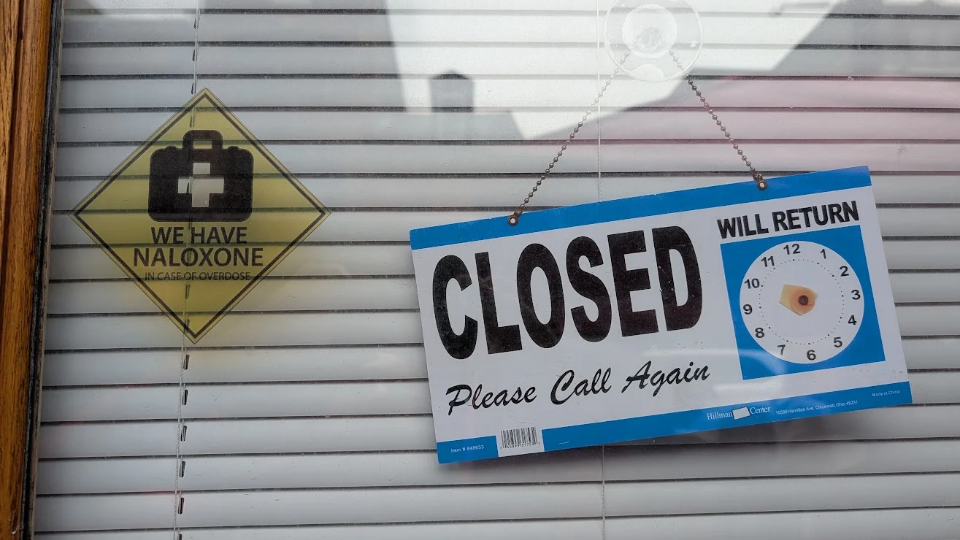
PITTSBURGH—Unhoused residents of the Northside braved the rain on Friday, Oct. 2, to access the ROOTS Center for the last time. Gathered outside, dozens of community members greeted each other with hot food and expressions of solidarity. For Northside’s unhoused community, the ROOTS Center at 519 East Ohio Street was more than a directory for services.
Reaching Out On The Streets is a program of the Pittsburgh Office of Community Health and Safety that “aims to reduce the prevalence of homelessness by addressing the social determinants of health” by operating resource hubs for unhoused individuals. The city employs workers at these hubs who help with “human services, drug and alcohol treatment, housing, healthcare, behavioral health, and criminal legal navigation,” according to the OCHS website.
For many, the ROOTS program is a source of safety. Every year, thousands of Americans die from hypothermia, and increasing rates of homelessness are causing the number of deaths to grow. Drop-in centers like ROOTS save lives during extreme weather. In March, Haitian-born asylum seeker Daphy Michel died of hypothermia after being released from an ICE facility, in what the Allegheny County Medical Examiner’s Office ruled a homicide.
Finding housing and getting healthcare take time. For people like David Wayne Palmer, the ROOTS center became a “home base” after being discharged from the hospital for surgery following a fall that broke his back. Over weeks, he obtained a copy of his birth certificate, a photo ID, and eventually an address. “They literally help an individual be nothing more than a pile of dust and water, and help them get in all the networking resources possible to conquer life,” Palmer told the Pittsburgh Post-Gazette.
Despite its importance to the community—and despite the Office of Community Health and Safety (OCHS) receiving $800,000 from Allegheny County this year to expand the ROOTS program—the Center on Northside permanently closed on Oct. 2 following an announcement from the office of Mayor Corey O’Connor. It was the last remaining ROOTS Center, and none remain.
The mayor’s role
Before being elected last November, Mayor O’Connor expressed concern about ROOTS’ imperiled status during a debate against then-mayor Ed Gainey. “There should be six hubs available. We had three open. Two are now closed. We’re down to one that is taking basic services into our community, providing social workers for our neighbors who are most in need to ensure that they get the help and support that they deserve.”
Soon after being elected, O’Connor told the press that he wanted to take ROOTS in a different direction. Instead of expanding the drop-in locations, his administration would move away from them in favor of mobile aid vehicles.
An outreach worker located on Northside working for another outreach organization predicts that O’Connor’s move will have deadly consequences for Pittsburgh’s unhoused community. As mentioned, the building will “no longer be a location to get out of extreme weather.” Beyond that, “lots of people with severe healthcare system trauma received care from doctors and nurses in this space. These people are a lot less likely to go to traditional medical facilities.”
The outreach worker’s warnings continue. “This was a good location for people to meet with housing program coordinators. There was a phone anyone could use. This was vital for lots of people that don’t have phones.” It was also “a space that was very low barrier” to entry, which made it “a good location to check in with people who aren’t always easy to connect with. It was a constant and safe location people could go to. Very important for people that don’t experience much stability in their day-to-day lives.”
Keep ROOTS open
In response to the mayor’s actions, Pittsburghers have organized a pressure campaign aimed at keeping the ROOTS drop-in center on Northside open. The coalition included the National Union of the Homeless, Our Streets Collective, the Pittsburgh Club of the Communist Party USA, the Pittsburgh Neighborhood Assemblies, and others.
The closure was announced Sept. 16, just two weeks before its last day. With so little notice, the pressure campaign began that day. A petition was immediately drafted and circulated throughout the city with the following demands.
- Keep the Roots office and drop-in center at 519 E Ohio Street open.
- Keep its warming and cooling services available to people experiencing homelessness.
- Preserve its mail service, outreach-worker access, resource navigation, free water and coffee, and community meeting functions.
- Recognize the Roots office as an essential community resource rather than closing it in response to complaints about the visible impacts of homelessness.
- Work with houseless Pittsburghers, Northside residents, businesses, service providers, and community organizations to address concerns about homelessness without eliminating a place where people can access basic services and support.
Organizers collected 260 signatures in 14 days.
In the days leading up to Oct. 2, Mayor O’Connor stated the ROOTS location was closing because the building’s lease was ending. However, in a statement to the Post-Gazette, the building’s lease owner said he “would give the city a new lease tomorrow” if they wanted it. O’Connor also claimed that his office is searching for alternative locations for ROOTS, but when asked for details, he provided none.
The campaign requested a meeting with the mayor to deliver the signatures, but the request was ignored. So on Wednesday, Sept. 30, a dozen organizers marched on the Mayor’s Office, carrying petitions and protest signs, demanding to speak with O’Connor.
Callie DiSabato, Pittsburgh Northside resident and member of the Northside Neighborhood Assembly, was one of the marchers. “Today the mayor offered weak answers and weak solutions. He was unable to answer why 519 E Ohio Street is not a viable location for a ROOTS drop-in site and offered no details about an actual search for an alternative location. It’s clear that his office either isn’t aware of—or simply doesn’t care about—the truly devastating impact that this site closure will have.”
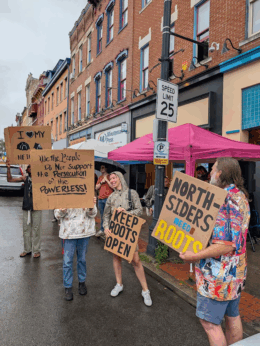
The pressure campaign also organized a rally just outside the ROOTS center on its last day of service. It closed at 2 p.m., so on Friday, Oct. 2, 1–3 p.m., dozens stood outside 519 E Ohio St holding signs and gathering expressions of solidarity from passersby. Nearby community members shouted and honked their horns in support, demonstrating how important the center was to the Northside residents.
One organizer brought a grill and cooked hot dogs and veggie dogs. Another was serving warm cider and hot cocoa. Musicians played “Solidarity Forever,” including members of Pittsburgh’s May Day Marching Band. Canopies protected everyone there from the rain.
What happens next
By that evening, the rally was over, and ROOTS was gone. But the pressure campaign has not ended. Since that Friday, its organizers have been mobilizing resources for community-run support centers that remain open on Northside, because they now bear a heavier burden than ever. QMNTY Closet, for example, is located right next door at 517 E Ohio St and is collecting monetary donations to cover the cost of running the space. Additional public demonstrations are also in the works.
It is not easy to understand the complex web of cause and effect that leads to someone dying while experiencing homelessness. “Even the way we count the number of people whose lives are lost to homelessness is kind of ambiguous,” says Sam Schmidt, co-founder of Our Streets Collective. “Because life is complex. Humans are complex. Health is complex.”
“It’s hard to pinpoint exactly the cause of certain consequences or outcomes,” Schmidt goes on to explain. “But we do know that last year there was a much higher number of deaths than the last two years, due to the experience of homelessness. And there were a ridiculous number of encampment sweeps. So there’s a correlation there, if not causation.”
For now, only a small number of people die from hypothermia while experiencing homelessness in Pittsburgh. This is due, in no small part, to the work of Operation Safety Net, founded in 1992 by Dr. Jim Withers, which helped establish the concept of “Street Medicine.” Their street medicine team spends significant time and resources preventing deaths from exposure.
But every time a shelter is closed, a heavier burden is placed on efforts such as Operation Safety Net. This, in turn, takes a toll on the other services they offer besides street medicine, such as street outreach, housing and care-management services, and legal services.
Social Murder
While the specific set of outcomes may be hard to predict, many say it is easy to see that the forced closure of the last ROOTS drop-in center will lead to the suffering and likely death of Pittsburghers who are experiencing homelessness.
Similarly, when President Donald Trump’s 2025 budget reconciliation (formerly called the “One Big Beautiful Bill Act”) ended the healthcare subsidies on the Affordable Care Act, the Congressional Budget Office estimated that an additional 10 million Americans will lose their healthcare coverage by 2034. According to research from the University of Pennsylvania, that could result in more than 51,000 additional deaths per year.
When the federal government hires ICE agents who shoot and kill innocent civilians, the link between policy and death is obvious. But policy is often less direct. In the case of the Big Beautiful Bill, by withholding funding for ACA subsidies, no direct harm was done. Yet, in effect, it has deprived millions of Americans of their healthcare; so, when they get sick, they are more likely to die.
This is not a new phenomenon. In fact, Friedrich Engels termed it “Social Murder” when he wrote about it in his 1845 work, “The Condition of the Working-Class in England.” Engels writes:
“When one individual inflicts bodily injury upon another such that death results, we call the deed manslaughter; when the assailant knew in advance that the injury would be fatal, we call his deed murder. But when society places hundreds of proletarians in such a position that they inevitably meet a too early and an unnatural death, … knows that these thousands of victims must perish, and yet permits these conditions to remain, its deed is murder just as surely as the deed of the single individual.”
It cannot be predicted exactly how many unhoused Pittsburghers will “meet a too early and an unnatural death” due to the forced deprivation of drop-in support from a city that used to provide it. But the number is undoubtedly greater than zero.
No paywalls at People’s World
We hope you appreciated this article. At People’s World, we believe news and information should be free and accessible to all, but we need your help. Our journalism is free of corporate influence and paywalls because we are totally reader-supported. Only you, our readers and supporters, make this possible. If you enjoy reading People’s World and the stories we bring you, please support our work by donating or becoming a monthly sustainer today. Thank you!
CONTRIBUTOR