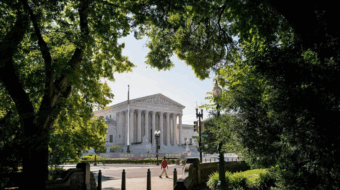
WASHINGTON—On the same day, Nov. 3, that the nation’s voters resoundingly rejected the Trump agenda of discrimination and bigotry, a Catholic school attorney tried to get the Supreme Court to rule in favor of discriminating against LGBTQ people.
The Trump administration supports the attempt by St. Mary’s Catholic pre-K school of Littleton, Colo., to legitimize the exclusion of the children of gay parents by Catholic schools in the state.
Nicholas Reaves, attorney for St. Mary’s, dropped a one-sentence bomb about constitutional rights midway through a two-hour oral argument before the High Court. His statement would apply to businesses, including unionized businesses.
St. Mary’s, like other such schools statewide, wants to accept Colorado’s pre-K subsidies but refuses to sign a required non-discrimination agreement. It, and two parents, say doing so would force the school to accept kids from LGBTQ-headed families, and force their daughter to sit next to them.
Reaves argued the state’s non-discrimination agreement violates freedom of religion, specifically church doctrine against LGBTQ people. The parents argued signing it would violate the religious beliefs they’re trying to teach their 4-year-old. The U.S. Justice Department sided with them.
And then, in an answer to Justice Ketanji Brown Jackson, Reaves declared “These are private religious schools. They’re not subject to the 14th Amendment.”
“What the religious entity would like to do is discriminate against a class of people,” Brown Jackson reacted. “Your schools want to discriminate by exclusion. Nobody else is allowed to do that.
“We’ve got a conflict…between the 14th Amendment right of the religious entity” to freedom of worship and “the 14th Amendment right of certain individuals who would have the right not to be discriminated against.” The school is “preferencing the religious entity’s ability to discriminate against others.”
“It’s Colorado that’s denying Catholic families equal access to this benefit based on a protected characteristic, their religious exercise,” Reaves replied.
The 14th Amendment is a key to expanding the entire Bill of Rights—and the entire Constitution—beyond just the federal government. That, of course, includes civil rights and worker rights. Reaves said it doesn’t apply to private enterprises, including religious schools. Or anyone else.
The 14th Amendment was one of three enacted and ratified after the Civil War—and which defeated Southern states had to accept before they could be readmitted to the U.S.
“All persons born or naturalized in the United States are citizens of the United States and of the state” they reside in,” it begins. “No state shall make or enforce any law which shall abridge the privileges or immunities”—in plain language, rights—”of citizens of the United States, nor deprive them of life, liberty, or property without due process of law.”
Reaves said that doesn’t apply to private enterprises, including pre-K Catholic schools. Jackson, a former public defender, jumped on that.
“You say that this is about the government subsidizing private conduct,” she said. “If we frame it that way…these parish preschools would like to do something the state has determined is a violation of its own principles with respect to discriminating against or excluding a certain group of people.
“Why isn’t it that the state can uniformly condition the receipt of these funds on something like ‘You can’t discriminate?’ It seems to me you’re asking for a special rule for religious schools that when Colorado says anyone who receives these funds has to be open to everyone.”
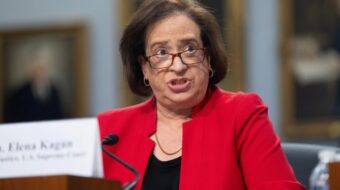
Other than Justices Jackson, Elena Kagan, and Sonia Sotomayor, Reaves’s statement drew little reaction from the justices. Justice Amy Coney Barrett came close, walking Reaves through the history of anti-Catholic discrimination, which led to the church founding religious schools nationwide in the late 1800s.
Some state constitutions still have explicit bans on using taxpayer dollars for private schools. In a friend of the court brief, the nation’s two big teachers unions warned that if the court rules for the Colorado pre-K school, it would open the door to rampant official discrimination against unfavored groups nationwide. They specifically mentioned people of color, LGBTQ persons, and the disabled.
And the NAACP’s friend-of-the-court brief reminded the justices of the “massive resistance” throughout the South to school integration after the 1954 Brown v. Board of Education anti-Jim Crow decision. Peak resistance was in Virginia. Its old racist Democratic machine closed all the public schools statewide for five years, and encouraged private whites-only “segregation academies.”
The justices and the attorneys, including Reaves for the school, Colorado Deputy Solicitor General Helen Norton for the state and Sarah Harris, Principal Deputy Solicitor General for the Trump Justice Department, spent more than two hours wrangling over the issue.
At one point, Norton offered a “solution” of sorts: The school could voluntarily refuse the subsidies—and the non-discrimination pact. Speaking for the school, Reaves compared the state subsidies to coercion. He told Kagan refusing the subsidies would cut school enrollment by 20%.
Reaves tried to reverse course a bit in a dialogue with a skeptical Sotomayor. “Colorado permits them to apply if they will accept all children,” the justice stated. “They’re saying, ‘We don’t want to accept the children of a certain class of people, homosexual people.’” Replied Reaves: “For the Catholic Church, it’s not about excluding anyone based on who they are.
“Well, I don’t see how that can be,” Sotomayor said. “I’m asking you a direct question. Your Catholic schools will reject a child merely because their parents are homosexual?” Replied Reaves, “If it’s the sincere religious exercise of the petitioner”—the school, the parents, and the church—“then I think that would be permitted.”
“If it’s a sincere religious exercise to exclude Black people, this principle would permit the exclusion of those Black children?” the justice followed up. When Reaves replied, “No” and started to elaborate, Sotomayor shot back, “Why?”
“In all of these situations, you can compare what this court said” in two prior rulings, including one against white nationalist Bob Jones University more than 40 years ago, upholding the IRS denial of its federal tax exemption because it discriminated against Black people. “The difference was the government said there is an overriding government interest, not just a compelling interest, an overriding interest,” said Reaves.
The three justices who questioned Reaves seemed unconvinced. A final ruling is pending.
No paywalls at People’s World
At People’s World, we believe news and information should be free and accessible to all, but we need your help. Our journalism is free of corporate influence and paywalls because we are totally reader-supported. Only you, our readers and supporters, make this possible. If you enjoy reading People’s World and the stories we bring you, please support our work by donating or becoming a monthly sustainer today. Thank you!
CONTRIBUTOR