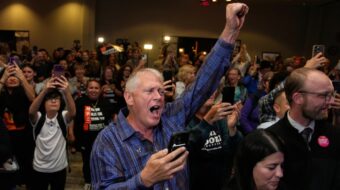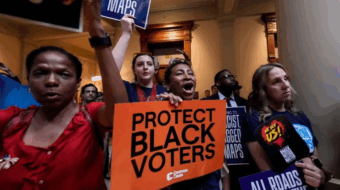
RICHMOND, Va.—While most of the election-night attention went to congressional races, voters in two states also used their ballots to make big progressive changes on their own.
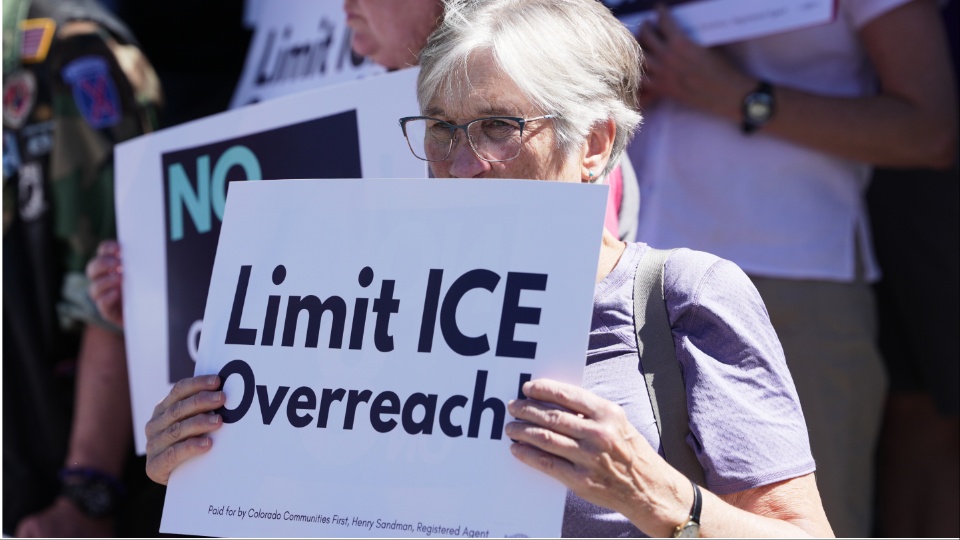
In Virginia, voters approved three constitutional amendments, all by large margins: reproductive rights, same-sex marriage, and voting rights for felons who have served their sentences. And in Colorado, voters showed their disdain for ICE by approving a referendum that forbids local jurisdictions in the state to cooperate with the agency, and voted to replace the state’s flat income tax with one that hikes taxes on the rich.
Of Virginia’s three amendments, the reproductive rights measure drew the most attention. It protects not just women’s rights to reproductive choice, treatments, and medications, but also the doctors and nurses who treat them. It passed 62.4% to 37.6%. It also basically writes the U.S. Supreme Court’s 1973 Roe v. Wade nationwide reproductive rights ruling into the state constitution—despite the High Court tossing that ruling out 49 years later.
That was the point. Right now, Virginia legally favors reproductive freedom. But a future governor and legislature of foes could overturn that, just as the Supreme Court’s GOP-named majority eliminated national reproductive freedom in 2022, leaving the decision up to the states. As a result, Southern and border states, except Virginia, have banned or severely limited reproductive rights.
The ACLU publicized the amendment, promoting a coalition campaigning for “Yes on 1,” the Virginia Reproductive Freedom Amendment.
“We are a coalition of Virginia families, doctors, nurses, and more than 25 partner organizations—including the ACLU of Virginia, Planned Parenthood Advocates of Virginia, REPRO Rising Virginia, Birth in Color, and more—working to pass Question 1, which adds the fundamental right to reproductive freedom, including birth control, abortion care, miscarriage management, and fertility care, to the Virginia Constitution,” the Virginia Coalition for Reproductive Freedom explained.
The amendment would also “protect patients, doctors, and nurses from being punished” for decisions favoring reproductive rights. And “it allows the state to restrict abortion during the third trimester, except when the patient’s health is at risk, or the pregnancy cannot survive,” the Yes on 1 coalition said. The third-trimester exception was in the original Roe v. Wade ruling.
The coalition also includes other women’s rights groups and several progressive religious groups: Catholics for Choice, Jews United for Justice, and the Union for Reform Judaism. It ran ads with individual stories about why reproductive rights are so important.
Catholics for Choice prominently posted on its website a statement from “Jen V.,” of Washington, D.C., who was an anti-abortion advocate when younger—and has changed her mind. “When I was a young anti-abortion activist, I believed I was pro-life. But now I understand that providing reproductive care is the most pro-life thing I can possibly do,” she wrote.
The Union for Reform Judaism first spoke out strongly for reproductive rights in 1975, two years after Roe v. Wade constitutionally recognized those rights nationwide—the decision the GOP-named court majority nullified in 2022. And while URJ recognized other religions could hold different views, it declared lawmakers should not “legislate the particular beliefs of those groups into the law that governs us all.”
On the other side, the Catholic Diocese of Arlington, which covers Northern Virginia, lined up with the church’s overall position against reproductive rights—and against same-sex marriage, Question 2 on the state ballot.
That amendment removed a state constitutional ban on same-sex marriage. Voters approved the removal 57.4%-42.6%. In a way, it anticipates that the same five-justice GOP-named Supreme Court majority that deleted reproductive rights could overrule same-sex marriage, too. Most voters wanted to ensure Virginia would refuse to implement any such decision.
The third amendment extends voting rights to felons who have served their time after being convicted of murder or manslaughter. Voters OK’d it 56.5% to 43.5%. Since September, voting rights restoration statewide has been legal for all other groups of released felons, while those convicted of murder or manslaughter have had to individually petition the governor to restore their rights. Felons in both groups are disproportionately Black.
Despite the stakes, the referenda got little coverage, except from WJLA-TV in D.C. An internet search disclosed no polling on the three questions, and both the state AFL-CIO and the Northern Virginia Labor Federation were silent, having converted their websites to the generic national AFL-CIO site, which is also silent on the referenda.
Organized labor was not silent in Colorado. Ahead of the vote on the ICE referendum, the state AFL-CIO came out against cooperation with the agency, saying in a statement that “reporting to ICE forces local law enforcement to report people to ICE agents. It risks racial profiling and threatens due process and civil rights.”
Colorado voters also approved a referendum that repeals the flat 4.4% state income tax, replacing it with one that hikes taxes on the rich and improves the state’s ability to fund education.
In both states, the progressive tide carried over to the congressional races. Democrats added two U.S. House seats in Virginia. In the Newport News-Tidewater area, former Democratic Rep. Elaine Luria reclaimed the seat she lost two years ago to Republican Jen Kiggans, winning by a 53% to 45% margin.
And in the 1st District, which stretches along the James River between Richmond and Williamsburg, Democrat Shannon Taylor ousted Republican incumbent Rob Wittman by 9,000 votes, or 51% to 49%, out of more than 406,000 cast. Taylor swamped him in the Richmond suburbs and in Williamsburg and lost the smaller rural counties.
In Colorado, voters ousted rabid right-winger U.S. Rep. Lauren Boebert, who represented Denver’s southern suburbs. Democrats now hold a 7-1 majority in the state’s U.S. House delegation. Voters also elected Democratic Socialist Melat Kiros to represent the 1st District.
No paywalls at People’s World
We hope you appreciated this article. At People’s World, we believe news and information should be free and accessible to all, but we need your help. Our journalism is free of corporate influence and paywalls because we are totally reader-supported. Only you, our readers and supporters, make this possible. If you enjoy reading People’s World and the stories we bring you, please support our work by donating or becoming a monthly sustainer today. Thank you!
CONTRIBUTOR