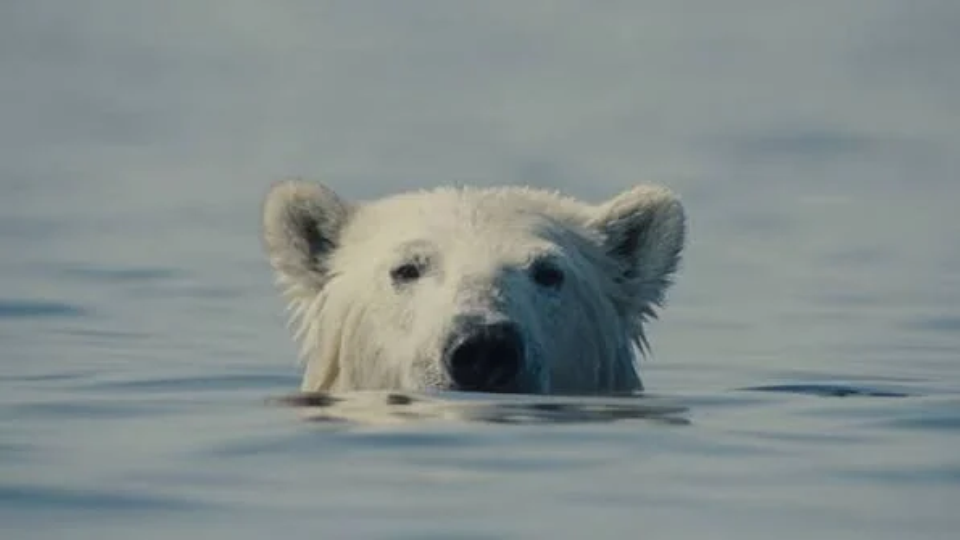
Nuisance Bear, which won the U.S. Grand Jury Prize for Documentary at the Sundance Film Festival 2026, the Werner Herzog Film Award 2026, and is nominated for five Critics Choice Documentary Awards, is one of the best documentaries about “the Great White North” since 1922’s classic Nanook of the North, which was also shot at Hudson Bay. Jack Weisman and Gabriela Osio Vanden’s profound film features exquisite cinematography in the Canadian Arctic of polar bears and their cubs, underwater shots of walruses, herds of caribou, foxes, etc.
But beyond being eye candy, Nuisance Bear is also a philosophical rumination on environmentalism and Indigenous issues. At Churchill, Canada, the so-called “Polar Bear Capital of the World,” eco-tourism and adventure travel bring herds of tourists with long-lensed cameras to impose on the creatures. When polar bears’ interactions with human interlopers, combined with global warming, become problematic, some bears are forcibly relocated hundreds of miles north to Arviat in the self-governing Indigenous nation of Nunavut, which in turn causes tensions to arise between the Inuit and the polar bears. The relocations cause a rise in the number of bears, who threaten to overwhelm the Inuit villagers in a competing struggle for survival of the fittest between two species, both overseen by a meddlesome federal government that regulates hunting and much more.
The film shows strong parallels between how white settler colonialism has dislocated and uprooted both the polar bears and the Inuit, and implies that the real “nuisance” is outside invaders and their consumer society, dislodging nature and a hunter-gatherer lifestyle. Part of the documentary is told from the polar bears’ point of view, using evocative music composed by Cristóbal Tapia de Veer and montage sequences that suggest what the animals are thinking.
Inuit elder Mike Tunalaaq Gibbons from the hamlet of Arviat provides spare Inuktitut narration in Nuisance Bear, which provides insight into the Indigenous people who, he says, traditionally knew no separation between humans and nature. But owing to the incursion and domination of the whites, Native communities were disrupted, and Inuits were taught to be ashamed of their way of life and language. This led to Gibbons being too embarrassed about his culture to pass traditional wisdom on to his son, which the father believes could have saved him from what seems to be a bear attack, although the grief-stricken Inuit gives no details.
Robert Flaherty filmed Nanook on the eastern shore of Hudson Bay at Inukjuak in Nunavik, part of Northern Quebec, while Nuisance was filmed at Arviat, on the western shore of Hudson Bay, in part of the Arctic self-governing Indigenous nation of Nunavut (atop Canada), as well as shot at Churchill, Manitoba. Widely regarded as a masterpiece of silent cinema, with documentary footage and staged scenes, Nanook depicts the traditional Inuit hunting-gathering lifestyle in a decidedly heroic way. A century later, Western society has greatly impacted the culture of the Inuits—and their millennia-long relationship with polar bears, as Jack Weisman and Gabriela Osio Vanden movingly and rather beautifully chronicle. Their production called to mind another recent nonfiction film about the age-old interrelationship and bond between Indigenous people and animals, Ken Burns’ 2023 The American Buffalo.
While Nuisance Bear is beautiful to look at, it’s also a thought-provoking documentary about how settler states, eco-tourism, and climate change harm and polarize polar bears and Native people—and even pit the two, who’d coexisted for centuries, against one another.
The 90-minute Nuisance Bear is in English and Inuktitut with English subtitles and opens Friday, Nov. 6, in L.A. and New York; Canada and the UK on December 4; and expands to additional markets the same day.
No paywalls at People’s World
At People’s World, we believe news and information should be free and accessible to all, but we need your help. Our journalism is free of corporate influence and paywalls because we are totally reader-supported. Only you, our readers and supporters, make this possible. If you enjoy reading People’s World and the stories we bring you, please support our work by donating or becoming a monthly sustainer today. Thank you!
CONTRIBUTOR