
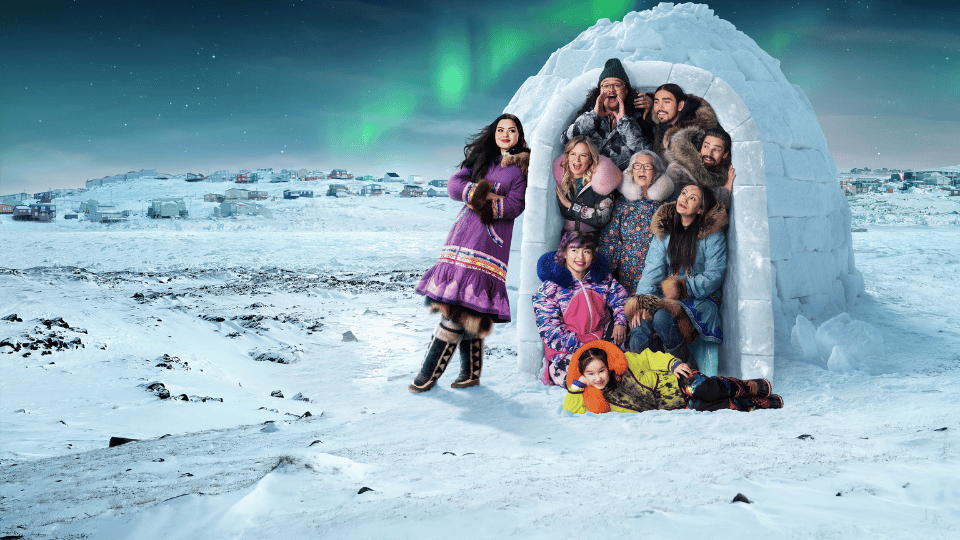
The Canadian Broadcasting Corporation and Netflix’s North of North is an extremely entertaining fable of life in the contested Arctic, with a beguiling Inuit star, Anna Lambe, now a breakout actress also starring opposite Brad Pitt in Heart of the Beast. The series, which has just released its second season, revolves around the Inuit woman Siaja who, in order to make something more of herself, leaves her husband Ting, regarded by the other women as the town hunk, but who only wants her to be mother to his children.
His self-centeredness is illustrated when, on a seal hunt, he guns the boat, not knowing he has knocked Siaja into the Arctic Ocean, and then, when she is fished out of the water, scolds her for ruining his hunt. “I blew up my whole life” is Siaja’s cry as she joins a barely functioning community center and attempts to enliven the place through a series of misadventures that ultimately prove to be successful. There is a strong relationship, both accepting and antagonistic, between Siaja and her mother, who has her own problems both with Siaja’s father, who returns to their far north settlement, and with a missing sister who has been taken from her.
Siaja is frequently comforted in her journey, as in the season two opener, by a shaman female elder and by Nuliajuk, a goddess whose domain is sea animals and who appears to her when situations are direst. The mythical Ice Cove is actually Lambe’s hometown of Iqaluit in the Nunavut region where the show is shot, and the show is created by indigenous veteran showrunners Stacey Aglok MacDonald and Altehea Arnaqua-Baril, using a cast primarily drawn from the region.
One of the production companies is Aboriginal Peoples Television Network, which produced, among others, Little Bird about the kidnapping and relocation of native children in Canada, a theme taken up with the story of Siaja’s sister, Reservation Dogs about four teens on relocated native land in Oklahoma trying to make it to California, and Tribal, a police detective series with Jessica Matten’s cop having to frequently prick the colonial bubble of her Anglo partner.
So what could go wrong? Nothing really; the show is delightful but limited in its depiction of Inuit life and especially in the problems, both geopolitical and more everyday, haunting the Arctic and threatening the very existence of its inhabitants, problems that can not be subsumed entirely into a story of female liberation, and when they are, it makes that liberation sound just a little hollow. That is perfect for a Netflix homogenization that is spreading across the world and now engulfing over 50 countries. The rhetoric on these series is all about “the local.” The reality is “the local” generally functions as flava and is fit into a few “liberal” patterns, such as individual female liberation minus the collective, that also fit nicely into a global Western hegemony.
So what is elided? The Arctic is an ecological battlefield in the process of being militarized even as it deteriorates because of global warming. Inuit territory, including Nunavut, from where Siaja comes, holds an estimated 25% of the planet’s undiscovered hydrocarbon reserves. This is not to mention that, with the melting, what Canada calls the Northwest Passage, with the country’s territorial claim based on its Inuit inhabitants, decreases the time it takes to ship these precious metals from the Canadian Arctic to Asian industrial markets, where they can be employed in about 15 days as opposed to shipping through the Panama Canal, cutting the distance by approximately 7000 kilometers. This is occasioning a shipping battle between the U.S., which, in its claim for Greenland and its denial of Canada’s claim to a territorial Northwest Passage, proposes an “open” sea lane, which simply means one controlled and patrolled by the U.S.
The Arctic is warming two to four times faster than anywhere else on the planet, making it easier to extract minerals and fostering shipping routes that disrupt traditional Inuit hunting grounds. The result is an increased chance of oil spills and leaks on these ships, broken ice trails that endanger local hunters who rely on the frozen paths to hunt, and underwater noise that disrupts marine mammals–seals, walruses, and polar bears—threatening to make Ting’s hunt a thing of the past—as well as railway lines for transporting the ores that disrupt caribou migration.
The series does deal with the new influx of Arctic tourism that goes along with the rise in shipping, as Siaja in the second season pilot attempts to ingratiate herself and the community center with this influx by putting on an Inuit show, which incidentally indicates a dramatic rise in budget for season two. The tension, though, in the episode is not about tourism cheapening Inuit culture but about how, in her personal drive to prove herself, Siaja can captivate these visitors.
What the show refuses to go near is the rapid militarization of the Arctic as it becomes a pawn in a U.S. and NATO hegemonic power grab. The NATO seven members of the Arctic Council, which previously had, along with Russia, whose coastline constitutes the majority of land in the Arctic region, been dedicated to peaceful and scientific pursuits in the Arctic as a no-go zone for global conflict, instead cut Russia off from the council, thus turning what had been a civilian ecological council into a security bloc. The power grab in the Arctic, turning it into another of the world’s choke points, is easy to understand given the current lack of Western control of the Strait of Hormuz and now the Red Sea, thus potentially locking out or greatly increasing the price of West Asian energy exports.
Beijing and Moscow, in response, are laying the groundwork for their own Polar Silk Road as an alternative to supply the rest of the world with energy sources such as liquid natural gas.
The Inuit challenges in maintaining their independence are increasing as their native hunting lands become the world’s next energy mining and shipping hotspot. Rather than Inuit unity, gained by a hard-fought acceptance byTing of Siaja’s own independence but then a coming together of both to face the problems of their people whether in a relationship or not, the show proposes instead that part of Siaja’s fulfillment is her back and forth courting of the Southern Canadian Cree Kuuk. Siaja’s personal battle for emancipation, in the context of the problems facing her people which this emancipation ignores, begins ultimately to look less like a triumph and more like a cloying tantrum that illustrates the increasing inadequacy of liberal identity politics, which most often is employed not to confront the actual challenges of an increasingly bellicose global order but to divide the challengers.
No paywalls at People’s World
At People’s World, we believe news and information should be free and accessible to all, but we need your help. Our journalism is free of corporate influence and paywalls because we are totally reader-supported. Only you, our readers and supporters, make this possible. If you enjoy reading People’s World and the stories we bring you, please support our work by donating or becoming a monthly sustainer today. Thank you!
CONTRIBUTOR