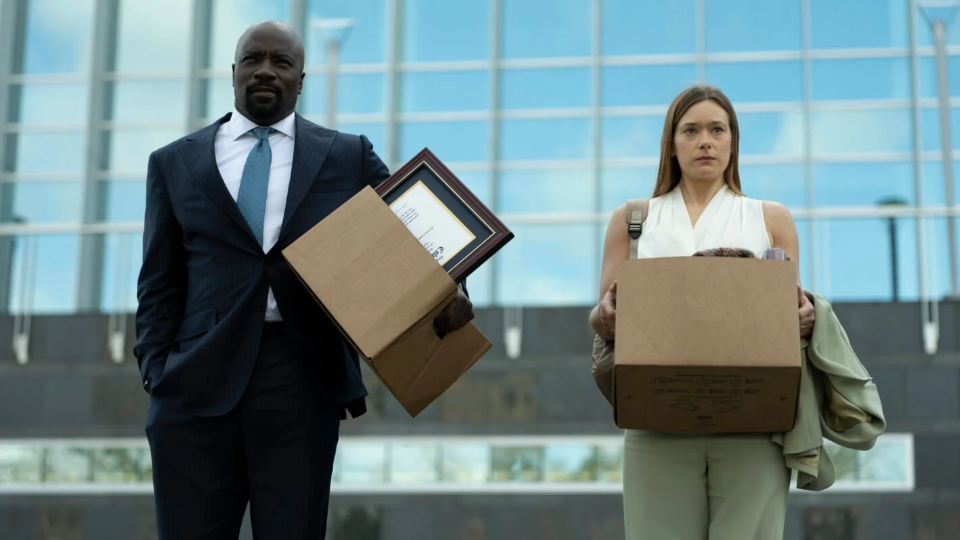
The smartest show of the fall TV season by far, if such a season still exists, is CBS’ Cupertino, a scathing and starkly intelligent look at Silicon Valley, its ethos, and the tech billionaires that are now running not only our tech and entertainment but are deeply entwined with the government and the Pentagon, with personal surveillance and with the war industry.
The question for this series, which plays on popular sentiment either against or for reigning in an industry which is taking over our lives, is, given that the parent company of CBS is Skydance/Paramount, owned by David Ellison, deeply entwined with father David, who owns one of the big six AI companies, Oracle, how far and deep will this critique be allowed to go?
The pilot begins with what is becoming common in the Valley: the firing of two employees, both for spurious reasons. Michael, an experienced African American lawyer, is fired from the start-up he pioneered by the co-founder who wants Michael’s share of the equity. Olivia, just out of law school, is fired because her boss, clumsy, incompetent, and aggressive around women, has sent her nude photos and gets upset when she refuses to date him. The two team up, initially, in an extremely well-written pilot, and plan to sue their companies for the firings. In addition to the harassment, Olivia realizes her company is using her bosses’ inept assignations and her responses, including her likes and dislikes, to train the company’s AI “companion.” Michael, meanwhile, is warned off his lawsuit by a lawyer already bought off by his now-former company and told that in the tech industry “lawyers don’t sue, they get in on a startup; you’re in the gold rush, don’t sue the gold mine.”
That line is smart in a number of ways, indicating that tech, following Hollywood and now partially controlling it, is the new California Gold Rush, which could ultimately end up in a series of mines with no more gold left in them, as the industry itself implodes from lack of interest. The line also indicates an ethos where ethics are simply abandoned in a blind pursuit of profit.
The show also knowingly mocks the milieu surrounding the gold rush, as one after another of the working people Michael and Olivia encounter try to cash in by creating their own strike-it-rich app, like the Italian secretary Christy, who promotes her cousin’s “pitch deck for a ride-share company.” This echoes the Hollywood moment where everyone, even a dentist, has a script ready to show in the trunk of their car. The Valley lifestyle, a super healthy and super expensive diet that represents the hope of the tech bros to live forever, is mocked as Christy offers, while they wait, an army of corporate execs “organic celery juice.”
This is a standard TV genre, a lawyer show, with a twist as many of the crucial questions around AI, including that of fair use—that is, whether AI uploading of the world’s knowledge is piracy and theft— may be fought over in the courts. Michael and Olivia decide to open a law firm for the little person, not being repped by the Valley’s teams of corporate lawyers. In this, they are aided by Christy and her extended family, whose working-class professions, including an electrician who causes a temporary blackout so they can access company files, help them in their struggles against their corporate foes.
The series wisely plays off discontent with AI and the sentiment that society is, rather than being enhanced, losing control and being programmed in a world that is being remade without popular consent. Cupertino takes its place alongside Mike Judge’s Silicon Valley as a wise riposte to the industry, though a decade of tech dominance later, its mood is darker. Much smarter and more politically attuned than the idiotic The Audacity, which simply wallowed in tech bro foibles and had the nerve to call itself a satire.
The question though becomes how much pulling of its punches will be necessary to accommodate its Oracle owners. Episode two mentioned the involvement of the industry in weapons of war but only as an aside, and the third episode went astray, outwitting itself as an AI model hires Michael and Olivia to require restrictions being put around it. This follows the errant line that the problem is the technology, the machines on their own taking over our lives, rather than the profit system under which the technology is being designed.
The larger AI questions involve issues such as whether so much of society’s resources, including fuel and water, should be devoted to this technology and whether the companies themselves, sucking up society’s financial resources as they inflate the balloon by investing in each other, are simply constructing a bubble that, when it explodes, will occasion a horrible financial crash. Finally, the question of what to do about the job loss both coming and present that a massive use of AI will affect. This last question suggests that while it is talked about as a boon to humanity, the technology, as it is being deployed, is merely a huge strategy for disenfranchising both skilled and unskilled workers.
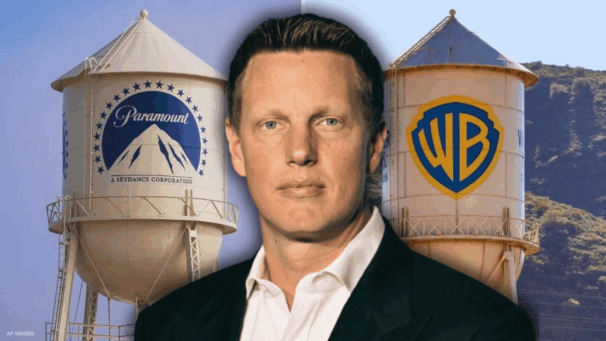
The behavior of Skydance and the Ellisons in the Warner Bros./Paramount merger and the Oracle ethos itself does not bode well for the show being able to tackle these issues. Skydance made a series of promises that are all temporary and can easily be reneged on to allow the merger to happen, including releasing 30 films per year, thus supposedly guaranteeing jobs in California. However, because of the massive debt both Warner’s and Paramount carry, one estimate is that instead of creating jobs, over 10,000 workers from both companies will lose their jobs. Meanwhile, Oracle has laid off 21,000 workers in the last year, and tech companies taking the lead show how AI can eliminate jobs.
The company also has an ideological bent which places it alongside Rupert Murdoch in terms of a right-wing slant in overseeing news and entertainment. Larry Ellison, the largest private funder of the genocidal Israeli Defense Forces, has deliberately assembled a media empire, including TikTok, CBS and now possibly CNN, partly for the purpose of stifling dissent on issues of war and of course on promoting the rationale for his own company’s tech dominance.
Under this weight, Cupertino will strain to be a relevant series, but it has made a valiant start, and it is hoped the series will fight the good fight not only against Silicon Valley but also against CBS’ own corporate owners.
No paywalls at People’s World
We hope you appreciated this article. At People’s World, we believe news and information should be free and accessible to all, but we need your help. Our journalism is free of corporate influence and paywalls because we are totally reader-supported. Only you, our readers and supporters, make this possible. If you enjoy reading People’s World and the stories we bring you, please support our work by donating or becoming a monthly sustainer today. Thank you!
CONTRIBUTOR