Sazan Island sat off-limits to ordinary Albanians for most of the 20th century. Enver Hoxha’s government turned it into a naval fortress, part of the Cold War policy that kept the country isolated from both the capitalist and socialist worlds. When that era ended in the early 1990s and the base was decommissioned, the island was left to the cormorants, the Mediterranean monk seals, and the flamingos that wade through the shallows of the Karaburun-Sazan Marine Park.
For over three decades, it was one of the few pieces of the Albanian coast that belonged to no one in particular—which is to say, it belonged to everyone. Now, the island is up for sale. And the buyer, as it turns out, is the family of the president of the United States.
In 2021, Jared Kushner and Ivanka Trump, as the story goes, spotted Sazan from the deck of a yacht while cruising the Adriatic. Kushner’s investment vehicle, Affinity Partners, has since teamed up with Qatari billionaire Moutaz Khayyat to turn the island and the wetlands nearby into a $1.4 billion resort complex, with another $4.7 billion earmarked for further tourism development along the Narta Lagoon in Zvërnec —the flamingos’ actual nesting ground.
The lease papers for Sazan are reportedly still unsigned and the terms under review, but the bulldozers have already been moving.

Dodgy paperwork
Prime Minister Edi Rama approved the project shortly after Donald Trump’s return to the White House. His party still carries the Socialist name it inherited from Hoxha’s old Party of Labour, but three decades of privatization deals and courtship of foreign capital by both it and the country’s other major party, the Democrats, have left little else of that inheritance behind.
Apart from the bad optics of selling off a piece of public land—which locals have now taken to calling Ishulli i Trumpëve, or Trump Island—Albanians are raising questions about how the government even managed to legitimize letting Sazan go on the market.
When you follow the money, the story gets very strange. Land records connected to the deal trace back to a forged Ottoman-era title. Artur Shehu, the man listed as Sazan’s owner, has been on the radar of Albanian and Italian police for years over suspected drug and migrant smuggling by boat to Italy. In 1999, he vanished from Albania after a shootout with a rival gang at a bar. His lawyer claimed “communist thugs” were after him, and on that basis U.S. immigration authorities granted him political asylum in 2001.
He eventually became a U.S. citizen and bought a home on, fittingly, Flamingo Drive in Miami Beach. Italian prosecutors tried and failed to have him extradited in 2012 over an ice cream business he ran with a mob boss.
None of that stopped a Kushner-linked company from paying him roughly $125 million in April 2026 for the Zvërnec land his lawyer had conjured out of a doctored deed—money Albanian prosecutors have since frozen. Two months later, they charged Shehu and 19 others with running a cocaine-trafficking ring that moved product from South America hidden in shipments of charcoal and fruit, accusing him of laundering the proceeds through exactly this kind of Albanian real estate.
Flamingo Revolution
Villagers in Zvërnec, for their part, say the land was never Shehu’s to sell. They were the first to hit the streets against the lease deal and ended up sparking what has become the largest civic uprising Albania has seen since the pyramid-scheme collapse of 1997, when the country’s headlong rush into unregulated capitalism wiped out the savings of two-thirds of families and nearly pushed the country into civil war.
It started in May, when residents of Zvërnec pushed back against security crews fencing off a public beach. Riot guards pepper-sprayed demonstrators and a reporter covering the confrontation, and the anger spread to the capital city, Tirana, within days. By June 20, more than a quarter million people—in a country of roughly 2.5 million—were on the march in what has become known as the “Flamingo Revolution.”

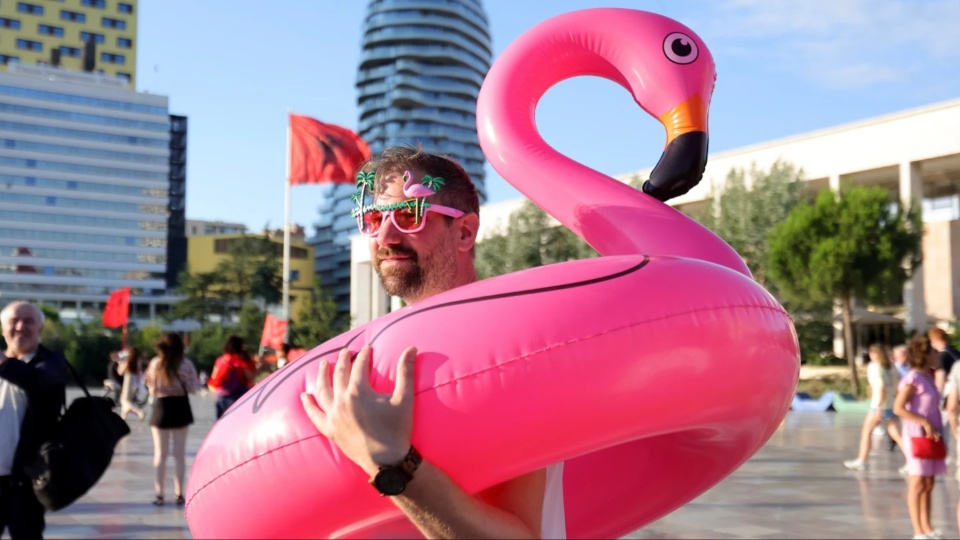
They’re still going strong over two months later. Protesters have carried inflatable pink flamingos and waved a version of the Albanian flag with the black eagle replaced by the wetland bird. Water cannon and tear gas have been the government’s response on multiple occasions, along with criminal charges against protest organizers.
The pressure hasn’t come only from the street, though. Trump Island’s developers have been leaning on Rama’s government to remove any regulations that might slow down construction, demanding changes to Albania’s Law on Protected Areas as well as designation of the resort as a “Strategic Investment” project. Those moves have prompted the European Union to intervene. In June, the European Commission warned that the project could jeopardize Albania’s bid to join the EU because Kushner’s construction work may violate European environmental standards.
Albanian Environment Minister Sofjan Jaupaj has tried to keep the EU satisfied, though with some reluctance. He’s promised construction is paused pending an environmental review with “civil society input.” Jaupaj stopped answering reporters’ questions, however, and the prime minister has continued to defend the deal publicly.
Rama also dismissed the ongoing uprising as a foreign-orchestrated “hybrid war,” a framing that lets him avoid acknowledging that there’s a homegrown revolt against his government. He calls the Kushner project a “vote of confidence” from international capital, but demonstrators see it simply as a government-backed sell-off of a national park to Trump family.
What makes the Flamingo Revolution remarkable is who is in it. Environmentalists and leftists built the early organizing muscle, but the crowds have pulled in LGBTQ activists, feminist collectives, clergy, and plenty of people who would never call themselves progressive. Gen Z, raised watching a third of the country’s population pack up for Germany, Italy, Britain, and beyond, has supplied the movement’s energy and its symbols.
Faith in neither party
Crucially, the crowds have refused to let the opposition Democratic Party, led by the equally scandal-scarred Sali Berisha, present itself as the answer. “Rama in prison, Berisha in prison” is now a standard chant. Berisha, who’s previously been both president and prime minister, is blamed for overseeing the country’s post-socialist impoverishment.

Albanians, it seems, are increasingly done choosing between the two mainline parties. They’re no longer confident in the current ruling circle surrounding Rama, which traded much of its socialist program for privatization deals and foreign investment contracts. And they want nothing to do with the Democrats, who’ve never pretended to have a program for working people. Both parties, the public has concluded, answer to the same investor class.
There is a lesson here that reaches well beyond the Balkans. Trump’s family has spent his second term converting the machinery of the presidency into a global real estate brokerage, using access and leverage to extract concessions that would draw scrutiny anywhere with a functioning press or an independent judiciary. Albania, still negotiating its way toward EU membership and still governed by laws that let “strategic investors” bypass ordinary environmental review, was an easy target—or so the Trumps and Kushners thought.
The Albanian people have decided otherwise. The working class and peoples of other countries would do well to study their response.
We hope you appreciated this article. At People’s World, we believe news and information should be free and accessible to all, but we need your help. Our journalism is free of corporate influence and paywalls because we are totally reader-supported. Only you, our readers and supporters, make this possible. If you enjoy reading People’s World and the stories we bring you, please support our work by donating or becoming a monthly sustainer today. Thank you!
CONTRIBUTOR