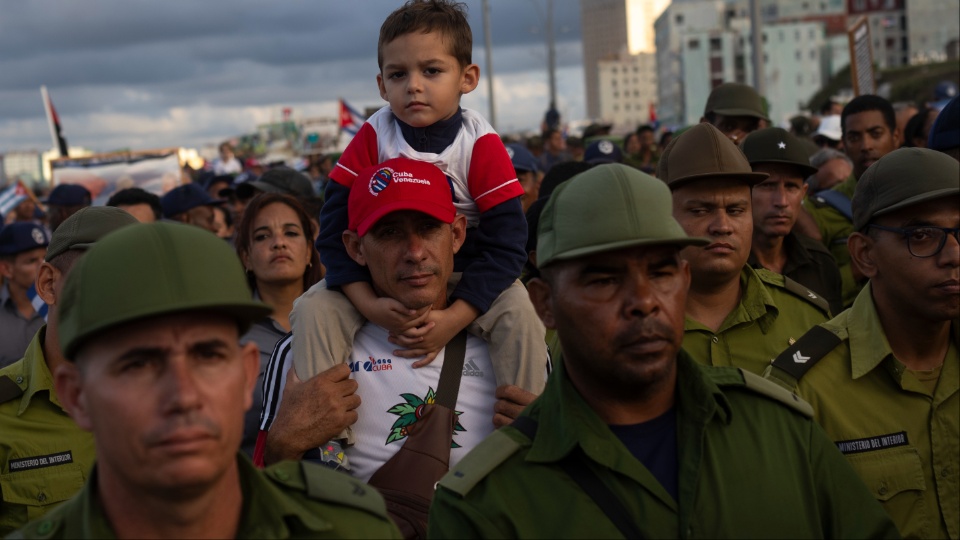
HAVANA—As the Trump administration tightens its energy blockade on Cuba and threatens war and regime change, the Cuban labor movement—along with all of Cuban society—is gearing up for a mass mobilization on May 1. The Workers’ Central Union of Cuba (CTC) and its affiliates have issued a call for this year’s May Day, International Workers’ Day, to “defend the homeland.”
Their labor movement’s call comes at a moment of maximum pressure. On Jan. 29, the White House imposed a total oil blockade on Cuba, cutting off nearly all fuel supplies to the island of 11 million people. Countries that dare to send oil face extreme sanctions. Combined with the intensified economic, commercial, and financial blockade that has suffocated Cuba for more than 65 years, the new measures aim to starve the Revolution into submission.
Now, the U.S.’ economic war is also poised to possibly become a fighting war. On April 15, USA Today reported that the Pentagon is speeding up plans for a potential U.S. military operation against Cuba, awaiting a directive from President Donald Trump as to when they might strike. The threat comes amid recent statements by Trump that “Cuba is next” after Iran and that he will “take” the island.
Cuban workers are not backing down
“Faced with the growing threats from the U.S. government, reinforced by the executive order of Jan. 29, which added an energy blockade to the already intensified embargo that has been imposed on us for more than 65 years simply for wanting to build a dignified, sovereign, and independent nation, there is nothing more important and decisive today than to work together and grow as a country,” the CTC declared in their May Day call.
The labor federation urged workers to celebrate May Day in militant parades and events in every workplace, town, municipality, and province.
“It is a call to defend the country, from the fields, the factories, the classrooms, the scientific centers, thermoelectric plants, hospitals, culture, sports; from every battle trench.”
‘We have not collapsed’
Cuba is facing its worst energy crisis in decades. Before the energy blockade, the country consumed about 110,000 barrels of oil per day, with 40,000 produced domestically and the rest imported from partners like Venezuela, Mexico, and Russia. Since January, that supply has virtually dried up. Only one Russian tanker has reached Cuban ports in three months, covering barely a third of monthly fuel demand.
The result is devastating, with major cities at a standstill, industry paralyzed, food becoming scarce, and hospitals struggling. Power blackouts have now become routine. Yet the Cuban people, their government, and the Communist Party refuse to break.

In an extensive interview with NBC’s Kristen Welker, President Miguel Díaz-Canel rejected the narrative of collapse.
“What country in the world would be capable, as Cuba has done, of enduring 67 years of sustained aggression from the most powerful nation in the world, with more than 60 years of blockade, with the last six or seven years of an intensified blockade, and now with an energy blockade, and not collapse? We have not collapsed.”
Díaz-Canel pointed to Cuba’s universal healthcare, free education from primary school to university, advances in biotechnology, and a safe society free of drug trafficking and organized crime.
“They are trying to impose a narrative of collapse on us when, through an aggressive, genocidal policy of blockade, they are leading us to live through a complex situation.”
Prepared to defend the revolution
When asked if Cuba is actively preparing for a possible U.S. attack, Díaz-Canel was direct: “Yes, we are preparing for defense.”
He recalled the words of 19th-century independence hero Antonio Maceo: “He will only gather the dust of his blood-soaked soil if he does not perish in the struggle.” Díaz-Canel added, “If you go out on the street now and say the first part of that phrase to a child, an elderly person, a young Cuban, they will immediately complete it. That is how we have been raised.”
Díaz-Canel also dismissed any notion that removing him, which the Trump administration and particularly Secretary of State Marco Rubio demand, would break the revolution.
“We have a collective leadership characterized by unity, cohesion, ideological unity, and revolutionary discipline. Removing one person solves nothing. There are hundreds of people capable of assuming that responsibility.
“The United States cannot impose change on us, nor can they demand it. The U.S. government has no moral authority to demand anything from Cuba.”
The Trump administration’s objectives remain murky. While Rubio — himself the son of Cuban migrants — has signaled a desire for regime change, the White House may be pursuing a more “pragmatic” goal: forced economic “liberalization” that benefits U.S. monopolies and billionaires.
According to reports, Washington seeks access to Cuba’s energy, ports, tourism, and telecom sectors, along with larger private enterprise, banking opening, and dismantling of state-owned enterprises.
‘Hands off Cuba!’
International solidarity with Cuba, a principle of working-class internationalism, continues to grow. The World Federation of Trade Unions’ (WFTU) week of action in solidarity with Cuba just concluded, and the international labor federation will continue to organize and mobilize its affiliates and members to stand in solidarity with Cuban workers.
Countries such as Mexico, Russia, China, Vietnam, and Spain have also expressed support for Cuba. More than 100 activists, trade unionists, and even European Parliament members recently arrived in Havana with half-a-million euros in humanitarian aid.
The Communist Party USA has also weighed in, demanding an immediate end to the criminal blockade and Cuba’s removal from the “State Sponsors of Terrorism” list. In the party’s May Day call, it declared: “Hands off Cuba! No war on Iran! Cut the military budget! End the forever wars! U.S. imperialism must be defeated!
“The same monopolies that drive down our wages and bust our unions operate internationally,” the party said. “They consciously pit workers of different countries against each other, including in wars, to maximize profits. Our resistance must reflect international solidarity.”
May Day as resistance
For this May Day, the CTC is invoking the legacy of independence hero José Martí, revolutionary leader Fidel Castro in his centennial year, and Army General Raúl Castro.
“We invite Cuba’s friends around the world to join us, as they do every year, in celebrating International Workers’ Day,” the CTC said.
“We thank them in advance for their solidarity and for having the courage to share our fate amidst a real military threat, which, far from intimidating us, makes us repeat, with optimism and confidence in victory, the glorious verse of our national anthem: ‘To die for the Fatherland is to live.’”
Díaz-Canel echoed that: “If the time comes, there will be a fight, there will be a battle. We will defend ourselves, and if we must die, we will die.”
But he also held out hope for dialogue. “What both the American and Cuban people deserve is peace—a peace that allows us to have an atmosphere of trust, cooperation, collaboration, solidarity, and understanding. Lift the embargo, and see what we can do.”
As May Day approaches, Cuban workers are preparing to march—not in desperation, but in determination. The homeland, they insist, will be defended.
People’s World is in the midst of its annual fund drive, trying to raise $140,000 by May Day. To support working-class journalism, please consider make a donation or become a monthly sustainer. Thank you.
CONTRIBUTOR