

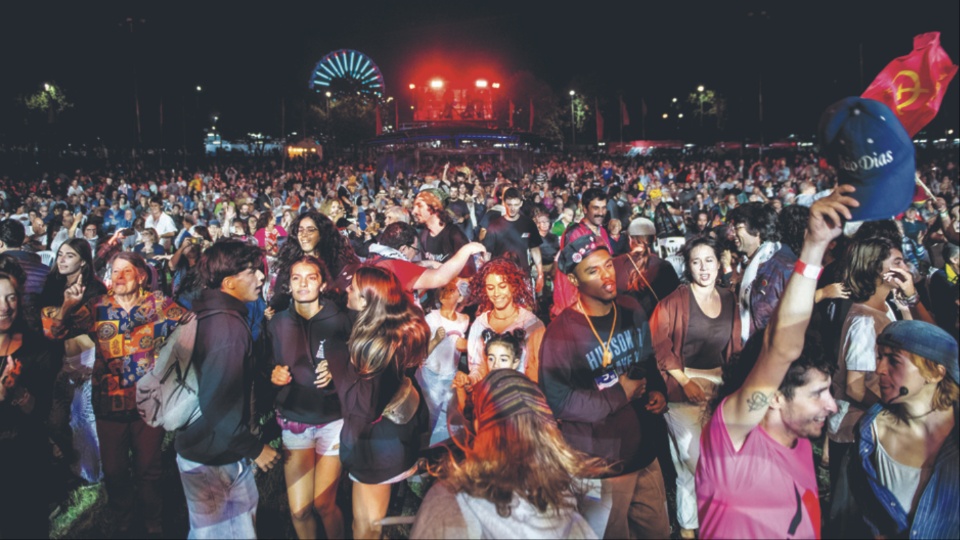
SEIXAL, Portugal—Hundreds of thousands of Communists, workers, youth, and their allies joined the 50th anniversary of the Avante! Festival (Festa do Avante!) from Sept. 4 to 6 in Seixal, Portugal, a suburb just outside the capital, Lisbon.
The event is named for Avante!, or Forward! in English, the newspaper of the Portuguese Communist Party, which organizes the massive gathering.
Held annually, the festival celebrates Portugal’s struggle for democracy after the 1974 Carnation Revolution, a bloodless coup orchestrated by left- and Communist-aligned sections of the Portuguese military. It brought an end to the fascist Estado Novo regime, which ruled the country through terrorism and political repression for over 40 years.
While imprisoning and torturing thousands of Communists domestically, the Estado Novo’s violence was most extensive in territories subject to Portuguese colonization. Powerful anti-colonial movements organized in Guinea-Bissau, Cabo Verde, Angola, Mozambique, Timor-Leste, and elsewhere in the Portuguese empire began waging struggles for independence in the 1960s. By the time of the revolution, the Estado Novo had murdered hundreds of thousands of people, mostly civilians.
The Carnation Revolution, named for the carnations placed in soldiers’ guns as a symbol of peace, ended the colonial wars against liberation movements and brought a return to democracy—only this time with workers taking the lead. Through an unstable transitional period marked by strikes, mass agitation, and counter-revolutionary conspiracies, Portugal elected a constituent assembly with a substantial Communist presence that gave rise to the progressive 1976 Constitution, now celebrated every year at the festival.
A celebration of progress
The festival organizes and anchors a tremendous range of cultural events, with a program spanning literature, art galleries, theater, cinema, sciences, political debates, dance, and music. Small crowds formed around drum troops in thoroughfares while symphony orchestras and rock bands drew thousands, their performances punctuated by slogans such as “25 de abril sempre, fascismo nunca mais” (“April 25th forever; fascism never again”).

Branches of the Communist Party in Lisbon operate large stalls with food, information, and merchandise, while the regional sections of the PCP outside of the city operate their own booths representing the economy and culture of the country’s districts. Regional staple foods are served next to artistic exhibits and murals bearing regional demands: for universal public transportation, against the privatization of national parks, and for food sovereignty, among others.
As one member of the Juventude Comunista Portuguesa (JCP), the party’s youth league, explained, the presentation of food is also political, whether reflecting culinary traditions drawn from ethnic and religious repression or from the country’s ongoing struggle for food sovereignty.
The European Union (EU) imposes economic measures that privilege production of specific goods by country, bringing the Portuguese agricultural sector (as well as its immense strides in land reform and collectivization) from a state of self-sufficiency into dependency on imported goods. As these costs have come down on the rural working class, Portugal’s largest cities and most popular tourist destinations have confronted housing speculation and informalization of the economy.
The forced deindustrialization of the country has been paired with increases in freedom of movement for EU citizens, shifting the entire economy toward tourism and pushing wider sections of the working class out of their historic neighborhoods and into the hospitality industry and contingent labor.
Political unity against the far-right
Not all attendees are directly affiliated with the PCP, but the party’s message of popular defense of the civil freedoms enshrined in the constitution by the 1974 revolution draws crowds from many elements of left and progressive movements in the country. Plus, young people from all backgrounds flock in for the hit parade of music acts that fill the schedule every day and evening of the festival.
Murals displaying pieces of the Portuguese constitution decorated stalls and walkways throughout the festival. Whether in the Young Pioneers area or the international section, the defense of legal rights of working people was the primary cultural current throughout.
As the political right has taken up a legal struggle to erode or reinterpret elements of the constitution, the PCP reminds festival attendees that the fight for civil freedoms is a continual process that must grapple with new political and economic realities as they arise.
One JCP member compared Article 73 of the constitution, which guarantees that scientific innovations will advance in the spirit of collective benefit and democracy, with the real difficulties transgender Portuguese citizens face in seeking gender-affirming care. They emphasized the dangers posed by sectarian forces tactically aligning with the far-right to challenge elements of the constitution while failing to defend the democratic rights it promises.
The festival this year took place amidst the political ascendancy of Chega (Enough!), Portugal’s far-right and MAGA-esque party. Signs featuring Chega slogans promising a “clean” Portugal now blanket Lisbon, covering thousands of streetlight poles with the face of the party’s leader.

Many years of alternating governance split between Portugal’s Socialist Party (PS) and Social Democratic Party (PSD) has left those parties stagnant and unable to mediate the relationships between labor and both small and large capital interests. Because of this, finance capital has been given more maneuverability—exerting influence both inside and outside the PS and PSD, and mediating a transition of power into the hands of the far-right.
Despite this, the PCP has stood as a stalwart defender of the constitution, peace, and progress. This was on full display during this past year’s two general strikes in December and June, led by the General Confederation of Portuguese Workers (CGTP-IN) that defeated the government’s proposed labor package and awakened a new level of consciousness in the Portuguese people regarding the true intentions of the far-right.
Palestinian solidarity was a major theme of the event, with representatives of the Palestine Liberation Organization tabling in the international delegate section, Palestinian artists performing in the music lineup, and Palestinian flags decorating many official displays or being flown by attendees.
Internationalist to the core
As the festival closed out on Sunday evening, tens of thousands of party members and attendees took up the flags of the PCP and JCP and filled the plaza in front of the main stage. Chants of “P-C-P!” and “Cuba vencerá!” [“Cuba will win!”] took the crowd by storm.
Children and elders alike took their seats for speeches by PCP leaders, including General Secretary Paulo Raimundo, who reaffirmed the party’s support for the international movement in defense of Palestine, saying: “The solidarity lacking from governments bent to the U.S. and Israel, as exemplified by the [PS/PSD] government that stubbornly refuses to recognize the state of Palestine, comes to you from the people who take to the street worldwide—and Portugal is no exception!”
The closing address also included a video presentation by Cuban President Miguel Díaz-Canel. Saluting the PCP for its struggle in defense of Cuba’s sovereignty, Díaz-Canel expressed the solidarity of the Communist Party of Cuba. “What the imperialists cannot forgive us for,” he said, “is the dignity, the courage, the ideological commitment, spirit of sacrifice, and revolutionary spirit of the Cuban people. Long live our Communist Parties!”
By the end of the speeches, the crowd was electric with anticipation of the festival’s final moments: renditions of “The Internationale,” “Avante, Camarada!” and the “Carvalhesa,” anthem of the festival movement. Where international working-class unity had been the message in speech, it was brought to life again in dance with tens of thousands of comrades bearing Communist flags from all corners of the planet, and with carnations in hands and minds.
We hope you appreciated this article. At People’s World, we believe news and information should be free and accessible to all, but we need your help. Our journalism is free of corporate influence and paywalls because we are totally reader-supported. Only you, our readers and supporters, make this possible. If you enjoy reading People’s World and the stories we bring you, please support our work by donating or becoming a monthly sustainer today. Thank you!
CONTRIBUTOR


MOST POPULAR TODAY

Warnings sound: Trump ready to stage what amounts to a full-fledged coup
Workers walk: Almost 100K California employees struck for a day

Redistricting leader Louise Lucas indicted as Trump’s revenge campaign widens

NEA, AFT, SEIU join Colorado to fight discrimination against LGBTQ people
The question of violence: Protests in France, riot or rebellion?