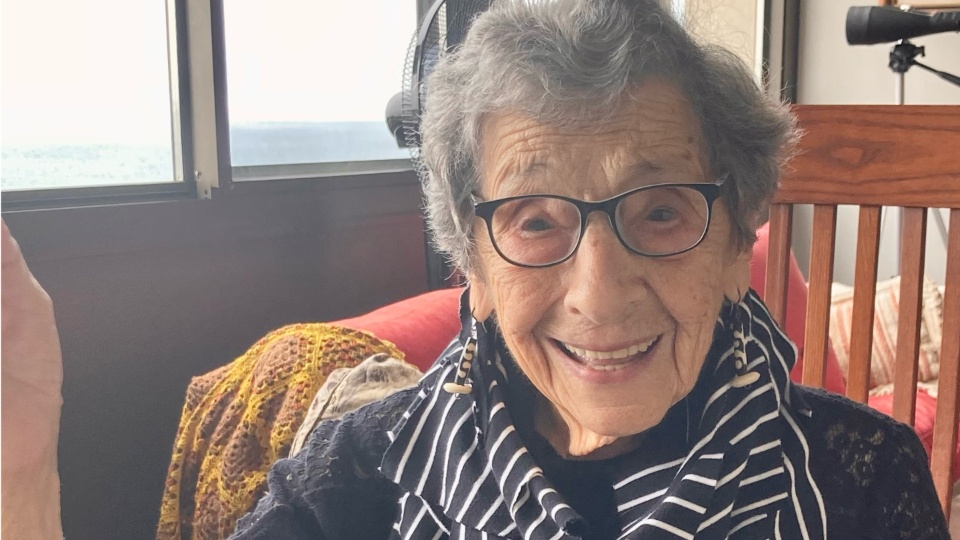
My newest best friend was a sparkplug, firing for worker justice. Among her first memories was on the playground at age six, arguing with another girl about the moral excellence of communism.
A teacher, an author, a professor, yet Bea didn’t rely on her powerful analytical skills alone to win socialism; she organized. One week into a job at a radio parts factory, at age 14, Bea walked to the union hall at lunch with her first paycheck to sign a card—with 50 of the 100 other workers at her worksite, all 14- to 16-year-old girls, in tow.
Her strategic wisdom, generosity of spirit, and eloquent advocacy have contributed to countless battles won and inspired generations of unionists, activists, and working people to stand for justice and be their best selves.
She had a great life, a good death, and she bequeaths us a liberatory and urgent legacy. Her legacy is to set us in motion to win a better world. So, to help you on your way, here are a few inspirations and wisdoms I learned from Bea.
Ending racism sets us all free
In honoring Bea, we must at the same time honor her lifelong partner and fellow lion of the labor movement, Frank Lumpkin. Bea fell in love with Frank’s family of Black, southern communists before she met Frank. Her heart and her head aligned, a prism, many-colored and bright.
Bea taught me that the fight for racial justice must be at the center of any successful fight for working-class emancipation. The imperative for racial unity in the fight for justice was the pole of Bea’s moral compass. Racism is an essential pillar of capitalism, and capitalism won’t fall until racism does. So, the task of uniting workers in an inter-racial, inter-generational, multi-gendered coalition was her and Frank’s life’s work.
Frank Lumpkin was called “the Saint of Chicago” by leading newspaper columnists for founding and leading the Save Our Jobs Committee on a 17-year campaign after Wisconsin Steel maneuvered in bankruptcy to defraud Frank and 3,000 other workers of their pensions. Even their last checks bounced.
Yet with Bea organizing at his side and never accepting pay for the work or even reimbursement for expenses, Frank kept the displaced Black, white, and Latino workers united, which was the key to their eventually winning tens of millions for the workers.
Always bring a crowd
That was the title of Bea’s biography of Frank, and she practiced that advice daily, especially in her labor organizing. Bea was amongst the most prescient strategic thinkers in the Chicago Teachers Union (CTU), as a member for 50 years and a delegate for 15.
Her legacy of militant organizing for worker power also resounds in the Illinois Federation of Teachers, the American Federation of Teachers, the Congress of Industrial Organizations (organizer), the Cook County College Teachers Union, United Electrical Workers, the Coalition of Labor Union Women (founder), United Steelworkers, Steelworkers Organization of Active Retirees (SOAR), the Chicago Federation of Labor (delegate), the Illinois Association of Retired Americans, and most recently in CTU’s Climate Justice Committee and Intergen, an initiative to build progressive, intergenerational power across racial lines.
Build a united front
Bea knew that labor must lead in the fight to defeat the rising threat of fascism today. But we need a grand coalition against such powerful forces, and labor is strategically positioned to assemble that coalition.
So, we need women’s rights groups, like the Coalition of Labor Union Women, of which Bea was a founder, as was Frank. We need to join or form Environmental Justice organizations, as Bea did, founding the CTU’s Climate Justice Committee. We need a multi-generational movement, the kind that Bea has cultivated for years through Intergen, which she also founded.
In a fight as existential as this, we need to build the maximum power possible. Employing a lesson from the fight against fascism in World War II, during which she also organized, Bea was clear that we may need strategic partnerships with organizations with which we differ radically on other issues, even those elements of the ruling class which are opposed to fascism.
Cultivate your loves
We should all enjoy a taste of that better world at home. Bea delighted in her children, Carl, Jeanleah, Paul, John and her generations of grandkids, including her grandson Soren, a fellow teacher, CTU activist, and companion.
For Bea, that home might be a camping trip from Paris to Moscow in 1965 or a Vietnamese restaurant, or a picket line. Her bonhomie knew no bounds. In her profound generosity of spirit, many comrades and friends also became family for Bea.
That communism was a fundamental act of love for Bea and Frank is clear from the story of their falling in love:
“I don’t know what Frank saw in me. But slowly, I fell in love. He had an unexpected strain of poetry that drew me to his side. When he first stroked my face, he said, “There are so many beautiful faces.” Had he told me that I was beautiful, I would have paid little attention. That’s what all men say at a moment like that. I was moved by the way he put it; we were part of a world of beautiful faces.”
Joy in the struggle
That was the title of her autobiography, not because she enjoyed fighting, but because she knew in her bones that a better world is possible, with actions. Because we are connected to that better world as we bring it to be, as together our labor builds it, as together we struggle to make it possible, as we manifest it together through solidarity.
On a trip to Cuba in 2001, Bea and Frank visited something of an outpost of the better world at a steel plant. Imagine you worked at a factory where you could bring your kids in the summer and which organizes trips and activities for them, with beaches and cabins available to you.
Imagine free medical and dental clinics there and a cultural center with theater, gyms, basketball courts, and a professional quality baseball field. Add air-conditioned dining rooms, a special bus service for pennies, a barber shop, and you can even bring your dirty clothes from home for the free laundry.
The fact that you do not work in a factory like this is not an accident of history, but the result of deliberate choices made by ruling classes, decisions that can and must be unmade by workers taking power for themselves, and we must start with worksites, sites of production—hence unions are key.
“Our immortality, Frank and I believed, is in helping new life flourish,” Bea wrote in Joy in the Struggle. Bea taught me that when we live our lives so that all may be free, we live forever when it happens. Joy in the struggle is as much about the pleasure of comradeship as it is a way of devouring immortality by anticipation. When we stand together against injustice, we are realizing the best in everyone.
Be tenacious!
Fifteen months before she passed, I offered to give Bea a ride home from a CTU House of Delegates meeting. She said, “Thanks, because my heat and power are out.” I was nervous as we drove to her condo, since she was 106 years old and lived on the 23rd floor. When we pulled up, the heat and power had been restored. I offered to ride up on the elevator with her. She said, “Nah, I’m gonna take the stairs. I do most nights.”
I asked her how she does it. She said, “Oh, it’s easy. You just start, and you don’t stop.”
That tenacity combined with hope and crowned with liberation is perfectly illustrated in an anecdote from Joy in the Struggle, in which Bea and Frank jumped into a stream that flowed into a cave:
“The water was not deep, but the stream plunged into darkness. Only a tiny pin-point of light could be seen. It was far through the water, maybe a mile. Cautiously, I pulled myself through the water, towards the light. I was scared and there was no turning back.
“For a long time, I swam but the light was still tiny and faint. After a while, it got a little larger…. At last, I emerged from the cave into broad sunlight. A lot of people were swimming in the river, and I was no longer alone. My love was waiting for me on the river bank.”
See you in the stream.
See you on the stairs.
See you in the streets.
See you in that brighter world we will continue to build, with Bea Lumpkin, ¡Presente! 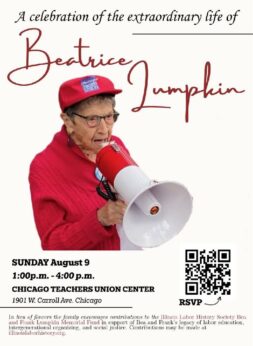
We hope you appreciated this article. At People’s World, we believe news and information should be free and accessible to all, but we need your help. Our journalism is free of corporate influence and paywalls because we are totally reader-supported. Only you, our readers and supporters, make this possible. If you enjoy reading People’s World and the stories we bring you, please support our work by donating or becoming a monthly sustainer today. Thank you!
CONTRIBUTOR