

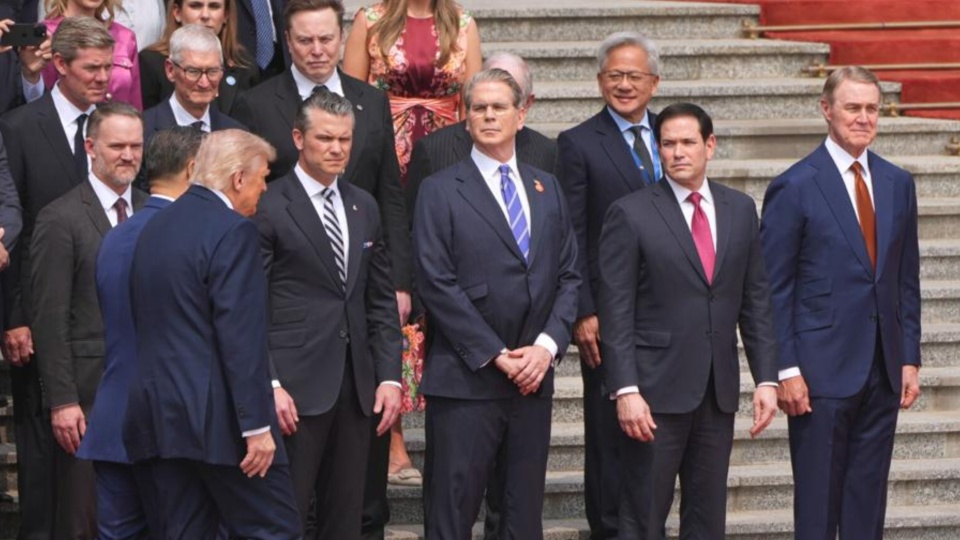
President Donald Trump’s long-awaited state visit to China took place on May 13-15 in Beijing at the invitation of President Xi Jinping and the Chinese central government. Trump traveled with a striking entourage of U.S. CEOs—a collection of capitalist billionaires including Elon Musk of Tesla, Tim Cook of Apple, and Kelly Ortburg of Boeing, among many others.
The president apparently wanted to show U.S. economic clout and facilitate big-time business deals. The overall tone of the event was positive, and the outcome indicated an extension of the tariff truce reached last fall, reducing tensions and adopting China’s proposal for “constructive strategic stability.”
A joint communique is common after such summit meetings, but this time, there was none, suggesting there may not have been much substantive change in the status quo of relations between the two powers. This was backed up by the fact that the official readouts from the two countries show marked differences.
What they said, and didn’t
While both touted the economic significance of the meetings, China emphasized Taiwan, which was left out of the U.S. statement. The U.S., on the other hand, said that China agreed with its position on the Iran war, but this was not mentioned in the Chinese summary.
There was agreement that U.S. investment will be welcome in China and that Chinese investment in U.S. industries is also desired. The actual implementation of the sentiments expressed in the official summaries remains to be seen; Trump’s changeable nature and impulsive decision-making are well known. A year ago, he was attacking China with huge tariff increases, while today he claims to want a decent relationship.

Xi’s remarks at the meeting focused on the long-term, strategic character of U.S.-China relations and their major impact on world affairs. He stressed that the two countries’ interests are complementary and that they should be natural partners: “cooperation first, competition second.” Relations need to be based on respect, peaceful coexistence, and mutual benefit. On this basis, he claimed, there will be many good, practical results.
Xi emphasized that proper handling of the Taiwan issue is most important from China’s perspective, its number one “red line.” U.S. support for Taiwan independence, such as Washington’s latest multi-billion-dollar arms deal, will create serious problems and could lead to conflict, the Chinese leader said.
Trump—hammered by inflation, the Iran War, and sagging poll numbers—badly needed the pomp and ceremony and media attention. He was effusive in the praise for his hosts and touted his personal relationship with Xi, whom he described as “very strong, a tremendous leader.” Together, he claimed they can solve many problems.
Trump came away concluding that China was a good place to make money and “a lot of good” resulted from the summit, which he characterized as a “big win” for the U.S. The CEOs gave a thumbs-up to the high-level meetings with Xi and Premier Li Qiang, without going into details.
Class considerations
Clearly, significant sectors of U.S. business continue to be committed to China when it comes to cutting deals in the socialist market economy, though many individual companies also seek protection from competition via tariffs and market restrictions on Chinese-made goods.
Some sections of the U.S. ruling class are skeptical of Trump’s latest turn towards China, however. The delegation makeup reflected the influence of the U.S. business community, the traditional core of the Republican Party. Some strategists of U.S. world domination and hegemony regard China as the main adversary, if not enemy, though. They seek less engagement with China, not more commerce.
For example, John Moolenaar, chair of the “U.S. House Select Committee on the Chinese Communist Party,” has warned of the dangers of doing business with China, recently berating Ford Motor Company for reliance on imported Chinese parts and equipment.
Moolenaar has been a leader in the effort to ban purchase of farmland by Chinese nationals; he actively discourages Chinese investment in U.S. industry as providing opportunities for espionage. He regards Chinese electric vehicles, increasingly popular throughout the world, as platforms for supposed communist surveillance.
The anti-China hawks and neoliberals worry that Trump will go “soft” on Taiwan in exchange for convenient or lucrative deals for those capitalist interests closest to him.
RELATED STORIES ON U.S.-CHINA RELATIONS
> The end of globalization? Trump’s tariff war and the battle for capitalism’s future
> Cold Peace with Russia / Cold War with China: Trump’s foreign policy agenda
> War of position vs. war of maneuver: China’s Gramscian trade strategy
The U.S. corporate media, as usual, frames situations from a Western-centric lens, projecting their own values. A common misconception is the “G2” idea promoted by Trump himself as well as mainstream media, that the U.S. and China are the two big powers in the world, the two countries that really count.
But Chinese foreign policy is based on a principle first stated by Mao Zedong: “Never seek hegemony.” China advocates multilateralism and what it calls the common future of all countries, which are linked together by the global environment, health, the need for economic security and peace, and now artificial intelligence.
China regularly champions the development of the Global South, arguing that every country should have an equal voice on the world stage, even though their situations and responsibilities may differ. China favors democratization of the UN Security Council and is a chief founder of multilateral organizations like BRICS and the New Development Bank, as well as the Belt and Road Initiative.
When it comes to U.S.-China relations, the Chinese leadership wants more tourism and people-to-people exchanges in science and technology, culture, and education, as well as stepped-up high-tech trade.
Compared to the business group on Trump’s first visit to China in 2017, the 2026 delegation took a sharp turn: Energy, traditional manufacturing, and agriculture have retreated, and technology and financial giants dominated. Issues have shifted from commodities and trade surpluses to chips, computing power, and capital access.

Commercial pressures caused by U.S. export controls have been unavoidable; chip giant Nvidia’s sales to China have hit zero in the last two quarters, explaining CEO Jensen Huang’s last-minute boarding of Air Force One to join the delegation.
In China, DeepSeek’s low-cost breakthroughs and Huawei’s Flex:AI revolution are sending the clear message that even if high-end chips are blocked, China will find its own path. American technology companies thus have urgent reasons to lobby for loosening the restrictive U.S. export controls so they can seize a short-lived business window.
As a result, deep differences between perceived national security interests and global profits for capitalist enterprises have been pushed to the front.
China may buy more soybeans, beef, and Boeing jets; the U.S. may loosen restrictions on certain high-tech sales and back off on some sanctions. But the immediate result of the summit is the optics of the two countries in dialogue, seeking better and more stable relations.
While the meeting appears to have been somewhat short on substance, the fact that it took place and there was no major negative fallout is seen by nations around the world as a hopeful sign for peace between the two big powers.
The authors are members of the Asia-Pacific Subcommittee of the CPUSA’s Peace and Solidarity Commission. The views expressed here are theirs and not necessarily of People’s World or the CPUSA.
We hope you appreciated this article. At People’s World, we believe news and information should be free and accessible to all, but we need your help. Our journalism is free of corporate influence and paywalls because we are totally reader-supported. Only you, our readers and supporters, make this possible. If you enjoy reading People’s World and the stories we bring you, please support our work by donating or becoming a monthly sustainer today. Thank you!
CONTRIBUTOR




MOST POPULAR TODAY
Credible sources say Trump readies to steal the midterm elections

Nobel Prize winner Satyarthi exposes and demands end to child labor

Rubio’s European tour met with protests as communists denounce US-NATO war plans

Sizzle Pie: Oregon pizza workers face firings and union-busting

Leonard Peltier, longest serving U.S. political prisoner, should be free