There’s an old saying among the ruling class: A worker in debt is a good worker. They don’t quit. They don’t strike. They don’t make trouble. They show up, they take what’s offered, and they say thank you. Even the authors of The Good Book knew it to be true: As Proverbs 22:7 put it, “The rich ruleth over the poor, and the borrower is slave to the lender.”
And for 43 million Americans carrying the weight of student loan debt—a collective burden now topping $1.69 trillion—the Holy Scripture has become official federal policy.
That’s because what the Trump administration has engineered over the past year and a half is not a student loan policy; it’s a system of social control dressed up in the language of fiscal responsibility and designed to keep people in a permanent state of financial anxiety.
Before we get to where we are today, though, it’s worth remembering where we were just a short time ago.
Stolen relief
When Joe Biden took office in 2021, tens of millions of student borrowers drowning under debt suddenly had a sliver of hope. His administration made a historic promise: up to $20,000 in relief for borrowers, with the most help going to Pell Grant recipients—students who needed loans most because their families had the least money to pay for college in the first place. Over $400 billion of education debt would have been wiped away.

In a 6-3 decision written by Chief Justice John Roberts, the Supreme Court’s right-wing majority killed it, deploying the “major questions doctrine”—a legal theory essentially invented to strip executive power whenever that power might benefit working people. Conservative justices said that erasing these loans was a “major question” with vast economic and political significance and, therefore, a president could not make policy on it.
Biden went back to the drawing board and crafted the SAVE plan, a sweeping income-driven repayment program that slashed monthly payments and fast-tracked loan forgiveness for low-income borrowers. Eight million people enrolled. Republican attorneys general, led by Missouri, sued immediately. Lower courts blocked the program, and the Supreme Court in August 2024 refused to revive it. Trump’s Education Department announced SAVE’s final death in December 2025.
The dream of relief was killed twice by a combination of Republican legal warfare and a court stacked with ideological allies of the interests that profit from keeping people in debt.
Trump turns the screws
If the Biden years were defined by the hope of relief and its systematic destruction, the Trump years have been defined by something far more aggressive: the open mobilization of government power against borrowers.
Since he returned to office, a student borrower has defaulted on a loan every nine seconds on average—an unprecedented default crisis three times worse than before the COVID-19 pandemic. More than five million student loan borrowers were in default as of the end of 2025; by March 2026, the number was nine million—around 25% of all borrowers.
The administration’s response was not to provide help for these borrowers; instead, it punished them. The Office of Federal Student Aid lost 653 employees—a nearly 42% decrease—leaving borrowers with fewer civil servants to turn to for help. And by gutting the independent Consumer Financial Protection Bureau, the administration also rendered the government’s main student loan watchdog powerless.

Trump signed new rules empowering Education Secretary Linda McMahon to kick workers out of the Public Service Loan Forgiveness program if their employers engage in activities deemed to have a “substantial illegal purpose”—a designation so vague it has drawn multiple lawsuits. The designation has essentially served as blanket label to cover any organizations that MAGA ideologues deem unacceptable. Teachers, nurses, and social workers who spent a decade making payments toward forgiveness now stand to lose those credits.
Then there was the One Big Beautiful Bill, signed July 4, 2025, which slashed repayment options and eliminated temporary tax relief for forgiven debt, meaning borrowers who receive forgiveness may now face crushing tax bills on the cancelled amount. Canceled debt ends up being counted as taxable income.
And with SAVE eliminated, millions of borrowers are being pushed toward just two options launching July 1, 2026: the new Repayment Assistance Plan (RAP), which sets monthly payments at up to 10% of a borrower’s gross income for up to 30 years, and a tiered standard plan with fixed payments over 10 to 25 years.
The Trump administration claims RAP is an improvement, but analysts and advocates are not convinced: Even the poorest borrowers must make payments regardless of whether they fall below the federal poverty line, and RAP carries lower income protections, higher payment percentages, and a longer road to forgiveness.
For anyone who doesn’t voluntarily choose RAP before the transition deadline, the Education Department says they will automatically be placed on the standard repayment plan—which will mean significantly higher monthly payments with no adjustment based on income whatsoever.
Debt shuffle
Perhaps the most consequential development is happening right now. The U.S. Treasury is set to take over responsibility for federal student loan operations in a three-phase transition that will eventually include management of most federal student loans as well as the student loan application process, the FAFSA, or Free Application for Federal Student Aid.
The administration frames this as a matter of financial competence. In reality, it’s part of the Project 2025 goal of completely decimating the Education Department. In a 2015 pilot, Treasury tried to collect payments from a sample of thousands of borrowers in default. Its success rate was lower than that of the private collection agencies contracted by the Education Department.
More importantly, unlike the Department of Education, the Treasury does not operate under the borrower-protective framework of the Higher Education Act of 1965—meaning the move could fundamentally strip borrowers of legal rights they don’t even know they have.
The NAACP Legal Defense Fund warns that “Treasury staff are not experts on the complex federal student loan system and cannot ensure that borrowers are able to access all of the tools and programs they are entitled to under the Higher Education Act. This action will inflict real harm on borrowers and will disproportionately burden Black borrowers, borrowers of color, and low-income borrowers.”

The group points to the fact that the student debt crisis does not fall equally on all shoulders. Among bachelor’s degree holders, Black students are the most likely to borrow federal loans, at 82.9%, and the burden compounds long after graduation. Four years after receiving their degrees, Black borrowers owe an average of $25,000 more than their white peers for the same degree, and 48% of Black student borrowers actually owe more than they initially borrowed— compared to just 17% of white borrowers.
When the Trump administration dismantles forgiveness programs and moves defaulted loans to a Treasury Department with no knowledge of or concern for borrower protections, there are clear class and racial aspects to the decision.
The maneuver is thus not simply a bureaucratic reshuffling. The goal is to strip borrowers of legal protections while moving the portfolio closer to the private financial interests that have been circling this debt like vultures for decades.
The nation’s biggest private student loan companies have been expanding their portfolios rapidly. SoFi’s 2024 lending portfolio stood at $3.8 billion, up from $2.2 billion in 2022. Sallie Mae’s stood at $7 billion, up from $6 billion. College Ave saw a 71% increase since 2022. Most lenders said the elimination of federal programs will continue to bolster their growth.
They are openly celebrating what the Trump administration has done. Sallie Mae’s leaders have said the One Big Beautiful Bill is likely to bring them billions in new business, and the company has entered a “strategic partnership” with KKR, one of the world’s largest private equity firms.
Meanwhile, the neutered CFPB quietly dropped an enforcement action against predatory student loan practices that included lying to borrowers in advertisements and contracts about their right to bankruptcy, sending harassing collection messages to borrowers who had already undergone bankruptcy proceedings, and telling borrowers that loans were not dischargeable—even while warning Wall Street investors that these same loans could, in fact, be discharged.
Debt as a weapon
Debt has always been one of capital’s most powerful instruments of control. A person in debt cannot afford to take risks. They can’t quit a bad job, start a business, or stand up to an abusive boss. They may not be able to buy a home, get a loan, or even afford their own kids’ college.
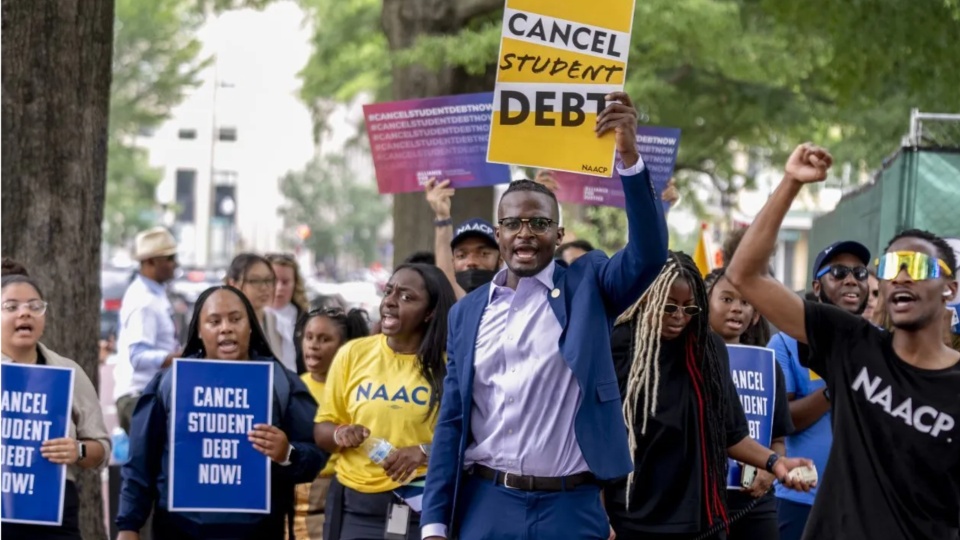
A coalition including Protect Borrowers, the American Federation of Teachers, the National Education Association, the NAACP, the Debt Collective, and Young Invincibles pushed back against the administration’s wage garnishment plans and won a temporary pause. The AFT sued over processing delays threatening borrowers with massive tax bills and forced the administration into a court-supervised agreement to protect them.
Over 70 lawmakers led by Rep. Ayanna Pressley and Sens. Elizabeth Warren and Bernie Sanders have urged the administration to abandon plans to privatize the student loan portfolio, warning it would “enrich the wealthy and well-connected at the expense of working-class borrowers and taxpayers.”
Grassroots organizations like the Debt Collective—a debtors’ union organized in the wake of the 2008 financial collapse—continue building power from the bottom up, reminding borrowers that a debt owed by millions is not a personal problem but rather a political one that demands government action.

The financial industry and its political allies understand that an indebted population is a controllable population. The movement fighting back—in the courts, in debtors’ assemblies, in the halls of Congress—understands it, too.
Tackling the doomsday of student debt in the long term, however, will require more than affordable payment plans or forgiveness schemes. None of this debt fell from the sky. It was accumulated thanks to decades of deliberate policy choices that shifted the cost of higher education from governments and institutions onto the backs of students and their families.
According to the National Center for Education Statistics, average tuition and fees at four-year public universities have more than tripled in inflation-adjusted dollars since the 1980s. The spiraling costs have been driven by state disinvestment in public universities and the explosion of administrative positions and salaries. Meanwhile, wages for young workers have failed to keep pace, turning what was once a manageable investment into a generational debt trap.
The loan industry didn’t create this crisis, but it has certainly fed on it, and the politicians now dismantling borrower protections have made sure it continues.
People’s World is in the midst of its annual fund drive, trying to raise $140,000 by May Day. To support working-class journalism, please consider make a donation or become a monthly sustainer. Thank you.
CONTRIBUTOR