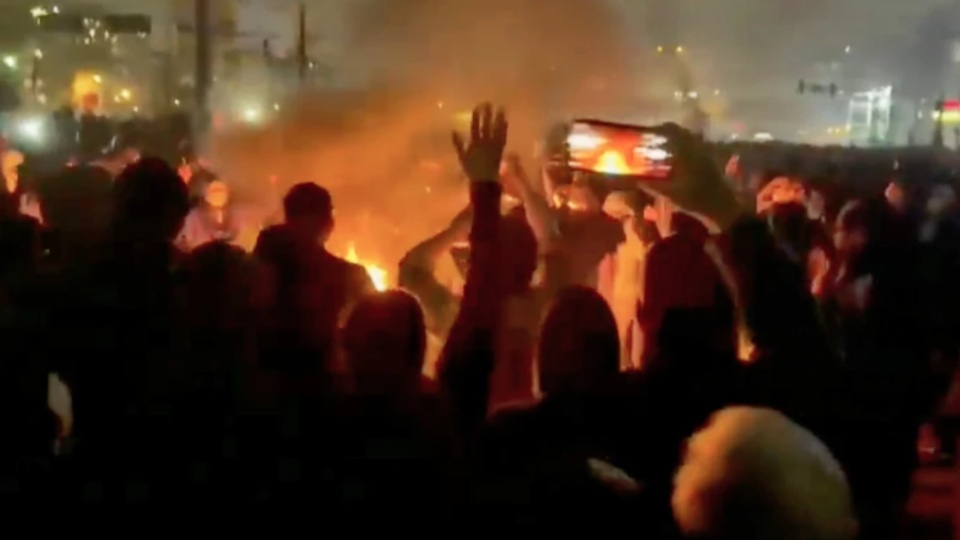
Lashing out with deadly violence, the theocratic regime that rules Iran has murdered, according to unverified numbers, at least several hundred demonstrators and possibly thousands in a desperate attempt to crush the mass popular uprising that’s rapidly spread across the country since mid-December.
The scale and lethality of Supreme Leader Ali Khamenei’s security forces’ response to protests is clear evidence, according to Iranian progressives, “that the overwhelming majority of the Iranian people do not want the continuation of the current corrupt and anti-popular government.”
That’s the assessment of the Tudeh Party of Iran—the organization of Iran’s Communists—which has been transmitting almost daily commentary on what’s happening in the country. It is rallying international support for the working-class struggle in Iran, asking for help in blocking U.S. and Israeli interference, and trying to break through the cloud of misinformation disseminated by the corporate media in the West.
Representatives of the party provided People’s World with extensive details concerning the roots of the current economic and political crisis in Iran as well as analysis of the maneuvering by outside forces hoping to control the country’s future.
“This government has destroyed the country’s productive economy,” the Tudeh Party says, “and through its adventurous foreign policies aimed at ‘exporting the Islamic revolution,’ has placed Iran increasingly at risk of foreign intervention and its catastrophic consequences.”
Imperial maneuvers
Looming over Iran’s domestic crisis is the danger of an attack by the U.S., Israel, or both. President Donald Trump announced that the U.S. military is “looking at some very strong options,” though he claimed leaders in Tehran contacted him “to negotiate.” He said the clerics who run the country “are tired of being beat up by the United States.”
A report from The Jerusalem Post, meanwhile, suggests that Israel “came close to striking Iran twice in recent weeks” but is closely coordinating any possibly action with the U.S. Former Israeli Military Intelligence Directorate chief Tamir Hayman told an Israeli radio station that even if bombs are not yet falling, there are already U.S. actions underway to shape events in Iran.
Hayman alleged that information and influence operations along with cyberattacks are active, pointing to a wave unverified reports, rumors, and videos supposedly emerging from Iran, suggesting they are part of a cyber-based influence effort to create confusion inside and outside the country.

The former Israeli intelligence boss didn’t rule out the possibility of “special operations” possibly akin to what the U.S. carried out in Venezuela “or even open war, depending on developments.”
While Washington and Tel Aviv are eager to manipulate events in Iran to their benefit, the Tudeh Party believes it’s important for the world to know that the uprising itself is not a foreign fabrication, like the “color revolutions” seen in other nations.
“Contrary to the claims of the ruling dictator, this popular protest movement is not a creation of U.S. imperialism or the genocidal Israeli regime,” the party says, “but rather the direct result of the disastrous economic policies of the ruling capitalist system and the widespread corruption, insecurity, and sweeping oppression imposed upon the country by the leaders of the regime and their collaborators.”
Brian Topping, a Marxist and editor of Iran Today, made the same point this weekend. He has previously argued that Israel and the U.S. hope for a subservient Iran that “offers no opposition to Israeli expansionism and where Iranian mineral wealth is expropriated by U.S. monopolies.”
And in the current demonstrations, Topping said, “U.S./Israeli manipulation cannot be overlooked,” however, “the economic and political crisis in Iran and the condition of the people are the fundamental cause behind the current situation.”
He emphasized Sunday that “strikes and demonstrations have been going on a long time, and the regime’s only response has been more state oppression.”
Capitalist catastrophe
The immediate trigger for the current wave of protests, according to analyst Steve Bishop of the Committee for Defence of Iranian People’s Rights (CODIR), was the catastrophic devaluation of the Iranian rial, the national currency, in December.
Coming after a wave of strikes and previous demonstrations, the collapse of the currency resulted, effectively, in a massive wage cut for Iranian workers and their families, who were already suffering from out-of-control inflation.
The December currency instability didn’t come out of nowhere, though. The re-imposition and tightening of U.S.-led international sanctions remains a primary driver of the country’s woes. The trade restrictions have crippled Iran’s ability to export its crude oil as well as blocked its access to the international financial system.
Last summer’s war with Israel also weighs on the economy in the form of capital flight. Investors and wealthy Iranians remain reluctant to invest due to fear of more bombings and are instead holding onto their assets or moving them out of the country.
But even more damaging, according to many economists and the Tudeh Party, are internal factors. The pursuit of free market, pro-privatization policies over the last few decades by the Islamic State destroyed jobs, slashed food subsidies, widened inequality, and concentrated wealth in the hands of elites connected to the military and religious authorities.
From 2022 onward, the administrations of President Ebrahim Raisi and his successors entrenched these policies further. Following an agenda they called “economic surgery,” leaders allowed the prices for basic goods like bread and medicine to soar.

Combined with sanctions and war, the capitalist program pursued by the state has resulted in catastrophe. With little oil money flowing in and access to foreign currency reserves frozen, the government has resorted to printing money to cover its massive budget deficits.
This has rocketed inflation toward 60%, destroying the purchasing power of the average working-class household and driving small businesses like those in Tehran’s bazaars—where the current protests started—into bankruptcy.
“By implementing neoliberal policies and a so-called ‘economic surgery,’ which was shock therapy, this regime has pushed tens of millions of Iranians below the poverty line and dragged the livelihoods of workers and other working people to such a dire condition,” the Tudeh Party says, “that their wages and incomes no longer cover even the basic necessities of life.”
Country at a crossroads
The protests have brought Iran to a crossroads. Agreeing with the recent statement by 17 prominent Iranian civil society figures, the Tudeh Party says the “only viable escape from this predicament is through the assertion of the people’s agency and their right to determine their own future.
“This path neither aligns with internal despots nor does it pass through war and dependence on foreign powers.” That means a rejection of both the ruling regime and opposition to outside interference by Israel, the U.S., or anyone else.
While the bullets of the Islamic Republic’s security apparatus are the most immediate threat to the protests, Tudeh says there are other serious challenges facing the uprising. There is no coherent progressive national leadership to guide the strategy and tactics of the protests, as the regime has disrupted or suppressed all independent political organizing.
Furthermore, the movement is being derailed by the extensive efforts of foreign governments and “imperialist media outlets” to lend a “hollow legitimacy” to the former U.S.-backed ruling family. Haaretz, for instance, reported months ago that Israeli intelligence has been funding the production of Persian-language deepfake videos aimed at building support for installing Reza Pahlavi—son of Shah Mohammad Reza Pahlavi, the last shah of Iran deposed in the 1979 revolution—as the monarch of a new Iranian puppet state.

Many Western broadcasters and publications, along with Elon Musk’s X platform, have been promoting Pahlavi as a spokesman of the protest movement in recent days, beaming out videos of him issuing directives to demonstrators from his home in Maryland. It’s a blatant attempt to hijack the uprising, the Tudeh Party says.
It accuses these same outlets of manipulating videos of protests in Iran, adding in audio and splicing footage “in an attempt to misleadingly portray the restoration of the monarchy as the core demand of this popular uprising.”
The party says that replacing the current theocratic-capitalist dictatorship with a re-run of the monarchical-capitalist dictatorship that ruled before 1979 would “once more turn Iran into a military base for imperialism in the region” and result in the plundering of Iran’s oil and other natural resources.
Confronting the brutality of the ruling dictatorship and the designs of U.S. and Israeli imperialism are the dual tasks of the uprising, according to Tudeh. It emphasizes that the success of the protest movement will depend on the extent to which there is a continued direct presence and participation of the working class in its ranks.
A broad front led by workers and including retirees, civil servants, intellectuals, and patriotic segments of the middle strata of society “are essential.” It also urges efforts to convince the members of the military and security forces to join the struggle against the regime.
Eventually, Tudeh says a general strike to cripple the Islamic Republic’s ability to rule any longer will be necessary, followed by a free and democratic referendum to determine the country’s future.
Getting to that point won’t be easy, though, as the massacres this weekend showed. The government has resorted to mass murder to save itself and has even broadcast videos of overflowing morgues on television as a warning to the people of Iran that it will shed as much blood as necessary to put down the rebellion.
Organizing is more difficult, as well, thanks to the total communications blackout imposed by the state. People’s World confirmed with several members of the Iranian diaspora in North America that they have been totally cut off from family and friends inside Iran for several days.
Looking back on Iran’s recent history, though, the Tudeh Party maintains its optimism. It warns Islamic Republic authorities to remember the example of the Pahlavi monarchy: “We have borne witness to countless examples of oppression, corruption and plunder—as well as the eventual fate of the regimes responsible.”
We hope you appreciated this article. At People’s World, we believe news and information should be free and accessible to all, but we need your help. Our journalism is free of corporate influence and paywalls because we are totally reader-supported. Only you, our readers and supporters, make this possible. If you enjoy reading People’s World and the stories we bring you, please support our work by donating or becoming a monthly sustainer today.
CONTRIBUTOR