DETROIT—“The artist must take sides,” famed singer, actor, and activist Paul Robeson proclaimed in 1937. “He must elect to fight for freedom or slavery. I have made my choice. I had no alternative.”
Robeson took his stand in a speech given in support of the People’s Front fighting against fascism in the Spanish Civil War, making clear the role of artists in the fight against suppressive regimes. Red Scare intimidation tactics and FBI harassment are often associated with Robeson, but more than that, his life was also defined by art, camaraderie, and a love for humanity. He believed steadfastly that artists must step up in the struggle for a better world.
“No alternative” means the fight for freedom and basic rights will never be obsolete under a system of exploitation, and Robeson’s remarks are still echoed today by workers and artists around the world—including in Detroit.
In the Motor City, the role of artists in that fight is intrinsically tied to labor’s revival, and the inaugural year of the Union Hall Arts residency is setting the standard for what workers can do through their unions and for what artists can do for a broader working-class movement.
Taking place from Aug. 10 through Sept. 7, this first year welcomed artists whose practices include writing, beat-making, painting, sculpture, film, printmaking, and more. Each resident is a member of a union, and each of their union contracts include an Organizing Education Clause—the key clause invoked by Union Hall Arts to enable members to take time away from work with pay covered by their respective unions.

Typically, this clause is used for the purposes of shop-floor organizing and union education, but with Union Hall Arts, a new approach to building leadership, confidence, and creativity among rank-and-file workers has been introduced.
The lead visionary of the program is Annemarie Strassel, a director with the Education and Support Fund (501c3) of UNITE HERE, the labor union representing more than 300,000 workers across Canada and the U.S. with a special focus on hospitality workers. Strassel says the idea for the residency program came from a conversation with her brother, and later she brought it to Wes Taylor of Talking Dolls Studio, based in Detroit.
From there, the seedling of an idea blossomed into a first-of-its-kind artist residency at the intersection of art and labor.
The goal of the residency is two-fold. First, it exemplifies how unions exist beyond the bargaining table; they are there to protect workers as people and nurture aspects of their lives outside a paycheck—creativity included. Second, the program is deeply rooted in the belief that the creativity of artists, their critical thinking, and their ability to imagine a better future are essential components of movements for progressive social change.
The residency’s premise:
“Unions keep us connected and keep us human, mobilizing worker power so that people can lead full, healthy lives with time to do the things we love. Culture is how people make life livable, creating joy in otherwise oppressive systems. Art is how we survive and thrive. We are making space to create again.”
Union Hall Arts has thus moved past bringing artists into the fold because artists are already in the fold—they are on the shop floor, at the assembly line, working on commercial generators, or maintaining hotel rooms. They are workers themselves, not people separate from the broader movement for working-class rights. What is needed, then, is to support them as artists to cultivate a working-class culture that can bring carry the struggle to a higher level—fighting for workers’ rights while also dismantling the oppressive systems that hold back worker empowerment.
Another component of these worker-artists’ role is to help carry out education around labor history, contemporary struggles, and organizing. Strassel says the program seeks to provide those things by grounding the residency in the traditions, histories, and values of the labor movement.

“Creating time for creativity is one piece of the residency experience, but another piece is community and a deeper understanding and connection with who we are as union members,” Strassel told People’s World, “which includes labor history, contemporary fights, and getting a better understanding of what work looks like in different industries.”
The residency would not have been possible without a team of facilitators who organized a plethora of programming and education alongside Strassel and Taylor. Each facilitator—Nour Arafat, Andrea Cardinal, and Heather Mawson—is an artist in Detroit who brought in their skills, connections, and mentorship to support the resident artists throughout the month. They organized everything from tours of the Walter P. Reuther Labor Archives and the Detroit Institute of Arts to workshops in printmaking, labor history, professional development, and more.

The significance of the residency taking place in Detroit does not go unnoticed. With a rich history of labor organizing, including being the birthplace of the United Auto Workers and the League of Revolutionary Black Workers (LRBW), Detroit is a bastion of not only the labor movement, but of working-class resilience generally.
One of the residents, Nevena Pilipović-Wengler, remarked that Detroit is “a city which connects community to labor, intrinsically tying them together,” such as in the case of the LRBW and the Arab Workers Caucus of the UAW.
Pilipović-Wengler is a member of UAWD—the Unite All Workers for Democracy caucus of the UAW. UAWD is the progressive arm of the union works to re-instill the rank-and-file voice into union decision-making and leadership. They have been responsible for successful campaigns like ending UAW investments in Israeli bonds and have advocated for a strike demanding the abolition of ICE, bringing the issue to debate on the floor of the union’s convention.
The seven artist residents of the 2026 cohort were:
Dexter Dixon – Musician, beatmaker, and member of UA Plumbers Local 98 (Detroit)
Miles Eason – Filmmaker and member of UAW Local 140 (Inkster, Mich.)
Jamie Hearn – Painter, multi-media artist, and member of UAW Local 276 (Arlington, Texas)
Ana Palacio – Painter and member of UNITE HERE Local 11 (Los Angeles)
Nevena Pilipović-Wengler – Printmaker and member of UAW Local 22 (Detroit)
Sammie Sprole – Creative writer and member of IBEW Local 429 (Goodlettsville, Tenn.)
Murphey Stromberg – Ceramicist and member of UNITE HERE Local 17 (Minneapolis)
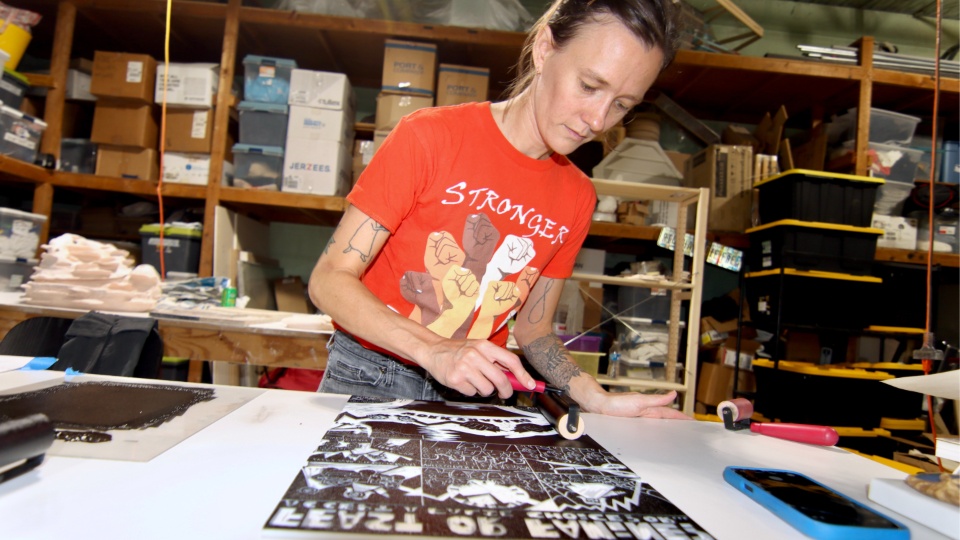
While the residency did not require artists to produce artwork that relates to labor, the influence and inspiration nonetheless took hold in different forms. Pilipović-Wengler produced her cycle of block prints, which she calls, “Feast or Famine?”, to highlight the exploitation and layoff of workers at the Detroit-Hamtramck EV plant.
Musician Dexter Dixon also found inspiration to incorporate the concepts he learned and the history of labor struggle into his art through experimentation with labor archives and beatmaking. One of the most impactful moments for him during the residency was being able to sit with Baba Charles Simmons, a longtime community organizer, writer, and professor emeritus of Journalism and Law at Eastern Michigan University. Baba Charles, as he is known, was at the forefront of the Black Liberation movement in Detroit and is a co-founder of Hush House.

Another resident, writer Sammie Sprole, is developing a novel in which she incorporates many of the struggles found in labor and the union movement. Sprole got a shoutout at Union Hall Art’s Labor Day celebration for the progress she made on her novel during the time of the residency.
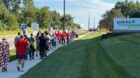
The celebration, which marked the end of the residency, brought together family and friends as well as an exhibition of the work each resident had completed during their time. At the Detroit Labor Day parade, the Union Hall cohort pulled up in a mobile gallery—a truck they transformed into a walk-in art exhibition to show their peers at the parade the variety of art that came out of the residency.
In many ways, this showcase was an argument for art’s role in the labor movement, thus bringing home the importance of supporting workers as creative beings and nurturing their artistic practice.
For Strassel, one of the most magical parts of the experience was witnessing “how many people came together throughout the program to support its mission and the artists who were brought forward.” The bridges built between cultural leaders, union leadership, and community organizers exemplify how art brings people together, driving a common spirit to imagine, preserve, and strengthen the movement for progressive change.
“Art can really unleash deeper feelings and dreams, get to something deeper about what life is all about, and what we want for ourselves and the people that we care about,” Strassel said. “That goes deeper than the traditional shop-floor contract demands.”
With a successful first year now complete, many are already looking forward to a continuation of the residency program in 2027.
No paywalls at People’s World
We hope you appreciated this article. At People’s World, we believe news and information should be free and accessible to all, but we need your help. Our journalism is free of corporate influence and paywalls because we are totally reader-supported. Only you, our readers and supporters, make this possible. If you enjoy reading People’s World and the stories we bring you, please support our work by donating or becoming a monthly sustainer today. Thank you!
CONTRIBUTOR