ROMULUS, Mich.—A couple of black unmarked SUVs sit watching us from a parking lot.
“These are ICE agents,” someone tells me, gesturing to the car. Pointing to one: “That’s an ICE agent.” Pointing to another: “That’s an ICE agent, they’re all federal employees, and they’re out here every week watching us.”
A protester shouts in their direction: “Get a real job!”
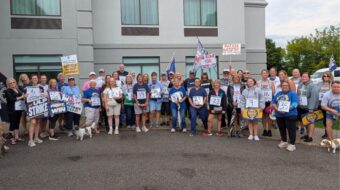
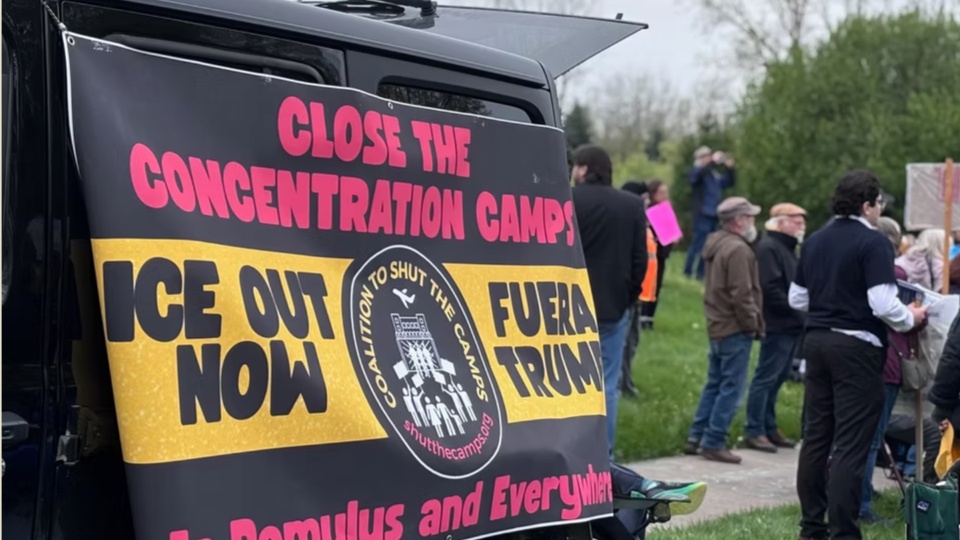
We’re standing next to a tan, nondescript building in Romulus, a small city just west of Detroit. People have been coming out here every Saturday for weeks to protest the site’s proposed use as an ICE detention facility.
As one of the organizers explains, they first started doing this after attending a Romulus city council protest, where they received a flyer for a mass meeting to talk about the possible center.
“A bunch of us showed up, no idea what we were there to do, we just knew that this warehouse had been bought by DHS, and we did not want it to be a detention center…. I’ve never done this kind of organized activism before, most of us haven’t.”
From that initial start, they formed the Coalition to Shut the Camps and have worked hard—not only to connect with groups all over the state but to come up with novel approaches to fighting this facility.

“One of the things that’s fundamentally different about our strategy is we’re not asking the federal government for anything,” says Chris Boyd, a coalition organizer who first began structuring some of the methods used.
“In order for a warehouse to be turned into a concentration camp,” he says, the local government has to approve all the permits and conversions needed, because “surprisingly, there are actually design standards for a concentration camp.”
He explains to us how they calculate the impacts of the facility: water, energy, sewage, medical needs. And from there, they can find the mismatch with what local infrastructure will support.
For example, the current facility has a sewer line that can accommodate 4 to 6 toilets, which was plenty for a warehouse, but in order to be able to accommodate all the sewage generated by the showers, toilets, and food processing for a prison, there would need to be major infrastructure upgrades.
“[These] are local decisions to say yes or no. Is that where we want to invest our infrastructure upgrade money? Well, no, that’s not where we want our money to go…. So, why would a local government use taxpayer dollars to facilitate that?”
The city and Michigan Attorney General Dana Nessel seem to agree. They’ve filed a federal lawsuit to block the building’s conversion. The suit argues that DHS and ICE ignored environmental requirements, failed to consider existing facilities, and violated local zoning ordinances.
As Nessel puts it: “The Romulus Warehouse is simply not, and never will be, an appropriate place for a large-scale detention center.”
But Boyd points out this kind of messaging ignores any connection to broader issues. “Some of the other resistance to detention camps doesn’t make the connections…. [They say] this is a non-partisan issue, this isn’t about Trump vs. not-Trump, this is just about the appropriateness of where you build concentration camps. So that’s fucking bullshit, there is no appropriate place for a concentration camp.”
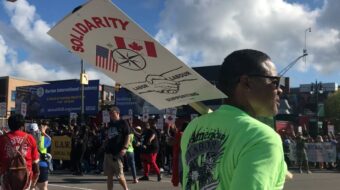
Avoiding this kind of narrow focus is one of the reasons the coalition has “Solidarity Saturdays,” where organizations in the coalition bring their members to the Romulus protest to educate one another about other aspects of the effort to combat ICE and support immigrants.
Past Saturdays have included groups that do incredibly practical interventions, like CAFE (Community Aid For Empowerment), a group that drives to the Baldwin detention center to bring people home who have been released. The goal in connecting with these groups is to try and build a better understanding of how the proposed center connects with the other issues of deportation and militarization.

On May 5, Melody Simmons, a lead organizer in the coalition, attended a city council meeting in Taylor to ask about some of those connections. She spoke during the open discussion period to question the council about how its prospective cooperation with ICE will negatively impact the community.
While she persistently asked Mayor Tim Woolley why he would work with ICE, he responded only by saying he would talk with her after the meeting. She was then forcibly removed from the session by three police officers. During our interview, she still had very visible, deep bruising on her arms.
As one protester put it: “It trickles down to everybody. Minneapolis was supposed to be about getting Somali immigrants…but really, they’re just going after anyone that doesn’t fit their racist agenda.”
We asked different people why they came out to protest. Some didn’t want higher property taxes, others didn’t want to see their neighbors taken away. But as one protester boiled it down:
“The deportations are illegal and violate the constitutional rights of people in our country. And they take the country in the wrong direction, you know? This country was built on the backbone of immigrants and if we want a future, we need to include all members of our community.”
We hope you appreciated this article. At People’s World, we believe news and information should be free and accessible to all, but we need your help. Our journalism is free of corporate influence and paywalls because we are totally reader-supported. Only you, our readers and supporters, make this possible. If you enjoy reading People’s World and the stories we bring you, please support our work by donating or becoming a monthly sustainer today. Thank you!
CONTRIBUTOR