WASHINGTON—Donald Trump’s ICE agents began with massive migrant sweeps. Then they started invading restaurants, dragooning people including U.S. citizens. Then came churches. Then came hospital ERs. Then came forcibly dragging people on their way to work from their cars. And then, eventually, in Minneapolis, Houston, Memphis and Boston, killings.
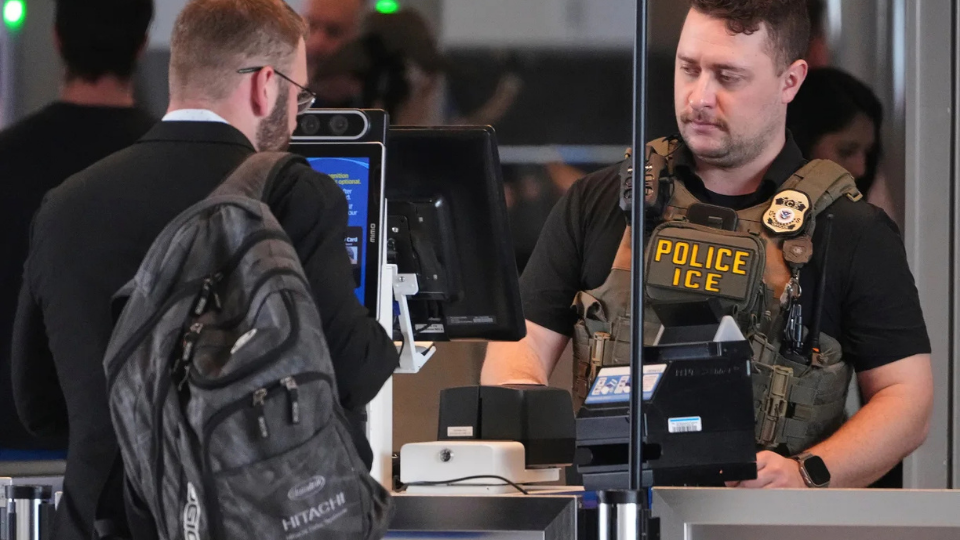
And now ICE is invading the nation’s airports, including passenger ticket lines and on jetways. About the only place they haven’t invaded yet is the planes themselves. And that’s on ICE’s list.
But ICE is putting pressure on airline personnel, and especially the workers who have direct contact with passengers, such as ticket agents and flight attendants, to cooperate. One big airline union, the Association of Flight Attendants-CWA, is saying “no.” Loudly.
The union published a detailed manual for its 50,000 members about what to do, and what not to do, when confronted by someone claiming to be a federal agent—especially if, like many of the agents who now sweep the streets of Democratic-run cities—the “agents” disguise themselves.
The advice, and the language, of the manual makes it clear that AFA-CWA trusts Trump’s ICE agents to follow the law about as far as a flight attendant can throw a fully loaded Boeing 747, i.e., not at all.
They’ve got a good reason for that mistrust. ICE has dragged people out of airport lines, held them for hours and released them only if they proved they’re citizens, and sometimes not even then.
Stories in the Atlanta Journal-Constitution, whose city is the headquarters of Delta—whose flight attendants are not unionized—the Los Angeles Times and Time magazine tell of ICE agents singling out passengers. ICE demands to see their papers, declares—falsely in at least one Atlanta case—the passenger overstayed a tourist visa or committed some other civil infraction, and hustles them off.
Unlike the sweeps on the streets of Chicago, Minneapolis and L.A., there’s been no ICE violence yet. And the AFA-CWA manual tells its members how to avoid that, using their de-escalation training.
The manual isn’t the first time unions have protested the presence of ICE rounding up people in U.S. airports. It’s just the most detailed description of what to do when faced with the equivalent of a raid.
In March, AFA-CWA, the Machinists, Teamsters Local 135 and the Association of Professional Flight Attendants—the independent union for Southwest Airlines flight attendants—banded together to denounce ICE intruding in airports.
Their statement, while in the context of yet another Trump-engineered federal shutdown, which forced the Transportation Security Officers (the screeners) to work without pay, also forecast the chaos that would ensue if ICE started arresting passengers.
“This latest threat of ICE invasion at the airports is another distraction from solutions that protect Americans,” the four unions said then. After describing the six-month training program for the TSOs, who learn how to “manage and evaluate risks within the unique context” of an airport, their statement stated: “This is expertise and training that ICE agents simply do not have, and cannot learn quickly.
“Furthermore, the introduction of ICE agents into airports creates contradictory missions, as attempts to question passengers about immigration status may distract them from ensuring airport security.”
In its manual for its members when confronted with ICE, “Guide for your rights in U.S. domestic airports,” AFA-CWA went much farther than that statement. The manual makes it clear that in these times of ICE invasions, entrapment outside courts, and its violence, Trump’s troops are not to be trusted. Many AFA-CWA warnings could apply to anyone’s encounter with ICE, and not just in airports.
“Federal agents generally need a warrant or consent in order to enter or search a non-public area like the jet bridge or aircraft,” while warning that ICE agents could “approach, detain, question or search” both aircrews and passengers, the guide begins. “This is a rapidly evolving area of law,” and flight attendants should contact the union in specific situations.
Among other advice it gives:
- “Law enforcement agents”—ICE or anyone else—must have proper ID and produce it before they can enter secure areas. If they want to enter restricted areas, such as jetways or planes, they need a warrant, or permission from the airline.
- You don’t have to turn over identification data, such as passenger manifests, to the ICE agents, again unless they have a warrant.
- If ICE quizzes you about passengers or co-workers, including their immigration status, “you have the right to remain silent” and should do so. If the agent insists on questioning you, you have the right to an attorney, just like anyone in a courtroom.
- If the agent demands to search you, refuse.
“Stating clearly you do not consent to a search preserves your legal position, even if a search ultimately happens. Under the Fourth Amendment” to the Constitution “in a domestic airport terminal, a law enforcement agent may not search your belongings or devices without your consent or probable cause unless the law enforcement agent reasonably believes” you’re armed or committed a crime.
The Fourth Amendment says “The right of the people to be secure in their persons, houses, papers and effects, shall not be violated” without “probable cause” backed by a warrant specifying who is to be searched, what is to be searched, and what specifically law enforcement—including ICE—seeks.
- Don’t sign anything you don’t understand.
- You should refuse agents’ orders to help them arrest passengers.
- Use de-escalation training to defuse confrontations.
“If you experience an immigration-related detainment or altercation, record the time, location, persons involved, and any other details carefully, and inform our union through the appropriate channels.”
- If you’re outside the “sterile areas” such as jetways, planes or security areas, you have the right to film the ICE agents’ actions. If the agent grabs your cellphone, demand a receipt. Don’t unlock the phone, but be aware ICE has the technology to do so and match it to your face ID.
- Don’t lie. If you don’t know the answer to an agent’s question, don’t answer it. Lies can hurt flight attendants legally later on.
We hope you appreciated this article. At People’s World, we believe news and information should be free and accessible to all, but we need your help. Our journalism is free of corporate influence and paywalls because we are totally reader-supported. Only you, our readers and supporters, make this possible. If you enjoy reading People’s World and the stories we bring you, please support our work by donating or becoming a monthly sustainer today. Thank you!
CONTRIBUTOR