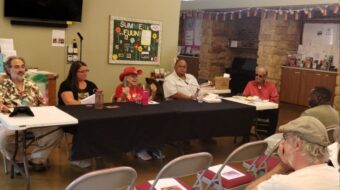
NASHVILLE—The month of October has seen a whirlwind of activity from the Indigenous community of Middle Tennessee. To begin with, on Saturday, Oct. 10, the Indigenous Peoples Coalition (IPC) held an Indigenous Peoples Day (IPD) celebration at the First Unitarian Universalist Church in Nashville. The theme of this year’s celebration was “What Indigenous Peoples Day means to me.” IPD was officially Monday, Oct. 12.
The IPC celebrated with a panel composed of Larry Davis, a community activist of Cherokee descent, Sabrina Buer, an educator who is Cherokee and Shawnee, and Melba Checote-Eads, an activist who is a member of the Muscogee Creek Nation.
Mournful reference must be made of Paulino Solorzano, who very recently passed away and who would have otherwise been a panelist in this years’ celebration.
Davis spoke of how IPD was a giant step forward for Indigenous people. Buer spoke of the positive effects of IPD on education. Checote-Eads spoke of the increasing sentiment for a change of name from “Indian” to “Indigenous” for Native people and also of a proclamation from the governor’s office recognizing Indigenous people.
It was remarked that this proclamation was surprising in light of a Republican administration in the state that is so close to President Donald Trump. Checote-Eads also recounted that the Muscogee Creek Nation had claimed two sites in Tennessee as being ancestral, one being the Fewkes Mound Archaeological Site in the Belmont section of the city and the other being in Chattanooga.
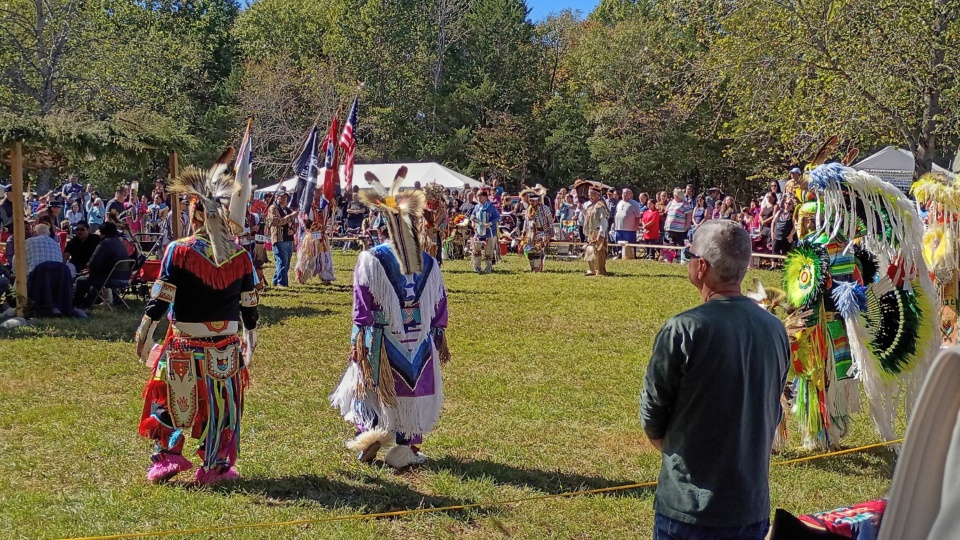
Next was the Native American Indian Association (NAIA) Powwow held the following weekend, Oct. 16-18, at Long Hunter State Park on the outskirts the city. This was the 45th Annual Tennessee Indian Educational Powwow and Fall Festival. Tennessee has a rich Indigenous history going back 14,000 years. The state’s name comes from the Cherokee language, referring to the name of an ancient Cherokee town in what is today eastern Tennessee.
“Tennessee does have a very strong Cherokee and Choctaw, Chickasaw, Creek influence,” said Andrea Walsh, Chippewa, Acting Vice President of NAIA.
As always, progressive state State Rep. Justin Jones visited the Powwow on Saturday and was warmly received by both attendees and participants.
It must also be noted that Mayor Freddie O’Connell proclaimed October Native American Indian Month in the city of Nashville.
A few words are in order about powwows. A powwow is a form of resistance, a form of resistance to centuries of racist colonial erasure, a way of maintaining culture and evoking sovereignty.
This Powwow started in 1982 with just 12 members and has grown to an annual three-day event attracting thousands over a weekend. It has become one of the largest powwows east of the Mississippi. It is always refreshing to see thousands from all nationalities and races gather to celebrate with Indigenous people from all over the U.S. and Canada.
Lastly, on Sunday, Oct. 18, there was a Trail of Tears commemoration walk in the Middle Tennessee city of Woodbury. This was a “prayer walk” led by Melba Checote-Eads of the Muscogee Creek Nation. It was dedicated to the remembrance of the 10,000 Cherokees and enslaved persons and 500 Muscogee Creeks who were marched through Woodbury in 1838-39.
No paywalls at People’s World
We hope you appreciated this article. At People’s World, we believe news and information should be free and accessible to all, but we need your help. Our journalism is free of corporate influence and paywalls because we are totally reader-supported. Only you, our readers and supporters, make this possible. If you enjoy reading People’s World and the stories we bring you, please support our work by donating or becoming a monthly sustainer today. Thank you!
CONTRIBUTOR