WASHINGTON—An expanded, improved, and strengthened Protect the Right to Organize (PRO) Act and raising the federal minimum wage for the first time since 2009 head the agenda of the AFL-CIO and the expanded Congressional Labor Caucus in the incoming pro-worker 120th Congress, which opens January 3.
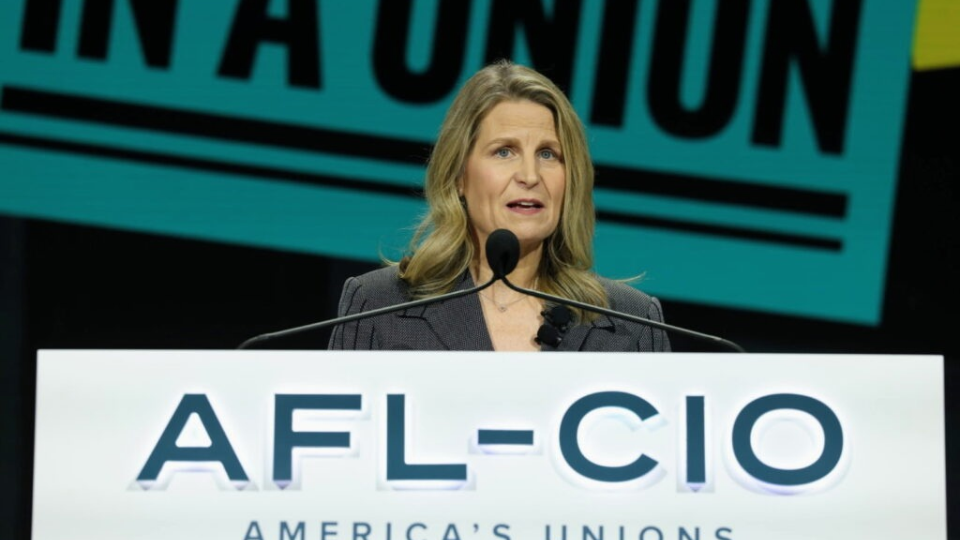
While Shuler made the PRO Act again labor’s top priority, she used it as the windup of her November 10 speech and lined up other goals as well. In a side conversation with a key lawmaker, she also raised the possibility of expanding labor law’s coverage to two big unrepresented groups of workers: Domestic workers and gig economy workers.
The PRO Act would remove decades of obstacles to organizing and bargaining first contracts, which bosses, backed by finance capital and right-wing ideologues in Congress and the courts, use to make successful unionization into an obstacle course or worse.
Fines for unfair labor practices—the formal name for labor law-breaking—would increase, captive audience meetings would be outlawed, getting federal court injunctions against labor law breakers would be easier, back pay for workers illegally fired would not just be net back pay but would cover their expenses, and joint employer arrangements would be regulated so workers would know who to bargain with and for what.
But before lawmakers can tackle the PRO Act or any other agenda items in the new Congress, they must get through their current lame-duck session of the present GOP-run Congress, and nobody knows what’s going to happen there, caucus co-chair Rep. Mark Pocan, D-Wis., a Painters Union member, told People’s World after the speeches and press conference.
Still, the caucus and political ranks nationwide will be filled with a record number of card-carrying unionists from the U.S. Senate and House—at least three dozen there—to state legislatures, city councils, Mayor Daniel Carson of Bangor, Maine, and mayors of other cities, school boards and other elected posts. AFL-CIO President Liz Shuler estimated the November 3 election yielded 719 card-carrying unionists in political positions as a result.
And the incoming Congress, she predicted, will be the most pro-union in years, as unionists and their families accounted for approximately one-fifth of the vote totals from coast to coast—and their votes, like those of the rest of the U.S., were overwhelmingly pro-union and Democratic.
Shuler and caucus co-chairs Reps. Debbie Dingell, D-Mich., Donald Norcross, D-N.J., Steven Horsford, D-Nev., and Mark Pocan, D-Wis., and incoming House Labor Committee Chair Bobby Scott, D-Va., unveiled the skeleton of the agenda—and its top priorities—at a sun-splashed celebratory press conference on November 10 on the U.S. Capitol lawn.
“This was a mandate, folks, from working Republicans, working Democrats, working independents. All joined together to say, ‘Fix this economy. Unrig this economy that’s been rigged against us for too long,’” Shuler declared.
“It’s a very clear message, but I know the Labor Caucus leaders up here with me today are ready to deliver. Our job for the next two years is to make sure this Democratic majority does what they said they were going to do—and that is to fix this economy for working people.
“America needs a raise. You heard it” from the lawmakers, Shuler said. “Put money in people’s pockets now. And that means lowering costs and raising wages. The two have to travel together because wage increases, even if we get ‘em, are swallowed up by the rising cost of living [and] health care skyrocketing.
“So we need to make sure that we’re raising wages and lowering costs because workers’ share of GDP is the lowest in this country’s recorded history right now. Think about that.
“Let’s raise the minimum wage,” Shuler urged. The federal minimum is $7.25 hourly, and it hasn’t risen since 2009. The federal minimum wage for tipped workers is $2.13, stalled at that figure since 1992.
Bosses are supposed to make up the difference between tip income and that figure or higher state or local minimum wages where they exist. But bosses instead often pocket the difference in a form of wage theft that costs the nation’s lowest-paid workers billions of dollars yearly.
“Let’s restore ACA [Affordable Care Act] subsidies,” which the current Congress let lapse at the end of 2025, Shuler stated. “Let’s undo the cuts to SNAP and Medicaid” from last year’s Donald Trump-GOP “big beautiful bill,” which slashed those programs by $800 billion-plus over the decade, deliberately began after Election Day. But Trump announced more SNAP cuts on November 10.
And “use trade policy to support good union jobs,” Shuler declared. “Not [to] bully allies like Canada, or to sow chaos.” Trump’s done both; Shuler never mentioned his name.
“Second, America needs a check on corporate power. Let’s make this insane pay gap between CEOs and the average worker—anyone know what it is, by the way?—I think It’s 312-1. So let’s make sure that corporations are paying their fair share and that our tax dollars are going to good union jobs,” said Shuler. AFL-CIO’s Paywatch study has that figure, but it doesn’t include the outlandish nine-figure payout to Trump pal Elon Musk. Throw that in, too, and the ratio goes into four figures.
“And third, when it comes to AI (artificial intelligence), America needs humans in control. No robot bosses. No spying bosses. We need to make sure our civil rights are protected, and that we share in the wealth these platforms are creating—wealth built on the backs of working people, by the way, and our knowledge and our labor.
“But the best and most fundamental thing we can do is to guarantee the right of every worker in this country to stand together in a union. That’s part of this economic equation, right? Workers do better when they’re in unions. So we need to restore, expand and strengthen the right to organize and the right to bargain.
The Labor Caucus co-chairs, plus Scott, used their speeches to add other pro-worker priorities to their agenda for the incoming 120th Congress. Besides the PRO Act, their specific labor law goals include “cracking down on employers who violate workers’ rights, such as illegal union-busting and wage theft.”
They also include “building a tax code that rewards work and supports working people over corporations and the wealthy and advancing a pro-worker immigration policy that raises standards for all, including by reforming employer-sponsored visa programs to give workers a voice on the job.”
The minimum wage increase would accompany “protecting and expanding prevailing wage requirements, and increasing overtime pay” and “putting people over profits by “robust enforcement” of workplace safety and worker protection. Those ideas would reverse Trump cuts. And there would be better access to “high-quality paid family leave, retirement and health care options.”
Missing is Medicare For All, a top cause of many of the incoming lawmakers, along with National Nurses United and at least a dozen other unions, and longtime advocates Sen. Bernie Sanders, Ind.-Vt., and Rep. Pramila Jayapal, D-Wash., a past Congressional Progressive Caucus chair.
And besides fair trade, which “creates a race to the top and brings jobs back home,” there would be a pro-worker industrial development policy and strong Buy America rules, as well as stronger workforce development programs. Workforce development drew the enthusiastic support of Reps. Norcross, the former president of the South Jersey Building and Construction Trades Council, and Horsford.
As a local Electrical Workers president and as council president, Norcross said he knows the benefits of such apprenticeship programs. So does Horsford, a member of Unite HERE Local 226 in Las Vegas and past supervisor of its training center for culinary workers.
But the current GOP-run Congress is another matter. In the short interview with People’s World, Pocan, who sits on the House Appropriations Committee, which helps dole out federal dollars, said there are only two certainties in the current lame-duck session. One is that Congress passes money bills or a temporary funding bill to keep the government’s doors open beyond the current December 11 deadline.
The other is that lawmakers must pass the annual military authorization bill. Labor has an interest in that, too, said Pocan. In it, the GOP-run House reversed Trump “War” Secretary Pete Hegseth’s Trump-ordered unilateral destruction of union contracts covering 150,000-300,000 civilian workers there.
But nobody at the celebratory occasion mentioned other obvious obstacles to next year’s agenda: Corporate, billionaire, and ideological opposition and lies, the tsunami of campaign cash which special interests can wield as a cudgel against foes and waverers or—even if Congress adopts the union agenda—Donald Trump and his veto pen in the White House.
Another obstacle may be the cautiousness of both congressional Democratic leaders, Rep. Hakeem Jeffries and Sen. Charles Schumer, both D-N.Y. Both have to balance competing forces within the big tent of the Democratic Party, but Schumer in particular has been so cautious that Sanders announced he will not vote for Schumer as the next Senate Democratic leader.
And the biggest obstacle, of course, is Trump. His anger at the landslide against him, his MAGA movement, his Iran War, and his repression of workers manifested itself even as lawmakers and Shuler spoke. His Agriculture Department cut off food stamps for 6.3 million people, including 1.8 million kids, whose families get federal Temporary Assistance for Needy Families, the Clinton-era welfare “reform.” Last year’s Trump-GOP “big beautiful bill” threw five million people off TANF.
No paywalls at People’s World
We hope you appreciated this article. At People’s World, we believe news and information should be free and accessible to all, but we need your help. Our journalism is free of corporate influence and paywalls because we are totally reader-supported. Only you, our readers and supporters, make this possible. If you enjoy reading People’s World and the stories we bring you, please support our work by donating or becoming a monthly sustainer today. Thank you!
CONTRIBUTOR