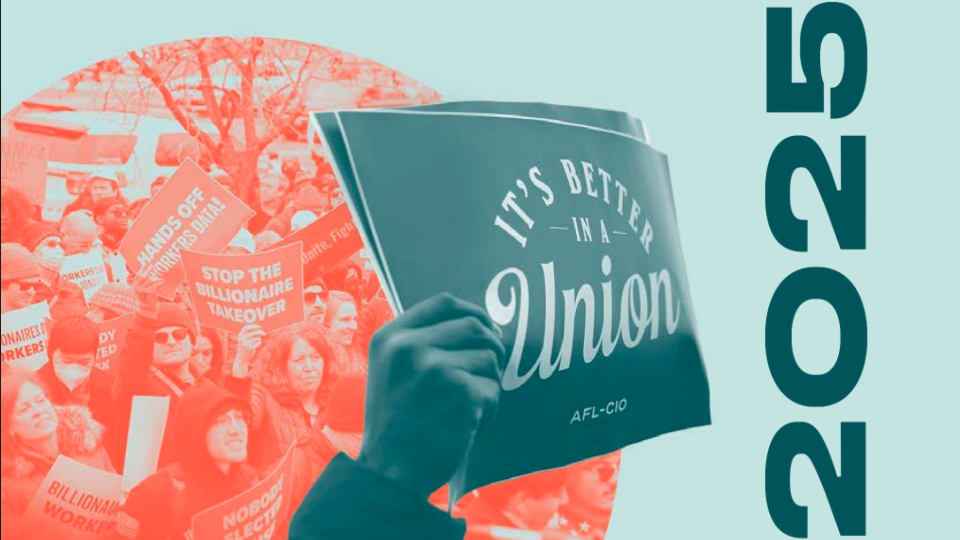
WASHINGTON—Workers faced one big, dominating, and dominant enemy in 2025: Donald Trump.
Through a series of edicts and with the gleeful aid of a compliant congressional Republican majority and two henchmen—Office of Management and Budget Director Russell Vought and multibillionaire chainsaw-wielder Elon Musk—President Donald Trump became “the biggest union-buster in U.S. history,” according to AFL-CIO President Liz Shuler.
Trump’s executive order eliminating more than 30 federal worker union contracts “is the very definition of union-busting,” Shuler said when he unveiled it. “It strips the fundamental right to unionize and collectively bargain from workers across the federal government.
“The workers who make sure our food is safe to eat, care for our veterans, protect us from public health emergencies, and much more will no longer have a voice on the job or the ability to organize with their co-workers for better conditions at work so they can efficiently provide the services the public relies upon. It’s clear this order is punishment for unions who are leading the fight against the administration’s illegal actions in court—and a blatant attempt to silence us.”
Labor has fought back through a series of lawsuits and won a majority it filed in lower courts. Appeals courts have split, however, and the six-justice GOP-named majority on the U.S. Supreme Court, especially Justice Samuel Alito, is hostile to workers.
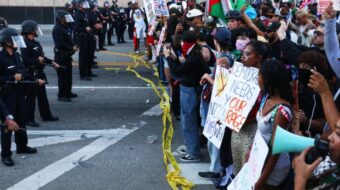
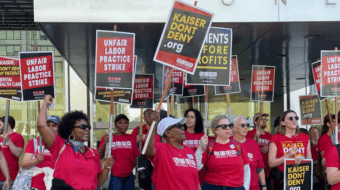
So, workers are taking to the streets, and often to strikes.
Season of strikes
“To every single American who cares about the fundamental freedom of all workers, now is the time to be even louder,” Shuler urged. “The labor movement is not about to let Trump…destroy what we’ve fought for generations to build.”
One big strike was open-ended, beginning Nov. 13, by the underpaid, exploited, and oppressed Starbucks workers nationwide. Their bosses are refusing to bargain in good faith for a national first contract, four years after the first workers’ wins in Starbucks stores in Buffalo, N.Y.

Others included strikes by 46,000 University of California grad student workers, all of them UAW members suffering from low pay, little health care, and lack of job security.
Additional high profile strikes included 10,000 grocery workers, UFCW members, in Colorado, as well as 3,200 Boeing workers in Missouri and Illinois and 3,000 Pratt & Whitney workers in Connecticut.
Teamsters across the country struck Republic Services, and won, while they continue to battle Air Gas, on strike since June 2. The Teamsters recently filed nationwide unfair labor practice charges against Airgas for violating numerous federal labor laws.
Also of note, 32,000 Michigan home health care workers sought union recognition and won. It was the largest organizing drive in the Midwest in decades.
National unions’ lawsuit-filled responses prompted Trump to label the largest union for federal workers, the American Federation of Government Employees (AFGE), an outright enemy.
And as the year progressed, workers took more and more to the streets, with the two big teachers unions in the lead. The American Federation of Teachers took an active part in planning the No Kings protests, May Day marches, and more, all against Trump’s tyranny.
The National Education Association also hit the pavement in red states, where it has more of a presence, winning a notable victory in Utah. It forced the heavily Republican legislature to roll back its own ban on public worker organizing.
But Musk and other top corporate moguls sued and won in deep-red U.S. District Court in rural Texas to abolish the National Labor Relations Board as unconstitutional. The case is before the Trumpite federal appeals court in New Orleans and likely headed to the U.S. Supreme Court and its six-justice GOP-named majority.
Union-buster-in-chief
In the executive branch, Trump’s prime tools were Musk’s chainsaw and Vought’s RIFs—“reductions in force,” aka wholesale firings. Trump and Vought then unilaterally eliminated more than 30 federal union worker contracts covering more than a million workers. And that’s not all.

Before the involuntary RIFs even began, Vought, at Trump’s direction, strong-armed some 175,000 federal workers into six-months’ paid leave and no jobs afterwards, ending Sept. 30. That and moves by Musk followed the Trump playbook that Vought oversaw: Project 2025, the 900-page policy and program tome authored by the radical right Heritage Foundation.
Those first RIF victims finally appeared in U.S. unemployment data in October, after the pay had run out: 168,000 ex-federal workers joined the jobless rolls, and 6,700 more followed in November. More may be out of work after the temporary money bill that kept the government going through Jan. 30, 2026, ends. So does its moratorium on further Vought firings.
Musk took his chainsaw, which he gleefully waved at a conference of extreme MAGAites, to federal agencies, firing all 68,000 workers of the U.S. Agency for International Development, cutting the Labor Department’s civil rights enforcement staff by 90%, and shuttering programs and projects to protect workers and the public. Other victims were government-wide, except for at the Defense Department, which Trump renamed the Department of War.
As an example, one program Musk smashed: The Labor Department’s Office of Federal Contract Compliance, a small civil rights agency that ensures federal contractors, such as those hired to cleanup Superfund sites, obey equal employment laws.
In an exclusive interview, the director of the Government Employees’ union local for OFCCP workers said his agency was cut so much it had to virtually halt inspections. He added one big site, the former radium-watch factory—now a field—in the contaminated city of Ottawa, Ill., had to be left with all its radium trapped and emanating from underground. Trump’s EPA stopped the cleanup work, throwing contractors out of jobs and leaving the dangerous site to “glow.”

Musk forced the firing of two-thirds of the workers—870—at the National Institutes of Occupational Safety and Health, the research agency that provides data which Occupational Safety and Health Administration and Mine Safety and Health Administration inspectors use to determine job safety and health hazards. That included cutting MSHA’s Pittsburgh office, which oversees most of Appalachia’s coal mines, to two workers.
That NIOSH cut prompted a Mine Workers’ pro-MSHA, pro-NIOSH, pro-OSHA protest outside the headquarters of Trump’s Health and Human Services Department, parent agency of NIOSH and other National Institutes of Health. Trump’s HHS Secretary, Robert F. Kennedy Jr., ignored them. He was too busy firing workers at the Centers for Disease Control and installing anti-vaxxers (like himself) at key HHS posts—leading to the prospect of making the country sicker.
Trump’s Occupational Safety and Health Administrator, David Keeling, who had worked for notorious labor law and safety and health violator Amazon, has orders to “go slow” or completely halt job safety and health regulations. Planned rules to reduce worker exposure to silica, which causes lung disease, were one casualty.
An injury to one is an injury to all
Trump’s attack on workers are mixed in with his attacks on people of color, particularly migrants, documented or not, citizen or not. He’s turned his ICE agents loose to deport people to hellhole prisons at home or those run by right-wing allied governments overseas.
ICE agents are now an occupying army, complete with beatings, tear gas, rubber bullets, flash grenades, invasions of churches, courthouses, and schools, and massive roundups in deep-blue cities such as Los Angeles, D.C., and Chicago.
Gleeful ICE and Border Patrol agents manhandled, hog-tied, and deported almost 500,000 people, splitting families. Another 1.6 million people “self-deported,” the agencies claim. ICE even sent a cancer-ridden 4-year-old U.S. citizen back to Mexico, with her undocumented mother. Agents also killed at least 24 migrants.

For unionists, the most-notorious deportation was of Kilmar Abrego Garcia, a Salvadoran refugee who had been in the U.S. for two decades, married to a U.S. citizen and with two U.S.-born kids. But ICE grabbed the Smart-TD union member while he was driving home from Tennessee, jailed him on a non-existent deportation warrant, then sent him to a Salvadoran prison without a hearing.
When judges ordered Abrego Garcia returned, ICE and Trump Homeland Security Secretary Kristi Noem defied them before reluctantly yielding. A federal judge in Greenbelt, Md., finally freed Abrego Garcia, with conditions, pending a trial on other charges. Abrego Garcia’s attorney fears ICE will try to deport him again, by arresting him outside the courthouse.
ICE agents’ roundups mean there are fewer home health care workers, fewer construction workers, fewer restaurant workers, and especially fewer farm workers. Those whom ICE hasn’t dragooned are staying home in fear, even if they’re legal. No farm workers means fields go unharvested, and food prices shoot up, for everyone.
Wages, women, and wrestling
A Trump executive order repealed Democratic President Joe Biden’s executive order mandating a $15 per hour minimum wage for more than 300,000 employees of federal contractors, such as fast-food workers at restaurants on military bases. The Economic Policy Institute calculated the workers, already low-paid, will see wage cuts of 25%-60%.
Trump repealed another Biden order, telling federal contracting officers to give priority to high-road employers, not low-ball bidders—such as anti-worker anti-union construction contractors who don’t pay prevailing wages and who cheat their workers on overtime or even straight pay.
Trump, a construction magnate, loves apprenticeship programs—as long as they’re not union-run. But he won’t spend federal funds on them. His latest move, at the end of the year, said apprentice nurses do not qualify as “professionals” eligible for larger federal student loans. National Nurses United and the Teachers/AFT protested, strongly.
It also hasn’t escaped notice that misogynist Trump particularly took an axe to programs that help woman workers—teachers, nurses, fast food workers, even women training for construction jobs. And he wants to abolish the Labor Department’s Women’s Bureau, too.
“Under these new caps, students pursuing a graduate degree can borrow only half of what students pursuing a professional degree can,” starting July 1, wrote Puneet Maharaj, National Nurses United’s Organizing Director, and Teachers/AFT President Randi Weingarten.
“Specifically, students earning a professional degree will be able to borrow $50,000 annually, or $200,000 total, while students pursuing a graduate degree will be able to borrow $20,500 annually or $100,000 total,” the duo wrote.

“The new law also requires institutions, starting in 2026, to prorate annual loan amounts for part-time students, meaning those attending graduate programs below full-time”—43% of all of them—”will have even less support to cover many of the basic necessities that make up the cost of attendance.”
In his second term, Trump has been even worse than he was in his first chaotic go-round, 2017-21. First, he broke the National Labor Relations Act in January 2025 by unilaterally firing NLRB member Gwynne Wilcox, the board’s first-ever female African-American chair. Wilcox, a former counsel for the Service Employees, wasn’t pro-corporate, Trump said.
The National Labor Relations Act bars firing NLRB members, except for cause. Wilcox’s term was scheduled to end in August 2028. She contested her dismissal through the courts, and lost at the U.S. Supreme Court.
Meanwhile, the board was unable to work because it lacked a three-member quorum the whole year—until the Senate, in mid-December, approved two Trump GOP nominees. One had been Kaplan’s chief of staff. The other was Boeing’s General Counsel during two Machinists’ strikes.
And Trump nominated, and the Republican-led Senate confirmed, on a party-line vote, Crystal Carey as the NLRB’s General Counsel and de facto chief of staff. Carey is the lead lawyer in the suit by Musk, Amazon CEO Jeff Bezos and other moguls to declare the NLRB unconstitutional. And she told senators she’d let the courts decide the future of the agency she’s supposed to lead.
Trump and his MAGAites hate the federal Education Department and federal spending to help schools educate poor kids. They hacked away at both.
Trump’s new Education Secretary, Linda McMahon, former wrestling boss and a big GOP donor, fired half her workers and set about—at Trump’s demand—dismantling her department. She particularly attacked its Office of Civil Rights because it rode herd on school systems that discriminated against students of color.
The GOP-run Congress played its part, slashing federal education spending by more than half overall and by 80% for schools which educate kids from low-wealth families. It’s no coincidence that more than half those kids—including 90% in Chicago and 80% in Minneapolis, for example—are children of color. Education unions lobbied hard against the cuts, but they lost.
Health cuts are attack on workers
Even worse for all workers, the Republican majority partially “paid for” its $4.5 trillion 10-year tax cut for the 1% through cuts over those same years in Medicare (an estimated $500 billion), Medicaid ($880 billion), and the end of federal subsidies to help workers buy health insurance.
Those subsidies expire Dec. 31, and their end will throw millions of people out of health care. They’ll wind up going to hospital emergency rooms, often too late, which must care for them. But ER care is the most-expensive, and that cost of “uncompensated care” will be passed on, through the private health insurers who put profits instead of patients, to the rest of us.

The Economic Policy Institute calculates the Medicaid cuts alone “would slash incomes for the bottom 40%” of all workers.
It’s also no coincidence that Trump’s federal firings particularly hit African-Americans. Black women are a disproportionate share of government workers, including federal workers, since governments in past years offered a route into the middle-class and with relatively less discrimination.
Congressional Democrats were by and large powerless to stop Trump, and when they had the chances to do so, key Democratic senators chickened out. They caught hell, particularly on a money bill in March to keep the government going through the end of fiscal 2025 that Sept. 30. Senate Minority Leader Charles Schumer, D-N.Y., endorsed the measure.
And late in the year, to end a Trump-engineered 43-day partial federal shutdown over Democratic senatorial demands to restore health care tax subsidies, Schumer looked on as seven Senate Democrats, led by Pennsylvania’s John Fetterman, and Maine independent Angus King, caved again.
They did so after the Government Employees (AFGE) reversed course and endorsed the “clean” money bill—without the subsidies. Separately, senators also voted down the health benefits clause. That pointed up another problem: Not all unions were on the same page all the time. Some opposed Trump and MAGA from the get-go. Others wavered. The Teamsters were the force behind Trump’s Labor Secretary nominee, former Rep. Lori Chavez-DeRemer, R-Ore., a Teamster’s daughter.
Not all doom and gloom
The news was not all gloom and doom, especially near the end of the year. Unions kept winning lower-court cases against Trump, including both against his worker firings and his ICE goons.
Some of the biggest corporations who have caved to or abetted the MAGA agenda faced increasing pressure from workers and consumers. Target, in particular, continued to reel from a Black clergy-led boycott over its retreat from diversity policies. The “We Ain’t Buying It” campaign has garnered support from the American Federation of Teachers, the Coalition of Labor Union Women (CLUW), and the Coalition of Black Trade Unionists (CBTU), among others. It’s making strong headway toward reviving the historic Black-labor alliance.

Meanwhile, a handful of House Republican lawmakers from swing districts, concerned about losing their seats, and the majority, in fall 2026, joined Democrats to pry at least one pro-worker measure out from under the clutches of Trump and anti-worker House Speaker Mike Johnson, R-La.
That bill, which passed 211-195 on a bipartisan vote on Dec. 13, would restore all the federal union contracts Trump eliminated, and give the workers their rights back. But in a note of continued Trump defiance, even after that balloting, Trump’s Transportation Security Administration, which is under Homeland Security Secretary Noem’s control, tried to trash the contract of the 47,000 Transportation Security Officers—the airport screeners—all over again.
Still, AFGE President Everett Kelley hailed passage of the Protect America’s Workforce Act. It went to the Senate, where its prospects are as yet unknown. House members “demonstrated their support for the nonpartisan civil service, for the dedicated employees who serve our country with honor and distinction, and for the critical role collective bargaining has in fostering a safe, protective, and collaborative workplace,” Kelley said.
“We need to build on this seismic victory in the House…and ensure any future budget bills similarly protect collective bargaining rights for the largely unseen civil servants who keep our government running.”
We hope you appreciated this article. At People’s World, we believe news and information should be free and accessible to all, but we need your help. Our journalism is free of corporate influence and paywalls because we are totally reader-supported. Only you, our readers and supporters, make this possible. If you enjoy reading People’s World and the stories we bring you, please support our work by donating or becoming a monthly sustainer today. Thank you!
CONTRIBUTOR