CHICAGO—“I’m so proud of you. Keep kicking ass.” Those were the final words that the late Beatrice Lumpkin said to United Steelworkers President Roxanne Brown when the two met up for the last time recently.
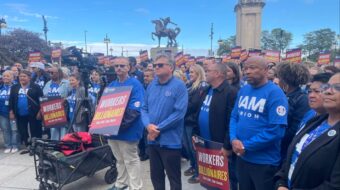
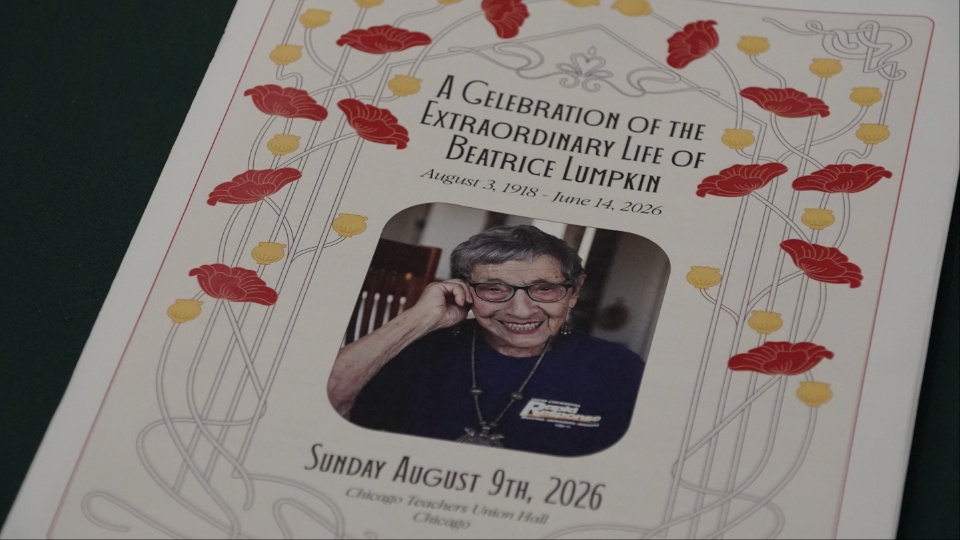
But it is Bea Lumpkin whom all workers should be proud of, Brown told a crowd of nearly 200 people who gathered at the Chicago Teachers Union Center on Sunday, Aug. 9, for a celebration of Lumpkin’s life.
A union organizer and academic who spent more than 90 years committed to struggling for a better world for working-class people, Lumpkin was lauded by labor leaders, elected officials, family, friends, and comrades.

“I wouldn’t be where I am, and so many female labor leaders would not be where we are, without Bea Lumpkin,” Brown said. “She paved paths for us that we didn’t even know existed; she allowed boulders to be moved out of our way.”
Known affectionately as Bea, Lumpkin was a former Chicago Public Schools teacher and math professor at Malcolm X College. She died in June at the age of 107. A lifelong member of the Communist Party USA, Lumpkin was a co-founder of the Coalition of Labor Union Women.
She also played a role in the “Save Our Jobs Committee” alongside her husband Frank, after Wisconsin Steel abruptly shut down its Chicago plant in an effort to cheat workers out of their last paychecks, pensions, and benefits. She remained active in civil rights and workers’ rights activism well into her eleventh decade, having taken part in recent “No Kings” protests.
Sunday’s event was moderated by Lumpkin’s sons, Paul and John Lumpkin, and welcomed members of the CTU, the United Steelworkers (USW), and other unions; progressive politicians like Chicago Mayor Brandon Johnson and Rep. Jesús “Chuy” Garcia; along with several of Bea’s colleagues and loved ones.
“When she passed away, it was a sad day for us,” John Lumpkin told attendees inside the CTU’s Jacqueline B. Vaughn Hall. “It was a sad day for so many in this room and around the country who got to know Bea. But today is not just a day to be sad. Today is a day to rejoice. We got 107 years, and we have a lot to celebrate.”
John thanked the CTU for providing “one of the many homes for Bea” and for being a place of support after Lumpkin’s “quote unquote retiring.” He then introduced CTU President Stacy Davis Gates, who said Lumpkin lived a “visionary” and “transformative” life.

“The justice we seek, the equity we deserve, and the liberation we are going to win comes in struggle,” Davis Gates said. “It comes in solidarity, and it comes in an uncompromising fashion for our values and our humanity.
“I want to tell you that Bea’s life cannot be remembered in caricature. It must be remembered in the power of her action, the power of her faith, and the power of her resilience.
“I am humbled and honored to have you all here to remember a woman that helped us build the most powerful union in this country, a woman of high moral integrity and character. We should all be so blessed to hear the remembrances of our sister, our leader, our fearless fighter for justice, equity, and liberation.”
Similar sentiments were expressed by the country’s top labor leader, AFL-CIO President Liz Shuler.
“Like so many women in labor, I walk the path Bea helped build. She and the sisters who came together in 1974 to found the Coalition of Labor Union issued a declaration to the world: We weren’t going back. Without Bea and that generation, I wouldn’t be here,” Shuler said. “She pushed open those doors and then held them open for the rest of us.”
The AFL-CIO president said Lumpkin stands as an inspiration. “She lived her values. Equality, solidarity, and justice were in her bones, and she believed in action.” Shuler told attendees, “The things Bea fought for are under attack, and the greatest tribute to her legacy is to carry her work forward.”
Lumpkin’s son Paul took to the stage to thank those in attendance and noted that Aug. 3, which would have been Lumpkin’s 108th birthday, was officially “Bea Lumpkin Day” in the City of Chicago, thanks to a declaration from Mayor Johnson.

“I am truly honored to be one of two mayors that Bea actually got along with,” Johnson jokingly said of Lumpkin, calling her a “towering figure in the labor movement.” He added that Lumpkin was an “unrelenting advocate” for fully funding schools and public institutions and serves as “an inspiration for all of us.”
“As you see and witness fascism at its most potent state that you’ve seen in a generation, I don’t think it’s a coincidence that the very areas in which the Trump administration is attacking were the demands of the formerly enslaved: education, housing, healthcare, transportation, good-paying jobs,” Johnson said.
“Those were literally all the areas in which Beatrice Lumpkin was fighting for. She was the living definition of what it means to be a devoted human being.
“She believed every generation has a responsibility to leave the world more just than the way we found it,” the mayor added. “That legacy she leaves with us today. So now more than ever, we have to hold true to not just her memory but to what she fought for.”
Shortly after Johnson’s remarks and a brief musical performance, Roberta Wood, the former secretary-treasurer of the Communist Party USA and a longtime friend of Lumpkin’s, spoke about how Bea always made sure to bring a “revolutionary plus” to everything she did.
“Bea shared the ‘plus’ that capitalism can’t be reformed, it can’t be made nicer because it generates exploitation, domination, and division. Her vision was a vision she shared of a different society, a different economic system: socialism,” Wood said to applause.
Wood said Lumpkin believed that from “every continent of the world, human innovation and invention had escalated human productivity to the point where it’s now objectively possible to feed, to house, and cure every human on earth.”
She went on to tell a story of when she first visited Lumpkin’s home in Chicago and complained that her flashlight had malfunctioned at work.
“She quickly ducked into her room and came back with a soldering iron and repaired the broken connection. She said, ‘I always keep a soldering iron in my top dresser,” Wood said to laughs from the crowd.
“You know, most of us keep our jewelry, some odds and ends and our underwear in the top drawer, things we use every day. But of course, Bea kept her soldering irons.”

“And workers, we love our tools, don’t we?” Wood continued. “And like all workers, Bea used the tools passed on to her from previous generations. And I’m not just talking soldering irons here.
“The tools Bea employed and refined, as workers do, were unions, books, strikes, petitions, demonstrations, picket lines, solidarity, stories, marches on Springfield, marches on Washington….
“She kept these tools in her top drawer, and now she leaves them to us to improve on and to wield collectively together. So, let’s take up the tools that she and her generation have refined and passed down to us. Let’s keep them in the top drawer and let’s use them every day.”
Wood closed by saying that a moment of silence “doesn’t make sense” for Lumpkin, because “Bea was a badass revolutionary.” Instead, Wood called for a “moment of outrage, a moment of noise, a moment of determination, and a moment on our feet” before leading the crowd through the following chants: “We’re loud! We’re proud! We always bring a crowd!” and “We make, good trouble! There’s joy in the struggle!”
DOWNLOAD the People’s World Memorial Tribute booklet
featuring a short biography of Bea Lumpkin and a selection of her writings published in People’s World over the years.
We hope you appreciated this article. At People’s World, we believe news and information should be free and accessible to all, but we need your help. Our journalism is free of corporate influence and paywalls because we are totally reader-supported. Only you, our readers and supporters, make this possible. If you enjoy reading People’s World and the stories we bring you, please support our work by donating or becoming a monthly sustainer today. Thank you!
CONTRIBUTOR