

PARIS—The protests in France keep accelerating, spreading from high school and university students upset at deteriorating school conditions and lack of teachers to pensioners and rural and periurban workers who can’t afford the rising price of fuel to drive to work or heat their homes to both public and private sector unions who demand not just a minimum salary increase but a wage indexed to rapidly rising prices, including the price of food.
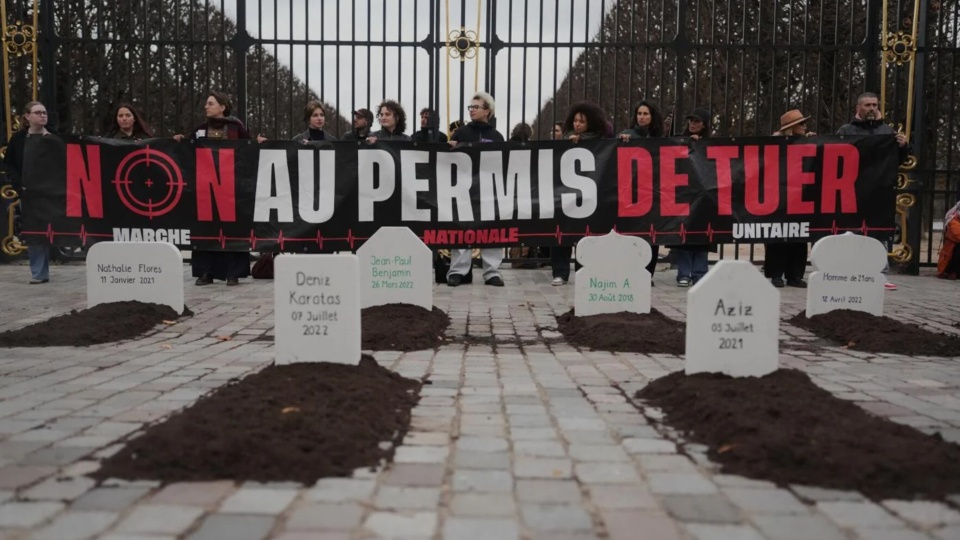
President Emmanuel Macron’s centrist government has so far done little to satisfy these demands, as the street protests grow in number and engulf ever widening portions of the society. Instead, in a deadly move decried by all manner of human rights associations and almost unremarked in the mainstream press, the government has now passed into law an infamous “license to kill” bill which puts the onus for combatting police violence on the victims of that violence.
The bill—passed in the National Assembly by a coalition of Macron’s center, the right, and Marine Le Pen’s neo-fascist National Rally party and then ratified by the right-wing Senate—suspends the policy of automatically detaining officers who fire their weapons, now taking for granted that these officers are acting lawfully.
Also, since the police often control the information around these incidents, the bill makes it much harder to prove otherwise. A United Nations spokesman criticized the bill as fueling “police immunity.”
That “immunity,” though it can now be used to discipline and intimidate demonstrators, will of course also be employed in the mixed Muslim and Black areas of the outer cities, where police violence often goes unreported. In the whiter central areas, it would immediately be the subject of scrutiny.

Interior Minister Laurent Nunez hinted at this use when he claimed the bill would protect “officers operating in dangerous conditions.” While there are police no-go zones in France, including a famous one in northern Marseille, the right-wing solution, instead of addressing employment and education in impoverished areas, is to have the police come in and eliminate the citizens who contribute to these “dangerous conditions.”
The only chance of stopping the legislation from going into effect is that it has been referred by left parties to the Constitutional Counsel, which will rule on its legitimacy. The bill was passed despite numerous nationwide protests and a petition of over 700,000 signatures opposing it.
The lethality of the the law and its precedents does not bode well for those against whom it is employed. A provision under the same article of the constitution allowing police to shoot at vehicles which do not obey their order to stop has resulted over the last decade in the death of 35 people.
On the same day the law was approved, ominously, a Paris criminal court convicted three police of a racially-motivated beating of a Black music producer whom they followed during the COVID-19 pandemic for not wearing a mask. The officers struck Michael Zecler with 30 blows from batons while also punching and kicking him, causing head trauma and a torn tendon. They then attempted to cover up the beating by falsely claiming he violently resisted arrest.
Critics warn that it is precisely this kind of racially-motivated violence that the new bill promotes, but at an even deadlier level.
The week the bill was passed also saw the government confronted with reports from thousands of women complaining of menstrual disorders and miscarriages because of exposure during the protests to police use of tear gas.
A group called Tears of Blood, in calling for an immediate end to police use of the gas, presented testimonies of 10,000 women who described excruciating uterine cramps, heavy or premature bleeding, and disrupted cycles, with 32% of the pregnant respondents reporting miscarriages. The response of the French government was no response.
On the day the law passed, 30 police vans surrounded a handful of students at a Sorbonne technical college Paris VI on the city’s left bank. Four students sitting cross legged in the street and another eight playing with a soccer ball were condoned off by the vans as the riot police, the CRS, lounged around and ate croissants and pastries.
The cost of this massive containment was an estimated 90,000 euros by a government that, when it comes to financing health and education, pleads poverty.
Even the police are exhausted by the government’s use of them, and they too are feeling the brunt of austerity budgets. On Nov. 17, a massive day of protests which included most of the public sector unions, CRS members claimed in droves that they could not report because they needed “medical consultations.”
As public sector employees, the police cannot legally strike, so calling in sick is their indication of discontent, and this action followed widespread complaints of overwork as well as a failed negotiation by their union with the state to increase their risk pay.
The protesters, meanwhile, are vowing to stay in the streets, if need be until the presidential elections next spring, and the discontent is growing, as the high costs of living are a matter of more than just inconvenience. A father of two reported that he shuts the boiler off, thus stopping heat for his family, in the middle of the month because they cannot afford heat for the entire month. He also reports the family has changed the way they eat, “less meat, fewer vegetables, more [cheap] pasta.”
Fianally, along with the sanctioning of police violence and its refusal to negotiate the demands of the protesters, the state remains in active denial about the numbers in the streets. The discrepancies are growing between the official and union estimates of the demonstrations’ size. For Nov. l7, the police prefecture count was 146,000 total in France as a whole and 28,000 in Paris, whereas the French union federation, the CGT, estimated the total figure at 500,000 with 175,000 in the capital.
Early mornings in Paris used to be characterized by the seductive smell of croissants and capucino. Now, the most dominant sensation is the constant wail of police sirens in a state that responds to its citizens not by listening to their urgent demands but by ever more intense repression and violence.
No paywalls at People’s World
At People’s World, we believe news and information should be free and accessible to all, but we need your help. Our journalism is free of corporate influence and paywalls because we are totally reader-supported. Only you, our readers and supporters, make this possible. If you enjoy reading People’s World and the stories we bring you, please support our work by donating or becoming a monthly sustainer today. Thank you!
CONTRIBUTOR


MOST POPULAR TODAY

The other ‘lizard people’: Why the Epstein files are shattering global theory

Fain accepts Debs Award, calls for May Day ’28 general strike

Laos’ economic miracle: From bombed-out semi-colony to advancing socialist nation

The Case of the Hollywood 10: Movie moguls launch blacklist in 1947

Working-class culture: Neglected by liberalism, under attack from the right