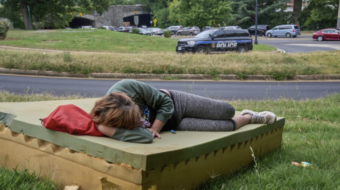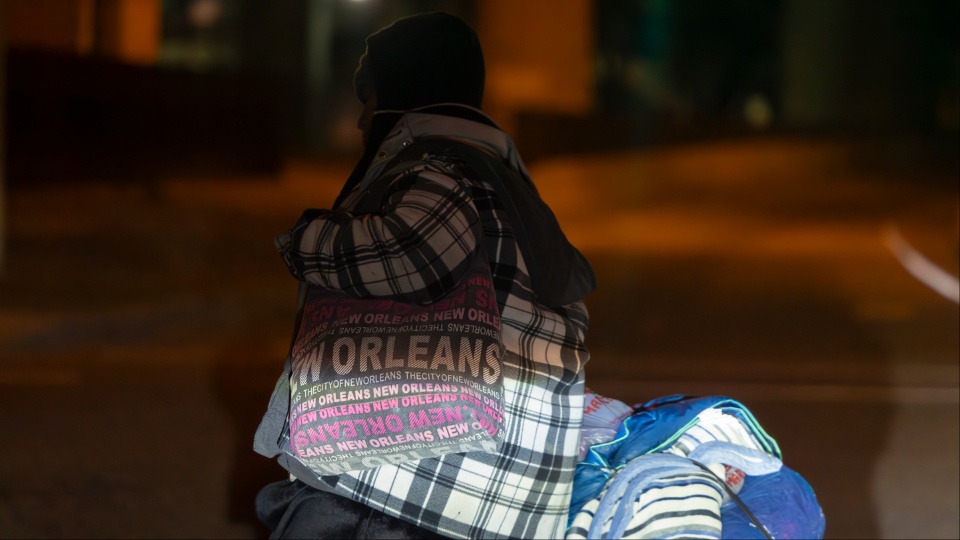
BATON ROUGE, La.—On April 15, the Louisiana House of Representatives joined the war on homeless people by making unauthorized sleeping in public places a crime. HB 211, known as the Streets to Success Act, passed by a vote of 70 to 28. It is now on its way to the state Senate.
Proposed by State Rep. Debbie Villio and supported by Louisiana Governor Jeff Landry—citing President Donald Trump’s policies aimed at the homeless—the bill imposes a mandatory fine of $500 and a minimum six-months prison sentence for violators.
On July 24, 2025, Trump issued an executive order to “prioritize available funding to support the expansion of drug courts and mental health courts for individuals for which such diversion serves public safety.” However, critics have stated that the executive order has enabled state actors to use force against the homeless population rather than aid in economic and personal recovery.
The National Homelessness Law Center (NHLC) has branded HB 211 “one of the cruelest anti-homeless bills” in the United States. The group has cataloged numerous government attacks on the homeless recently.
Lawyers from the Department of Veterans’ Affairs have been deputized “to strip homeless veterans of their rights and autonomy.” A congressional hearing surfaced internal documents showing the VA’s true intention, NHLC said: “to take away rights from homeless veterans to make decisions about their own lives.”
The Trump administration has also increased Justice Department funding to pay for involuntary commitment of homeless persons and court-conditioned treatment regimens for them.
Around $100 million dollars was emarked by the Health and Human Services Department to fund forced treatment and “backwards, unethical, and ineffective programming, including limiting lifesaving harm reduction services.” HHS funding also includes a chilling prohibition on grantees from “promoting” undefined “anti-American” values.
NHLC says the federal government has wasted time and money fighting an injunction that stopped changes to the Department of Housing and Urban Development funding models that would have led to the eviction of nearly 170,000 formerly homeless people from the places they now live.
These same rules would also place conditions on states and cities seeking housing department funding, requiring them to “enforce laws that make it a crime to be homeless, assist ICE, and reject proven solutions to homelessness.”
It also criticized the federal government for using homelessness as rationale for taking over cities and states. This includes the ongoing occupation of D.C., which has displaced homeless Washingtonians, as well as the ICE occupation of Minneapolis, during which three homeless members of the Oglala Sioux tribe were taken by federal agents.
New Orleans Councilmember Lesli Harris stated that the bill would criminalize homelessness and sleeping on the streets, as well as lead to the congestion of the Louisiana court system, as homelessness in the state continues to rise.
According to both the NHLC and Harris, none of these measures have addressed the root causes of homelessness within the United States. Harris asked that Louisiana lawmakers look to New Orleans’ Home for Good program as an example of how things could be done.
“[W]e house an individual for roughly $21,844 per year. By comparison, jailing that same person costs an average of $51,000—and failing to act at all can cost up to $55,000 in emergency room visits and crisis rehousing,” Harris said. “HB 211 would steer Louisiana toward the most expensive option while producing no lasting housing, no services, and no real path forward for the people involved.”
Incarceration of the homeless in Louisiana would cost the taxpayer more than double the amount per person in comparison to the New Orleans program. According to the U.S. Department of Housing and Urban Development’s 2024 Annual Homelessness Assessment Report (AHAR), there are over 3,000 homeless people in this one state alone.
Further complicating the enforcement of HB 211 if it passes would be the intensified congestion of the state court system. Prosecutors, public defenders, and judges would have to divert critical resources towards the processing, defending, and jailing of thousands whose crime would be nothing more than sleeping in a public space.
Such measures echo the history of the country’s “War on Drugs,” in which people of color were disproportionately affected by the crackdowns against drugs and homelessness across the U.S.
According to the National Alliance to End Homelessness (NAEH), the rate of homelessness in Louisiana, per 10,000 residents, is highest amongst indigenous people, at 55, with African-Americans being the second highest, at 13.
The displacement of the homeless would not only be costly for the Louisiana taxpayers, but it would also continue a history of discrimination.
Currently, HB 211 is being considered by Louisiana State Senate. Should that body pass the bill, it will have to once again have to push its way through the House of Representatives before reaching Gov. Landry, who’s signaled his intention to sign it into law.
Public funds being allocated to further complicate the judicial system’s tackling of homelessness, which has historically been rife with mental health issues, drug addiction, and violence against the homeless themselves, will only continue the historically poor outcomes of the war on poverty. Whilst some locales such as New Orleans have taken measures to alleviate the homeless population’s issues, the state legislature is headed in a direction that has been shown to harm, not help, the poorest amongst the working people.
People’s World is in the midst of its annual fund drive, trying to raise $140,000 by May Day. To support working-class journalism, please consider make a donation or become a monthly sustainer. Thank you.
CONTRIBUTOR