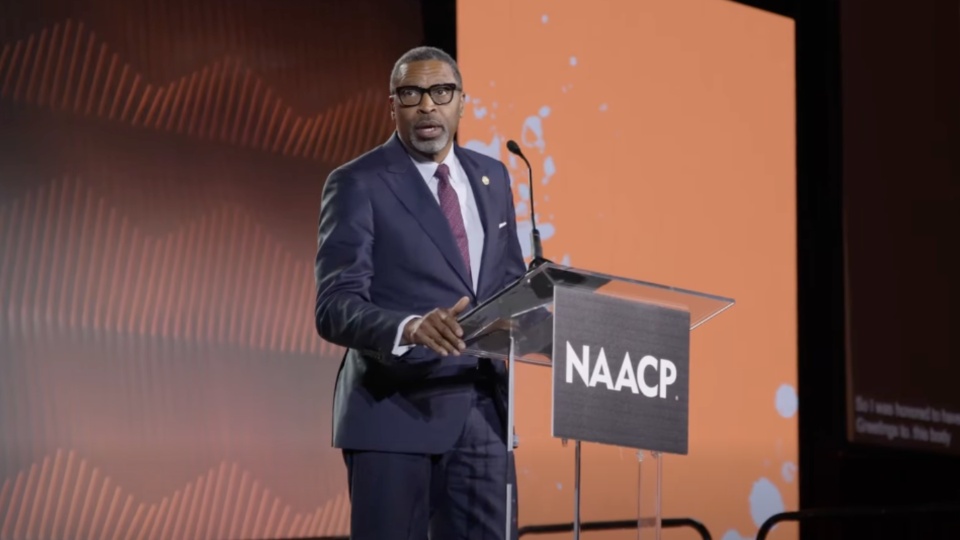
CHICAGO—The NAACP, the nation’s oldest civil rights organization, and the union movement plan closer cooperation in the fight to defeat MAGA and the Trump administration, which both call an enormous threat to workers and people of color.
NAACP Executive Director Derrick Johnson and board chair Leon Russell announced that closer collaboration in back-to-back remarks at a special labor-oriented session on July 20 during the organization’s convention here.
Both said that while unions and the NAACP share the same goals and labor often worked hand-in-hand with civil rights leaders—providing money and people power—the reverse was not always apparent. And there needs to be more collaboration at the local level between union locals and NAACP local chapters, they said.
 That will change, the two leaders promised. And the change could appear in a variety of ways, and not just in the electoral battle to defeat the MAGA forces of Donald Trump and his retrograde Republicans, who want to take the country back to Jim Crow or before.
“Let’s keep our eyes on the same prize,” Johnson urged.
The cooperation with labor will be “around more than collective bargaining,” Johnson said. “For instance, now they”—the right wing—“are even using your pension dollars against you” in investments and also refusing to invest in homes or businesses of communities of color, he explained.
That comparison should ring a bell in the nation’s urban areas, particularly Chicago, the site of the convention. The first fully documented case of financial discrimination—redlining Black loan applicants who had the same background and finances as white applicants—was documented there in 1961.
It led to later legislation forcing financial institutions to disclose their loan patterns and office locations, showing which areas, invariably communities of color, are redlined and “unbanked.”
“And as things”—other issues and corporate practices—“evolve technologically, we have to evolve, too,” said Johnson.
Russell took a different tack, but reaching towards the same cooperative goal. “We can talk all we want here about workers’ rights, but we have to stop talking and start organizing,” especially jointly around common issues, he said. “And we have to make sure our (NAACP) branches are connected to local union leaders.”
Connection also starts at the top and that also needs improvement, according to NAACP and union leaders. Only recently have three international union leaders, including Teachers/AFT President Randi Weingarten and National Education Association President Becky Pringle, joined the NAACP board.

NEA is the nation’s largest union, and Pringle, a Philadelphia science teacher, is African-American.
New York City civics teacher Weingarten heads the nation’s third-largest union is Jewish and an activist in the LGBTQ movement.
Before them, the most prominent union leader on the NAACP board was the late Bill Lucy, the AFSCME Secretary-Treasurer, a founder of labor’s constituency groups for African-American workers and a key force behind Dr. Martin Luther King’s civil rights campaigns.
That includes the 1968 campaign where King was murdered while leading labor’s support for unionization of the mostly Black sanitation workers of Memphis, Tenn. Lucy, in turn, was preceded by A. Philip Randolph, president of the Brotherhood of Sleeping Car Porters, the first African-American majority union.
Randolph, one speaker said, forced FDR into integrating defense industries, which aided workers of the Great Migration from the segregated South to cities of the North. Randolph’s leverage was to threaten a 250,000-person march on Washington in 1941. King took that up 22 years later.
As part of the session, rank and file unionists discussed questions facing both groups, ranging from the threat of artificial intelligence taking away jobs to, for the first time in this conference, discussing how to reach the millions of people in the U.S. who are turned off by a political system that does not meet their needs and thus do not vote.
“We have got to encourage the six million who are not voting and who don’t think about voting,” said Russell. The number is the NAACP’s minimum target for new voter registrations and mobilization between now and Election Day, in a $20 million campaign it announced the day before.
“They don’t understand that an attack on diversity, equity, and inclusion” by the Trump administration “is an attack on them. They don’t understand that an attack on health care,” and specifically the Affordable Care Act which former President Barack Obama pushed through Congress, “is an attack on them.
“All of the gains we made in the 1940s, 1950s and 1960s” are in danger, Russell declared.
One union leader whose local stretches from lower Manhattan to Newark, N.J., a city which is majority people of color and a large number of poor, also pondered the problem in a conversation with People’s World.
“They’re taking away things that threaten them,” he said of the GOP’s slashes against voters of color. “If voting was not a threat to them, they wouldn’t take things away.”
But while the leaders raised the problem of reaching and motivating non-voters, they said more must be done in the way of solutions. The consensus, among both the union presidents and the rank-and-file members who spoke, was to find common ground to appeal to workers of all races, creeds, genders, and political views.
They cited common-sense issues such as keeping food safe or ensuring you can fly safely. One worker, LaQuita Honeysucker of the United Food and Commercial Workers, raised the food safety issue, as did Government Employees (AFGE) President Everett Kelley.
Another solution for representing the working poor who are not voting, both among unions and at the NAACP, is not just to support collective bargaining, but to ensure union contracts nationwide expire on the same day, said Julia Lewis of Unite HERE. Doing that “at 48 hotels and one casino” ensures bosses cannot play off workers against one another and provides a sense of solidarity, too, among the low-paid workers, Lewis added.
“We’re attempting to negotiate them into restoring the staffing levels” they had before the coronavirus pandemic hit, Lewis explained. The hotel chains wail that business is still below 2019 levels and they can’t afford to hire more workers. The workers, Lewis said, are loaded up with two or three or four rooms to clean rather than one. They know the bosses’ complaints aren’t true.
Among Trump’s firings, Kelley said, were federal food inspectors. And a disproportionate share of the 317,000 total of feds whom Trump and trillionaire Elon Musk axed were African-American women. AFGE member Darrell English raised the air safety issue. He’s a Transportation Security Officer—a screener—and the two recent GOP-prompted federal shutdowns led 2,100 of his colleagues to quit for other jobs.
The TSOs had to work for three months without pay. Now, Trump wants to fire 8,400 more TSOs out of the remaining 45,000. News reports which surfaced after the Chicago session says he also wants to privatize the entire TSO workforce at two larger airports, including busy and prominent Washington National, the airport most lawmakers use to fly to their home states.
Airport screening by privatized workers was prevalent before the al-Qaeda attacks almost 25 years ago and it was ineffective at best, Kelley has said before. It’s now in effect in 200 small airports.
“It isn’t enough that Trump and the right” want to prevent workers of color “from climbing the ladder to the middle class” through unionization, Kelley said. “They want to pull the ladder away.
“If they can do this to Black workers protecting our food and keeping our flying safe, they can do it to you,” he warned the crowd.
“This our generation’s fight” for worker rights and civil rights, Kelley urged. “Will you march with us? Will you stand with us? Will you pray with us? And will you fight for us?”
“Yes,” the crowd roared back.
We hope you appreciated this article. At People’s World, we believe news and information should be free and accessible to all, but we need your help. Our journalism is free of corporate influence and paywalls because we are totally reader-supported. Only you, our readers and supporters, make this possible. If you enjoy reading People’s World and the stories we bring you, please support our work by donating or becoming a monthly sustainer today. Thank you!
CONTRIBUTOR