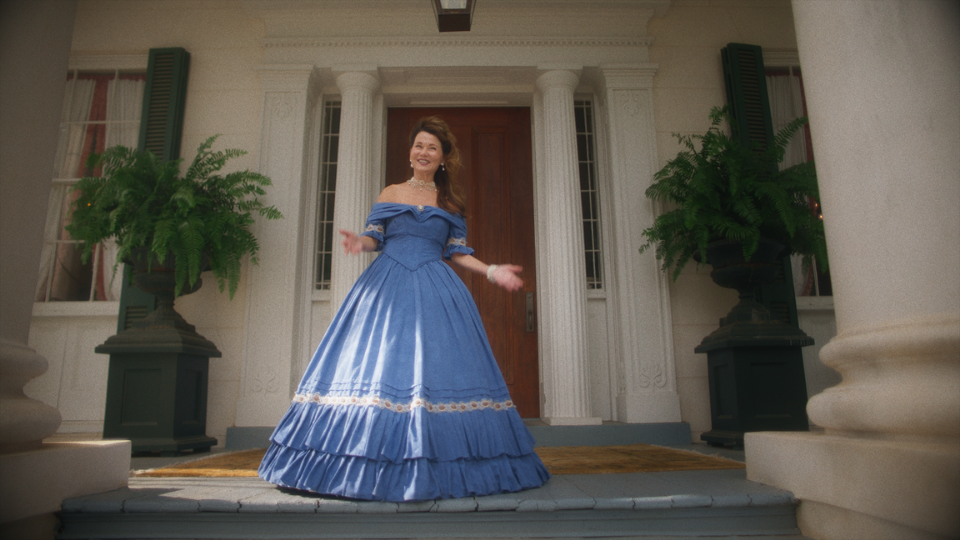
The documentary Natchez is one of those rare films that is beautiful and welcoming while simultaneously gut-wrenching and powerful in the way it explores its subject. It draws you in with the Southern charm of exquisite antebellum dresses and scenic landscapes of Natchez, Mississippi, but that’s just preparation for a brutal journey. It then starts peeling away the layers of this small town’s complex history with slavery, racism, and how the townsfolk—and the tourists who visit—grapple with it. The people you meet and the stories you hear stay with you long after the credits roll.
Natchez is a documentary film directed and produced by Suzannah Herbert. As its name implies, it explores the town of Natchez, which relies on antebellum tourism to survive. This reliance on such a pivotal and divisive part of American history—the pre-Civil War American South—often has the townsfolk reckoning with their past as they deal with an uncertain future. The tourist industry is waning, and the people here ultimately have to figure out what the town truly owes to descendants of slavery. For the latter, the antebellum South is not a time or place they feel nostalgic about. The doc features a host of interesting and, at times, quirky characters who each bring their own complexity while living in a town at a cultural crossroads. 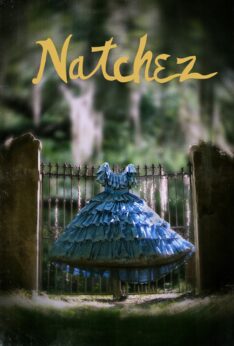
The film comes at a time when education is under attack in the United States. While there have always been those who push against teaching the complexities of history when it comes to slavery, the Civil War, the Confederacy—and race relations in general in the country—there has been a growing movement to pass laws and regulations that outright remove parts of this history from school textbooks, libraries, and museums. This is often done under the guise of not perpetuating so-called “white guilt.”
As one education professor put it, if history is taught by the victors, the Civil War is a rare exception in which the South/the Confederacy was somehow allowed to eventually dominate the narrative. This push and pull of narrative and facts is what we witness in Natchez. In a way, the town becomes a microcosm of a broader battle unfolding across the country.
Many tourists visit the town to see the extravagant plantations with elaborate homes and gardens. The people who own them are often descendants of the original (white) owners. They dress up in antebellum fashion and hoop dresses while giving tours of the preserved estates. These tours often present a glamorized version of the times in which these estates thrived, and for years, often glossed over the very reason that they thrived—slavery.
The labor that kept those beautiful gardens maintained, kept the fields producing, and kept the mansions immaculate for decades was slave labor. And, interestingly enough, it was after the Civil War, when many of these estates were losing money because they no longer had free slave labor to pick cotton, that they began offering antebellum tours to make money. The very existence of this tourist industry in the town leads back to slavery and the fallout of its abolition.
The strongest aspect of the film is the people who tell their stories in it. The cast is so open about their lives and thoughts that it’s not until the end of the film that viewers realize there was no omnipotent narrator speaking throughout. The documentary doesn’t have to rely on this often-used device to tell Natchez’s story because the people of Natchez provide more than enough commentary on their own.
The film’s grounding force and heart are showcased through Tracy “Rev” Collins. Collins is a community leader, pastor, and historian. His tour business, Rev’s Natchez Country Tours, focuses on Black history, enslavement, and the Civil Rights Movement. The history he explains to his customers on his bus tours is interwoven with the other townsfolk, often putting on full display some of the contradictions of the glamorized version presented in the house tours. Collins, along with some others in the film, is shown as seeking to present a more honest depiction of Natchez and the history of slavery, but they face pushback from others who would rather stick to the way they’ve always presented it.
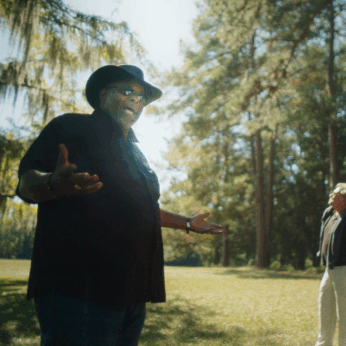
Moments of racism, both out of ignorance and malice, are on full display in the film. There are times when you see members of the community sincerely grappling with what the “correct” way to present history is—such as needing to take Confederate soldier hats out of the gift shop or being more direct about slavery’s role in the town’s development. Then there is perhaps the most contradictory figure in the film, who will no doubt cause strong reactions from viewers: David Garner, the elderly white and openly gay owner of the Choctaw Hall.
Early in the film, we see Garner as someone proud of his Southern heritage and family estate. He’s boisterous, funny, and charming during his tours. He has no problem speaking about his husband, and we even see him attending a charity drag event as he makes large donations to the foundation. In this same scene, we see protesters outside condemning those who are part of the LGBTQ community.
Garner is part of a community that has been persecuted simply for who they are. Director Herbert ingeniously puts this on display, knowing that later in the film, Garner will show another aspect of himself that sharply contrasts this part of his identity. For you see, Garner is extremely racist, and some of the most vitriolic and overtly racist rants will come from him later on in the film.
He unabashedly slings around derogatory names for Black people, while making the case that the country went down the toilet (and how Hilary Clinton lost the presidential race) when “everyone” started catering to “the blacks.” Perhaps some of the most haunting aspects of Garner’s scenes are when he uses these derogatory names about Black people in front of some of his white tour guests—and many of them laugh along with him.
Herbert provides no commentary in instances like these, instead letting them stand on their own, allowing the audience to grapple with their meaning. The whole film is emotionally weighty moments like this dressed up in a pretty package of Southern “hospitality.”
The fantasy of the antebellum South is nothing new. For decades, Hollywood has made classics of films that push the narrative of a white South where slavery was more of an afterthought than the very institution that kept the white wealthy afloat. The film Birth of a Nation comes to mind, considered one of the highest-grossing movies of all time, and screened at the White House during its release, setting the tone for presenting white supremacy as protecting “heritage” and not hate. Natchez is a film that powerfully challenges this fantasy.
As another standout figure in the film, National Parks ranger Barney Schoby, put it, “Natchez swallowed a master narrative about the old south.” And in all reality, Natchez isn’t the only place that has embraced that narrative, nor is it the only place where there are people who want to actively keep it firmly in place. That’s what makes the doc so relevant beyond the town it focuses on. Natchez is a must-see film, perhaps one of the most evocative documentaries in recent years.
Viewers can watch Natchez in its entirety for free at PBS.org.
We hope you appreciated this article. At People’s World, we believe news and information should be free and accessible to all, but we need your help. Our journalism is free of corporate influence and paywalls because we are totally reader-supported. Only you, our readers and supporters, make this possible. If you enjoy reading People’s World and the stories we bring you, please support our work by donating or becoming a monthly sustainer today. Thank you!
CONTRIBUTOR