

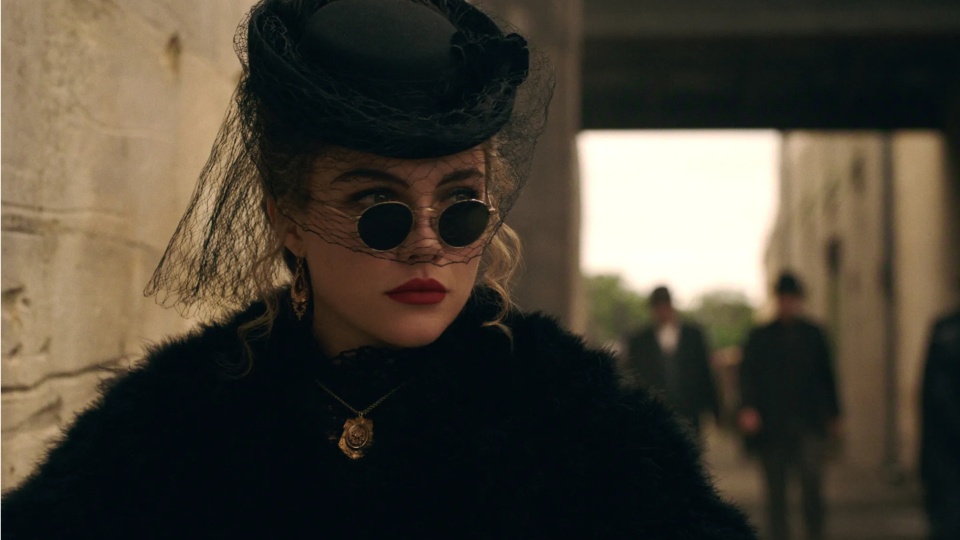
I recently finished watching Netflix’s East of Eden television adaptation of John Steinbeck’s novel. I was inspired to view the series by Dennis Broe’s Oct. 21 review of it in People’s World. I enjoyed the series immensely, and as I often do when viewing something recommended by a reviewer, I returned to reread the article that sparked my initial interest.
When I read Broe’s review a second time, I was struck as to how supportive he was of the character Cathy. And, I was bothered by his concluding political analysis of the Trump regime and its connection to the series.
Steinbeck initially introduces us to Cathy as a monster, something practically removed from humanity because of her lack of empathy or a consciousness. Cathy manipulates the affections of her high school teacher without care; deliberately demeans a lover, admittedly a violent, evil man, to his face; shoots her patriarchal, but loving husband and leaves him for dead to go work in a brothel; and murders Faye the brothel owner, who treats all her workers, but particularly Cathy, with maternal affection.
I agree entirely with Broe that Cathy is the center of the series and that actress Florence Pugh was absolutely incredible in the role. But the series has been criticized for creating a rationale for Cathy’s incredibly cruel behavior in a childhood incident of sexual abuse that is not in the book.
This serves to give Cathy a psychological “out” and frames her actions within a highly patriarchal society that allowed very little freedom of choice for almost all women. Broe goes even further than the series, describing the deliberate, intricately planned murder of Faye, as a “betrayal.” It certainly was a betrayal, but from Broe’s review, one would never understand that it was first degree murder.
So what? There’s no question that this whole story can be framed from a purely feminist perspective, as I think Broe goes overboard in doing. This is a woman who just wants to control her own life, and, hey, in 1900 prostitution was one of the few avenues for a woman to have her independence from the demands of society. And certainly, the John Steinbeck of 1952, when much of this exact same patriarchal system still dominated American life, might fear a truly independent woman, and therefore, portray her as a monster.
The problem with such an argument is twofold. First, it leads the viewer away from the core theme of Steinbeck’s novel, which is timshel, Hebrew for “thou mayest.” Steinbeck casts Cathy as pure, unmitigated evil in order to contrast her with her son, Cal, who faces a true moral test in which he must choose whether to be evil or not.
Steinbeck’s thesis is that sin is a choice; it’s not an inescapable blood inheritance. He makes that argument by allowing Cal to choose to escape from some of his bad choices in life. The Netflix version, and Broe to an even greater extent in his review, makes the argument that Cathy is a victim of the trauma of her past. She has no control over her evilness; she’s just doing what she has to do to be free.
The second problem with the Netflix/Broe argument is that it ignores Steinbeck’s own humanization of Cathy later on in the novel. I have to say that Steinbeck’s portrait of Cathy is very deeply developed. I would argue that she is the most psychologically developed character in the book and the series.
She’s an incredibly intelligent and strategic thinker with a completely logical worldview of obtaining autonomy. Her character deteriorates over the course of the novel, though: The more power she obtains, the more paranoid and entrapped in her candlelit room she becomes. And, she’s genuinely terrified of kind, unselfish people whom she cannot corrupt.
She’s no evil automaton. Yes, Steinbeck lets us think that she’s just a pure monster at first, but less than halfway through the book the narrator stops and reassesses his own take on her. Pugh does such a good job in the role of Cathy that we don’t need the narrator’s intervention to see her change.
My second critique of the Broe review concerns his political analysis of the series. Broe uses the idealistic characters of Adam and his son Aron to develop the theme from Graham Greene’s The Quiet American that the United States is full of naïve do-gooders who cause true destruction while believing in their own moral purity.
Broe himself realizes the distinction between idealists like Adam and cynical conmen like Adam’s father, Cyrus, who lies about his role in the Civil War and uses his position in the Veteran’s Administration to enrich himself. Washington is NOT full of the “Adams and Arons” who “pretend innocence of their violent motives.”
No, Washington has a full-on authoritarian regime attempting to institute open fascism to make the world safe for business. Not even Trump’s most naïve supporters would ever argue that Trump and company are naïve idealists. No self-delusion here—this is the straight up, unapologetic self-interest of the billionaire class.
No paywalls at People’s World
At People’s World, we believe news and information should be free and accessible to all, but we need your help. Our journalism is free of corporate influence and paywalls because we are totally reader-supported. Only you, our readers and supporters, make this possible. If you enjoy reading People’s World and the stories we bring you, please support our work by donating or becoming a monthly sustainer today. Thank you!
CONTRIBUTOR