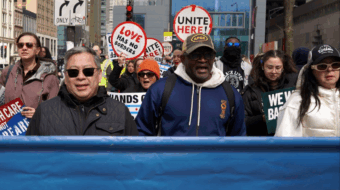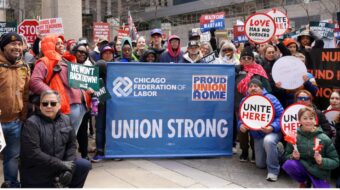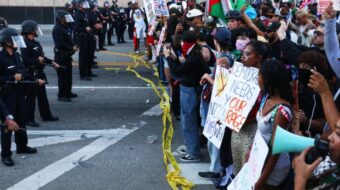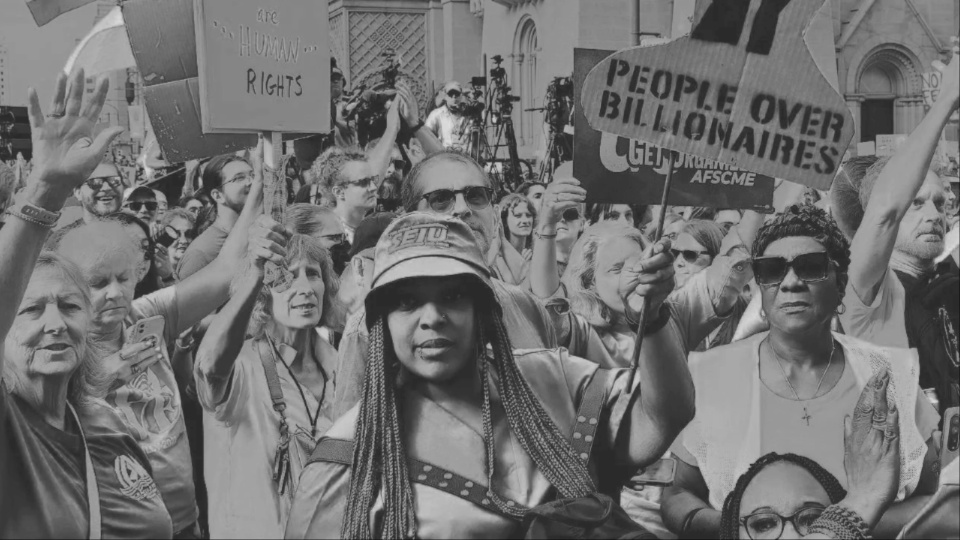
On the heels of the massive “No Kings” mobilizations that saw millions take to the streets on March 28, the fight against the MAGA agenda and the spiraling economic crisis is entering a new phase. Standing before a crowd of thousands at the flagship rally in Minnesota, Indivisible co-founder Ezra Levin issued a call that seemed to echo the sentiments of a growing labor-community alliance: a nationwide “general strike” on May 1.
“The next major national action of this movement is not just going to be another protest,” Levin declared. “It is a tactical escalation. It is an economic show of force.”
The call for action on May Day—International Workers’ Day—is being organized under the banner of the “May Day Strong” coalition with the demand of “No Work, No School, No Shopping.”
The goal is to shut down the engines of profit that sustain the current administration’s agenda and to demand a government that invests in healthcare, housing, and schools rather than war, blockades, and the intimidation of immigrants.
Minnesota inspiration
The momentum for a national walkout is rooted in the recent “Minnesota General Strike,” which started in Minneapolis. In January, Minnesota residents and workers electrified the movement by launching a citywide general strike against the brutal tactics of federal immigration enforcement. Despite temperatures plunging to -30 degrees, over 100,000 people marched, and hundreds of businesses closed down.

That action forced a partial retreat of federal ICE and Border Patrol agents from the state, though not before they killed a second civilian, Alex Pretti, after the killing of Renee Nicole Good just days earlier.
The Minnesota General Strike, many organizers feel, proved that a work stoppage remains the most potent tool of the working class.
“We are going to build on that courage, that sacrifice that Minnesota residents showed,” Levin told the crowd at the No Kings rally. “We want to replicate that power across the country.”
Labor steps up
While pulling off a general strike has historically been viewed as a difficult lift in the U.S., the current political and economic climate has galvanized a considerable section of the labor movement’s rank-and-file. Several trade unions and labor organizations are already moving to support the May 1 action.
The National Education Association (NEA), representing millions of educators, has released a “May Day Strong” toolkit, urging its members to join others in the streets under the slogan “Workers Over Billionaires.”
Other unions and labor groups that have signed on or are mobilizing members, according to Payday Report, include the American Federation of Teachers (AFT), the American Association of University Professors (AAUP), and the United Electrical, Radio, and Machine Workers of America (UE).
In Chicago, the 30,000-plus members of the Chicago Teachers Union (CTU) have officially backed the call, as well. CTU Vice President Jackson Potter says, “Teaching our students what civic action looks like requires more than textbooks when the president sends federal agents to occupy our cities and the governor chooses to continue giving tax breaks to billionaires instead of giving our students the school day they deserve.”
 These groups have been joined, so far, by Starbucks Workers United and dozens of local labor councils, from the North Carolina AFL-CIO to the Milwaukee Labor Council and UFCW Local 3000.
Organizers recognize the legal hurdles involved in a general strike for many unions, especially given the terms of collective bargaining agreements, but they emphasize that this movement is coming from the ground up and that workers are being creative in finding ways to participate, just as they were in Minnesota.
Cliff Smith, Business Manager of Roofers Local 36 in Los Angeles, noted that while high-level leaders might sometimes be hesitant, the desire to overcome organizational “inertia” is becoming more powerful.
“These calls typically come from the streets,” Smith said. “Then, they tend to get officially taken over by higher-level organizations” once they show strong momentum in union locals. “Circumstances are changing quickly around us.”
Smith said that the effort to mobilize for May Day is evidence that workers aren’t waiting for the midterms to take action. “We should not only depend on the November elections to provide us with solutions,” he said. “A demonstration of power on May Day shows the billionaire class that there will be serious consequences if they continue to attack our democracy.”
We hope you appreciated this article. At People’s World, we believe news and information should be free and accessible to all, but we need your help. Our journalism is free of corporate influence and paywalls because we are totally reader-supported. Only you, our readers and supporters, make this possible. If you enjoy reading People’s World and the stories we bring you, please support our work by donating or becoming a monthly sustainer today. Thank you!
CONTRIBUTOR