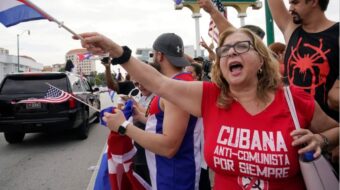
The Dominican Republic expelled at least nine Cuban diplomats on April 13, though Cuba claimed the number was ten. The day marked the centennial of Fidel Castro’s birth, and the announcement came as a celebratory three-hour “political-cultural gala” was taking place at the Autonomous University of Santo Domingo. News of the action spread while attendance at the event swelled to over 2,000.
Journalist Pablo McKinney wrote after the expulsions that, “I’ve never felt so much like we were a pawn of another country.” Leaders of small left-leaning Dominican political formations criticized their government, among them: Minou Tavárez Mirabal, founder of the Democratic Option; Guillermo Moreno, president of the Alliance for the Country; and María Teresa Cabrera, president of the Broad Front.
The diplomats arrived in Havana five days later, and Cuban Deputy Minister of Foreign Affairs Josefina Vidal commented that “Dominican officials were unable to offer one reason justifying their decision, because there are none.” But serving their U.S. overseers would have been reason enough, and the timing of the action with Castro’s birthday would have pleased them.
Kicking out the Cuban diplomats was the latest in a string of actions taken by the Dominican government that seem aimed at currying favor with the Trump administration.
At the U.N. General Assembly in October 2025, the Dominican Republic abstained rather than vote its customary approval of an annual resolution calling for the U.S. blockade of Cuba to end. In November 2025 and again six months later, Dominican authorities opened up two of the country’s airports to the comings and goings of U.S. military aircraft.
Prompted by the U.S., Dominican President Luis Abinader canceled the 10th Summit of the Americas which he was to have hosted in Punto Cana in late 2025. He had previously disinvited Cuba, Nicaragua, and Venezuela.
The Dominican Republic also joined with the right-wing governments of Panama, Costa Rica, and Ecuador to form the so-called Alliance for Democratic Development (ADD). The group fosters commercial and political cooperation under U.S. tutelage.
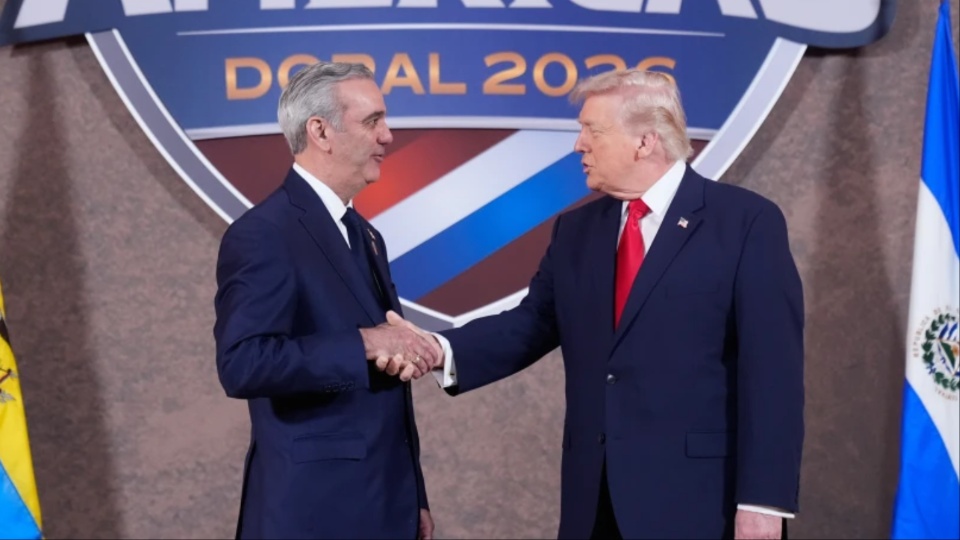
The Abinader government cooperated with those same nations in sending electoral observers to Honduras’s most recent presidential elections, venue for U.S. interference. Under U.S. auspices, the compliant Dominican government joined ten other right-wing regional governments in March 2026 in Florida to form the so-called “Shield of the Americas.” The meeting centered on building support for U.S. military interventions against “narcoterrorism.”
History of domination
U.S. sway over the Dominican Republic has been long in the making. The U.S. government proposed to annex the nation during the Ulysses Grant administration and carried out a military occupation from 1916 until 1924. Only at the end of the brutal Rafael Trujillo dictatorship (1930-61) did the U.S. back off from supporting it.
President Juan Bosch took office in 1963, four years after the victory of Cuba’s Revolution. He introduced progressive reforms and was opposed to the Dominican Republic becoming “a base of operations for the CIA against the Cuban Revolution.” The result was a military coup that removed him seven months later.
A group of young officers in April 1965 deposed the coup government, seeking Bosch’s return to power. The U.S. government, apprehensive about another Caribbean revolution, carried out a military invasion. U.S. troops by the tens of thousands occupied the country for 11 months, and 4,000 Dominicans died.
This was a watershed moment. The occupation and subsequent presidency of Joaquin Balaguer (1966-78) introduced aggressive modes of control. Balaguer presided over oppression of social movements and tolerated paramilitary violence in the countryside.
The center-left governments arriving after the Balaguer era of oppression included a repeat and tamed Balaguer presidency (1986-96). They managed a few democratic openings, while emphasizing neoliberal reforms. Large-scale migration of Dominicans to the United States “acted as a safety valve alleviating pressure for change” during these years.
Considerations of race and social class
The U.S. and the Dominican Republic are as one in carrying out racial oppression and beating up on Haiti. Cooperation shows in the illegal arms and coup plotters entering Haiti from the U.S. The Dominican government, meanwhile, is building an anti-migrant wall along its Haitian border.
Anti-Black hatred has long prevailed in the Dominican Republic. Haitians and their families have lived there for generations. They are mostly undocumented and regularly suffer abuse. As a low-paid labor force, they are essential for Dominican agriculture. Even so, by the end of 2025, the Abinader government had forcibly deported over 200,000 Haitians at a rate of 10,000 deportations per week. A 2013 court ruling depriving Haitians of birthright citizenship opened the door for the deportations.
But Haitians are far from the only Dominican Republic residents living difficult lives. In fact, 14% of all Dominicans lived on less than $5.50 per day in 2024. The Dominican minimum wage, $200-$300 a month, is the third lowest in the Americas. Half of the Dominican Republic’s population in 2024 accounted for only 11.4% of the income generated there, and only 4.6% of the accumulated wealth.
There’s more to the story. The Dominican Republic’s 5.1% GDP growth in 2024 testifies to enrichment, and the nation’s president is worth some $76 million. Abinader formerly headed the ABICOR group of tourism-related companies. Latin America’s richest president has soul-mates; 16.9% of all the income generated in 2024 belonged to only 1% of the population. That sector accounted for 24.9% of that year’s accumulated wealth.
Political resistance is weak. The small leftist political parties mentioned in a recent report are more reformist than revolutionary and are far removed from unified struggle. A few support the neoliberal reforms being advanced by mainstream parties. The report has it that non-involvement of youth represents the Dominican left’s principal failing. There are “almost no leftist worker or student organizations…[and] a Dominican Republicaconian labor code…prohibits strikes.”
Cuba represents hope
This report on the expulsion of the Cuban diplomats has covered political and historical realities of the Dominican Republic and the government’s subservience to U.S. interests. Dominicans’ historic ties with Cuba are a necessary part of the story, though. In that regard, the notion of hope as projected by Cuba still prevails in the Dominican Republic. Hope sparks ideas of political change, and the U.S. takes notice.
Miguel Mejía, general secretary of the United Left Movement, one of the aforementioned small political parties in the Dominican Republic, also denounced the expulsion of the Cuban diplomats. He explored the history of Cuba-Dominican Republic relations.
Mejía condemns the Dominican Republic government’s action as “breaking a long-standing tradition in bilateral relations and representing an unfortunate exception.” He cites “bonds…forged by the peoples themselves…[resulting from] unique events that history has brought about between our two peoples.”
He sees a “two-way channel fueled by waves of migration in both directions [since the 19th century].” He proposes that, “This brotherhood—so deeply rooted, so profound and robust—has never been and will never be broken regardless of the decisions made by any ruling leader.”
Now, the “Dominican people, regardless of ideologies and political preferences, are mobilizing against this shameful measure [of expelling the diplomats], which does not fit within the tradition described and reveals a very dangerous and unpopular subservience to the U.S. government.”
He is saying that people of his Caribbean nation, and by extension, peoples elsewhere, have special regard for Cuba. They see Cuba as a forerunner of a better political way. The example of Cuba validates their own hopes, and so it’s no wonder that the U.S. government bends all rules of decency in order both to destroy Cuba’s revolution and dull the vision of the down-and-out everywhere, not least in the Dominican Republic.
We hope you appreciated this article. At People’s World, we believe news and information should be free and accessible to all, but we need your help. Our journalism is free of corporate influence and paywalls because we are totally reader-supported. Only you, our readers and supporters, make this possible. If you enjoy reading People’s World and the stories we bring you, please support our work by donating or becoming a monthly sustainer today. Thank you!
CONTRIBUTOR