WASHINGTON—Born and raised in Haiti, Fritz Emmanuel Lesly Miot works in a California laboratory, researching Alzheimer’s disease. Miot has lived legally in the United States for 15 years. Laila Doe, a Syrian citizen, lives in Illinois, where she works as a behavioral technician for individuals with disabilities and cares for her elderly American-citizen mother and her teenage daughter. Doe has lived here legally for 13 years.
Donald Trump wants to deport them—Miot to Haiti, Doe and her daughter to Syria. Miot has diabetes. Doe’s daughter knows little Arabic.
On June 25, in Mullin v. Doe, the Supreme Court ruled, 6-3, that the Trump administration can deport them immediately, even before their cases reach trial. This, even though the State Department warns Haiti suffers from “kidnapping, crime, terrorist activity, civil unrest, and limited health care,” and Syria still experiences “terrorism, civil unrest, kidnapping, hostage taking, and armed conflict.”
Often suspected of having more resources than locals, longtime U.S. residents like Miot and Doe make prime targets for foreign kidnappers. For a diabetic like Miot, exile to a nation with “limited health care” means a likely death sentence.
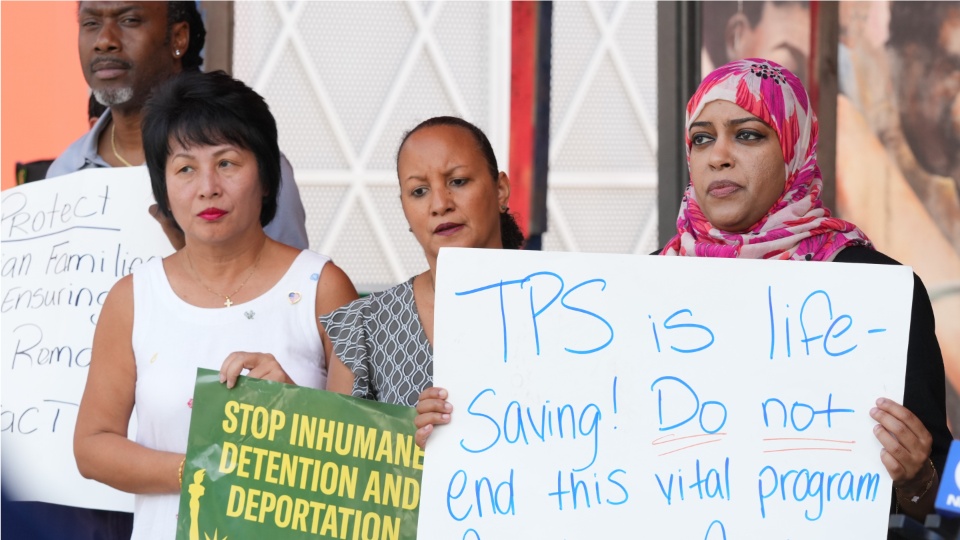
What is TPS?
To provide sanctuary for people fleeing countries like Haiti and Syria, in 1990 Congress and Republican President George H.W. Bush created Temporary Protected Status (TPS). The statute authorizes the Secretary of Homeland Security to designate countries for TPS if “extraordinary and temporary conditions”—such as “armed conflict”—prevent those countries’ citizens from returning “in safety.” TPS status allows refugees to live, work, and attend school in the United States.
Because of the “extraordinary” conditions related to its civil war, Syria received TPS designation in 2012. After a devastating earthquake, Haiti received TPS designation in 2010.
The TPS statute requires the secretary periodically, “after consultation with appropriate agencies of the government,” to review a designated country’s TPS status. Since 2010 and 2012, Haiti’s and Syria’s TPS designations have been repeatedly renewed.
Nevertheless, in her first year in office, and without consulting with any other federal agency, then-DHS Secretary Kristi Noem cancelled TPS for both countries. Instead of following the TPS-mandated process, Noem followed Trump’s lead.

As a presidential candidate, Trump spread the lies that Haitian immigrants “probably have AIDS” and that, in small Springfield, Ohio, they were eating neighbors’ dogs and cats. As president, Trump called majority Black or brown countries “shithole[s].” He asked why the United States can’t get “people from Norway [and] Sweden.”
Other countries that had TPS status canceled include Burma (Myanmar), Honduras, Nepal, Nicaragua, Ethiopia, South Sudan, and Venezuela. The administration has never stripped TPS status from a majority white country.
Meanwhile, despite generally denouncing immigration, Trump instituted a special refugee program for white South Africans, claiming—without evidence—that Black South Africans were systematically raping, maiming, and killing white citizens.
Unchecked executive power
In its 6-3 vote, in an opinion by Justice Samuel Alito, the Supreme Court sided with Trump.
To reject Doe’s plea to avoid forced return to Syria, Alito relied on a TPS provision barring courts from reviewing the DHS secretary’s TPS “determination” respecting “the designation, or termination or extension of a designation, of a foreign state.” Alito gave a blanket interpretation of the word “determination” to include not just the decision itself, but the “act of coming to a decision.” So, he reasoned, the courts can’t review anything a president’s Homeland Security secretary does under the TPS statute, regardless of whether her acts follow the required procedures or not.
Congress might, in many cases, have a good reason for leaving final decisions touching on foreign policy to the executive branch. But, as Justice Elena Kagan pointed out in dissent, Doe did not ask the courts to second-guess Secretary Noem’s final decision about Syria’s TPS status.
To the contrary, Doe questioned whether Noem followed the procedures that the TPS law requires the secretary to follow before terminating a TPS designation. By contrast with foreign-policy decisions, enforcing procedural requirements “fall[s] smack in the middle of the judicial wheelhouse,” she wrote.
That means, according to Kagan, that the court should have intervened to force the Trump administration to follow the law as it is written, but the majority chose not to do so.
If the TPS law prevents courts from forcing the secretary to follow its procedural mandates, the law effectively has no mandates. The secretary and the president can, in practice, bypass Congress and repeal the law themselves by ignoring its requirements.
Alito says racism can’t be proven
Alito took a different approach in ruling Trump can send Miot back to Haiti. The court considered Miot’s claim that Noem based her order, at least in part, on racism.
In doing so, the court purported to follow longstanding precedent that proving unconstitutional racial discrimination requires only showing racism was a “motivating factor.” But, as Justice Kagan wrote in dissent, “a” factor doesn’t mean the sole factor, or even “the dominant or primary one.” Moreover, at this stage of the case, Miot didn’t yet have to prove racism, just that—as the lower courts found—he’d made a “plausible” case.
For Justice Kagan, evidence of racist motive was “there, plain to see, in the president’s statements.” Trump’s own words, she said, “fairly shout, in their racial undertones and overtones alike, that race entered into the President’s resolve to remove Haitians from this country.” They were “so repellent and racially inflected” that neither the Solicitor General, at oral argument, nor Alito, in his written opinion, could “bear to repeat” them.
Nevertheless, the court’s right-wing majority found it “unlikely” Miot could prove race played any role at all in cancelling Haiti’s TPS status. “None of the cited statements” was “overtly racial” and all “could rest on race-neutral justifications.”
Conservative justices did not give examples of what they would consider “overtly racial,” since Trump’s rants somehow didn’t fit the bill.
The impact to come
Currently, at least 330,000 Haitians live in the United States under TPS, along with over 60,000 Syrians. One-third of these Haitians work in health care, like Miot. Tens of thousands of others work in sectors as varied as hospitality, food service, and janitorial to meatpacking, construction, and more. Syrian workers holding TPS are found in science, management, and arts roles in high numbers.
But the court’s decision has implications beyond what happens to Haitians and Syrians alone. It could mean deportation for 1.3 million TPS-qualified U.S. residents, most with full-time jobs, most of whom have lived here for years.

Perhaps that explains why unions and chambers of commerce alike urged the court to reject the Trump administration’s position. Already businesses complain they can’t find qualified employees to fill jobs in some sectors.
Despite Alito’s opinion, hope remains for Miot and Doe. The Supreme Court was reviewing only a preliminary order during the case, not an order finally resolving the case. The court’s order did not dismiss the case, but rather sent it back to the lower courts. As Alito observed, the Supreme Court was only making a “predictive—not a final—decision about the outcome.” Time will tell if the court’s “prediction” was accurate.
But the Trump administration is wasting no time in showing that it saw the decision as a green light to proceed with deportations. Within minutes of the ruling, U.S. Citizenship and Immigration Services (USCIS) posted an image on X saying, “Temporary Protected Status is meant to be temporary.” Almost instantly, right-wing social media personalities and bots amplified the same message again and again.
The TPS ruling wasn’t the only immigration case win for Trump on Thursday. The same 6-3 majority also gave him the power to turn away asylum seekers at the U.S.-Mexico border and granted border officials broad powers to deport lawful U.S. permanent residents.
“Never let anyone tell you this administration only goes after ‘undocumented’ immigrants,” said José Palma, a coordinator at the National TPS Alliance. “By trying to kill TPS, they are attacking people who are living and working here legally, paying fees and taxes, following all the rules. They are de-documenting people.”
We hope you appreciated this article. At People’s World, we believe news and information should be free and accessible to all, but we need your help. Our journalism is free of corporate influence and paywalls because we are totally reader-supported. Only you, our readers and supporters, make this possible. If you enjoy reading People’s World and the stories we bring you, please support our work by donating or becoming a monthly sustainer today. Thank you!
CONTRIBUTOR