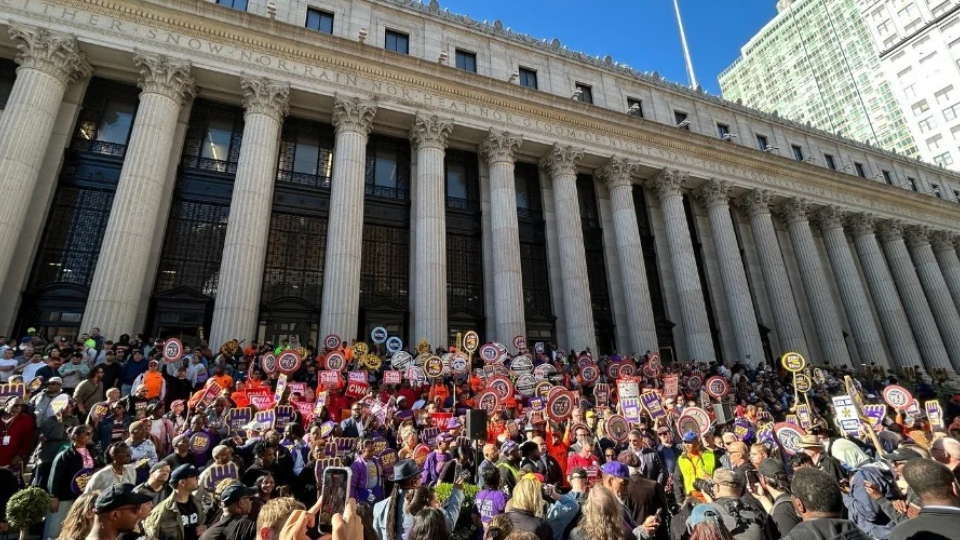
WASHINGTON—Enthusiasm among union members about voting in this year’s election is 83%, 10 percentage points greater than it was in the last off-year vote in 2022, an AFL-CIO survey shows.
Not only is that a good augur for the movement, the federation’s pre-election memo states, but it’s 12 percentage points higher than enthusiasm among any other subgroup of voters, the federation adds.
Combine those two numbers with the overall trust the nation’s unionists have in their unions to deliver accurate information (71%) and intensive door-knocking by tens of thousands of union volunteers, and the result is competitive races for both houses of Congress in a bigger electoral map.
“Turning that off-the-chart enthusiasm into votes will demand the unique union trust and relationships with members that are built through labor’s year-round organizing,” the survey memo states.
“For decades, we’ve been told the states and districts labor has put in play were out of reach, just like every worker who’s tried to organize a union or stood on the picket line is told that what they deserve is out of reach,” said AFL-CIO President Liz Shuler in the memo.
“But when we come together—whether it’s to take on a bad boss or hundreds of millions of dollars in spending—we can achieve things no one ever thought possible. Union candidates are doing just that: Putting once-safe seats in play and forcing billionaires to scramble to empty their pockets.
“This cycle, the labor movement has put it all on the line, using our infrastructure and the trust we have to mobilize millions of voters to elect people who will fight for us.”
The trust by voting workers and their families is so high, and the outrage against anti-worker GOP President Donald Trump and his regime is so large that the opposition finds itself playing defense on what had been political areas it won by double digits in prior years.
And that’s despite mountains of money the billionaires, the bosses and their right-wing allies can command. That includes $400 million from the anti-Trump MAGA, Inc. campaign finance trove and an equal sum from trillionaire and Trump pal Elon Musk.
One reason: This election, “Unions are organizing year-round—not parachuting into communities at election time—(so) union volunteers can move the needle even in deep-red districts,” the memo asserts.
Indeed, the GOP already threw in the towel on one U.S. Senate seat it now holds, in North Carolina. Democratic former Gov. Roy Cooper has a large lead over his GOP foe, former Republican National Chairman Michael Whatley. Trump drove GOP Sen. Thom Tillis into retirement by threatening to primary him. The GOP picked Whatley. On October 21, Trump threw Whatley under the bus, openly conceding the seat.
And Trump’s backing of scandal-scarred and far-right GOP Attorney General James Paxton over corporate GOP Sen. John Cornyn in the Republican primary opened the door for former seminarian and state lawmaker James Talarico, a unionist who backs the Protect the Right to Organize Act.
If he wins, Talarico would become the first Democrat to win a Texas U.S. Senate seat since 1988. Pre-election polls give Talarico up to a five-percentage-point lead, though one has the two tied.
The federation’s survey concentrated on the positive numbers, but did not dive deep into the issues organized labor is campaigning on this fall and the reaction to them, or what the overall issues driving worker turnout higher are.
But if workers and union workers are like the rest of the country, the drivers are “It’s the economy, stupid,” to use James Carville’s old phrase, the high prices of gasoline and rising costs for food, Trump’s unnecessary and unwanted Iran War—which has helped push the prices up–and corruption in the Nation’s Capital.
“When families can’t afford groceries and billionaires are buying elections, voters trust that union candidates are on their side. That’s why these candidates are exceeding expectations in districts that went overwhelmingly for Trump in 2024,” the memo says.
Indeed, one pro-worker Democratic senator thought to be in a tough race, and who was a GOP takeover target all year, Georgian Jon Ossoff, has linked the corruption and payoffs in Trump’s orbit to inflation.
Ossoff’s lead in public opinion polls has grown week by week. And he’s become more and more caustic about Trump. His theme is so potent that other pro-worker candidates follow his lead. As a result, he’s not on the memo’s list of close contests.
The AFL-CIO memo has one note of caution: In the swing states and districts it identifies, including some districts Trump won by at least 20 percentage points two years ago, the lead for pro-worker candidates is still within the margin of error.
But the memo is silent on the wide range of election obstruction, lawlessness, repression, intimidation, and outright threats to the sanctity of the vote emanating from Trump and his troops.
And it does not mention the Trump-ordered redistricting to have red states carve up congressional districts which pro-worker lawmakers of color represent—in North Carolina, Alabama, Tennessee and especially Texas and Florida—and replace them with white MAGAites.
That’s what makes the increase in enthusiasm among union members and their families so important. It could help drive such a massive turnout of voters hungry for change and angry at Trump to produce landslides all over the electoral map—margins so big that Trump and his troops wouldn’t be able to cry “fraud” or successfully steal the entire election.
With that in mind, the AFL-CIO listed five Senate races and 10 House races where it has paid extra attention and will keep doing so in the campaign’s final days. Pro-worker forces need to flip three more Senate seats, besides North Carolina, to take control there, and at least four U.S. House seats.
Privately, GOP strategists have already given up on holding the House, with forecasts of Democratic pickups ranging into the dozens. GOP internecine warfare has already begun.
The federation is concentrating on Senate candidates Talarico in Texas, Mary Peltola in Alaska, Sherrod Brown in Ohio and Troy Jackson in Maine—all seats to flip—and holding the Democratic seat in Michigan by electing Dr. Abdul El-Sayed to succeed retiring Democrat Gary Peters. All five have strengths and weaknesses, some of which the AFL-CIO memo admits.
Brown, one of labor’s strongest U.S. Senate supporters during three prior six-year terms, narrowly lost during the 2024 Trump win in Ohio. He faces GOP Sen. Jon Husted, named to succeed Trump’s VP, JD Vance. And Brown faces mountains of money, $171 million, from outside special interests.
Brown wears a pro-labor “canary in the coal mine” pin on his lapel, symbolizing how union workers are the first to blow the whistle on problems on or off the job. Brown’s spouse, Connie Schultz, is a former News Guild member and Pulitzer Prize winner with the Cleveland Plain Dealer.
El-Sayed’s outspoken criticism of the Trump-Israeli war on Iran has earned him enmity in Michigan’s Jewish community. His Democratic primary foe, Rep. Haley Stevens, and her fiancée both are voting for the Republican, Trumpite former Rep. Mike Rogers.
Outside groups, including the now-toxic American Israel Public Affairs Committee, have spent more than $100 million for Rogers and against El-Sayed, the memo reports. The Teachers, the Auto Workers, National Nurses United and the Laborers are all pounding the pavement for El-Sayed.
In Maine, Jackson started late after the original nominee, Graham Platner, had to drop out. He faces Sen. Susan Collins, the last GOPer in Congress from once-heavily Republican New England.
Collins has tried to recultivate her independent image, but her pro-Trump voting record—especially for his anti-choice Supreme Court justice picks—trips her up. So does a late-breaking scandal involving her steering federal contracts to favored campaign donors.
“Collins is backed by nearly 100 billionaires and their spouses, none of whom live in Maine,” the AFL-CIO laconically reports. But Jackson has also had to fend off national Democrats, in thrall to big givers and K Street lobbyists, who demand he play by their playbook or find national money cut off.
Despite all of these caution flags, all five have narrow leads in pre-election polls.
The House candidates in the AFL-CIO memo include more active union members than ever before. Including incumbents, some three dozen are running. The memo highlighted challengers Brian Poindexter in Ohio’s 7th District, smokejumper Sam Forstag in Montana’s 1st District, emergency room nurse Mitchell Berman in Wisconsin’s 1st District, social worker Teresa Benitez-Thompson in Nevada’s 2nd District, and union construction worker and commercial fisherman Bill Hill in Alaska’s at-large district.
The GOP now holds all those seats. The Montana race is of particular interest. Forstag, who worked for the U.S. Forest Service, was a victim of Trump’s and Musk’s chainsaw against federal workers, which saw 306,000 of them canned —many illegally. Trump handily carried Montana, but that western 1st District is more industrialized, and more Democratic, than the eastern farmer-dominated 2nd.
“Union member candidates are our best opportunity to flip key battleground seats, including Fife Fighter Bob Brooks in Pennsylvania’s 7th district”—he’s president of the state Fire Fighters Association—”pediatrician Richard Pan in California’s 6th district, and educator Randy Villegas in California’s 22nd district. Billionaire-backed outside groups are pouring millions into these seats to stop union candidates from winning,” the AFL-CIO memo reports.
No paywalls at People’s World
We hope you appreciated this article. At People’s World, we believe news and information should be free and accessible to all, but we need your help. Our journalism is free of corporate influence and paywalls because we are totally reader-supported. Only you, our readers and supporters, make this possible. If you enjoy reading People’s World and the stories we bring you, please support our work by donating or becoming a monthly sustainer today. Thank you!
CONTRIBUTOR