Recently, a friend of mine was asked, “What church do you go?” He replied he was an atheist. I heard his response and was left contemplating what that meant today and in this historical moment.
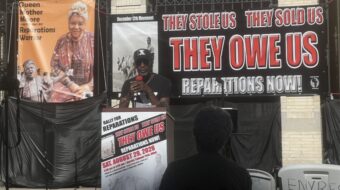
What did his declaration of atheism have to do with what we were all doing on that Saturday morning on a street in Washington, D.C., educating and asking people to join the economic boycott against the Target corporation?
Target was one of the first companies to announce a Diversity, Equity, and Inclusion (DEI) initiative after the police murder of George Floyd in 2020. Being a Minneapolis-based corporation, Target evidently felt it had a special responsibility to lead the country in terms of addressing racial injustice. At least it did until Donald Trump came to office.
Target was one of the first companies to bend its knee at the altar of the wannabe emperor. Trump’s attacks and demands on corporations and other entities to jettison DEI programs served as a litmus test of loyalty and patriotism. Nearly all other major companies followed suit, prostrating themselves before the gods of greed and political accommodation.
This is how dictatorial regimes work. They invent ways to distinguish “believers” from “non-believers,” to separate the trusted versus those who cannot be trusted. Therefore, when my friend asserted boldly, proudly, and loudly that he was an atheist, I was left to make a historical connection with what that meant in this heated political moment—and also what it meant to me, a church person most of my life.
“I am an atheist,” he asserted, and that caused me to wonder what that had to do with us boycotting Target these many months, and whether there was a historical correlation between what he was declaring and what we were doing?
After some time reflecting upon the history of the term atheist, I turned to my friend and shared that the word was used in the first century CE to label and castigate those who would not participate in emperor worship or the trappings of all of the other Roman gods and goddesses. An atheist was a person that did not worship Caesar. The Caesars were generally deified, and the worship of Caesar and all of the Roman array of deities served as a test of loyalty. Those who fell into line and worshipped Caesar were loyal and patriotic, and those who resisted the test were seen as a threat.
Early Christians were generally labelled atheists because they refused to worship the things of Caesar, and they generally resisted the Roman social order. It is rumored that John, who wrote the letter Revelation, not the John of the gospel, was exiled to the Isle of Patmos for his refusal to “Hail Caesar” or worship all of the other trappings of the Roman order.
I reminded my friend that he was standing in a time and place where his declaration, “I am an atheist,” could mean something more than the fact that he did not believe in God. Without him even knowing, he was declaring the same sentiments that were stated in the first century that separated the believers from the non-believers. The non-believers refused to accept the false gods, deities of human making, and the trapping of those gods for the sake of money, position, and power.
Given those historical facts, it made sense as to why we were on the street in front of a Target store boycotting the business and urging others to do the same.
We were doing historically what the atheists of the first century did—challenging those who acquiesced to power and governments and pushing back against the business entities and people that have surrendered their dignity to satisfy the gluttonous appetite of a king. We have been demanding that Target and other corporations stop genuflecting at the throne of Caesar.
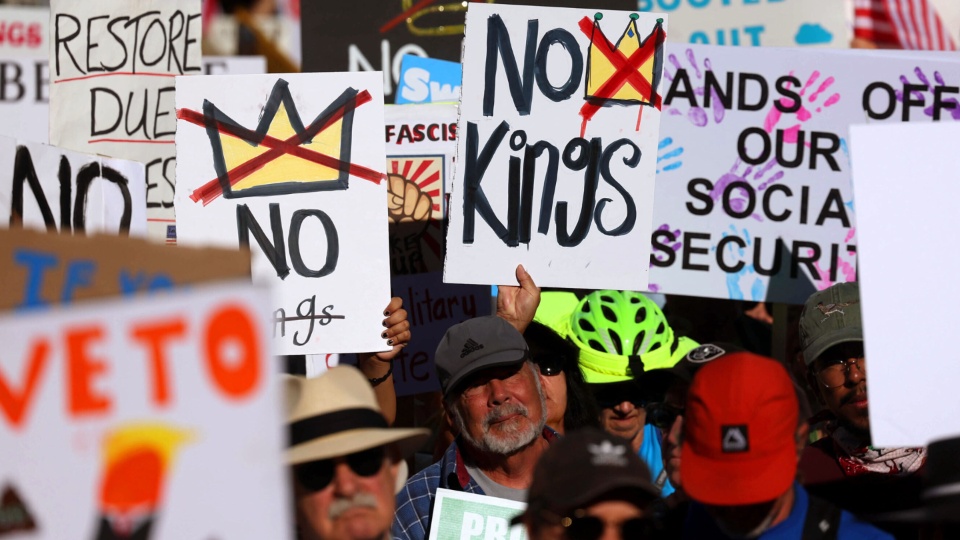
So, I was ecstatic over the “No Kings” rallies and marches held across the country on Oct. 18. I could smell an aroma of political atheism in the crowds.
The marches declared that in America there are “No Kings,” no Caesars, and no emperors. The marches confronted King Trump with the fact that people were not bowing or honoring the trappings of this Caesar-king. The marches across the country and in some cities overseas were a statement that, in this moment, some people were not bowing before this king.
But even with the celebration of the fact that seven million people came out in thousands of cities responding to the “No Kings” sentiment, there were fears and perils that became apparent, at least for me. I began to worry what would happen after the marches were over.
What will happen after this administration is driven out and its power has faded? Will people bow before a new king, perhaps one to their liking? This is why we need seasoned and committed political atheists who will demand that we not be seduced into the courtyards of this king or any new king.
Democracy is fragile, and people can easily be fooled by the charms of charlatans. We need political atheists with their cynicism to shock us by reminding us not to be seduced in any way or any season by any king. Without honest critique and cynicism coming from non-believers who are not seduced by the Democrat/Republican beauty contest, or the quixotic notions of an independent candidate, we will find ourselves in this predicament again.
We need political atheists who will sound the alarm of the dangers of a king lest we become beguiled and seduced again by the flash and form of a new snake-oil dealer. We will have to march and march, demonstrate and demonstrate to hold on to our country. The demagogues and charlatans, like the people who currently occupy the White House and fill the ranks of this administration—as well as the would-be kings of our liking—know how easily the country can be hijacked.
The average American citizen is a cultural believer in the myths of goodness and benevolence, believing that their country will do the right thing if the right king is at the helm. And, after the right person gets in, we can go back home and allow the “good” king to do the good things for us.
We generally have placed our trust in the goodness of the U.S. structures, but glaring before us is the reality that Congress and the Supreme Court are not the protectors we may have thought them to be. We have seen how members of Congress and justices on the Supreme Court can also prostrate themselves at the altar of political expediency.
The political atheists, however, call us to be cynical, remain alert, remain in the streets, protest even when so-called “good kings” fill the so-called “good structures” of democracy. They call us to march on the king even when we like the king but never again to prostrate ourselves before the throne of political satisfaction. Winning the country back would be a good thing, but to keep it will be difficult, and so we need the sentiment of political atheists who refuse to bow and demand that we refuse also.
My friend caused me to appreciate the atheism that does not believe, that doubts, that questions, and does not fall into line. That is an important political posture to have at all times.
The Christians of the first century were called atheists and considered subversives because they did not salute the emperor or the emperor’s men but instead pushed toward a higher order. So must we. But this is our calling not only today as we challenge and resist Emperor Trump, but in all political seasons, and with all people aspiring to be king.
As with all op-eds published by People’s World, the views reflected here are those of the author.
We hope you appreciated this article. At People’s World, we believe news and information should be free and accessible to all, but we need your help. Our journalism is free of corporate influence and paywalls because we are totally reader-supported. Only you, our readers and supporters, make this possible. If you enjoy reading People’s World and the stories we bring you, please support our work by donating or becoming a monthly sustainer today. Thank you!
CONTRIBUTOR