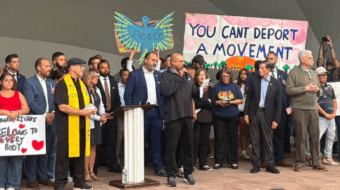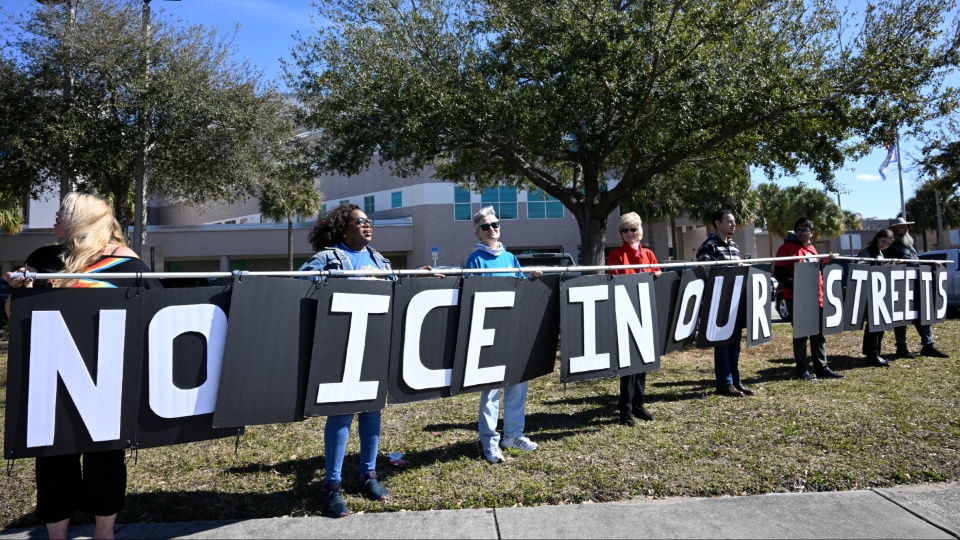
Across the United States, an intense fight is raging against collaboration with Immigration and Customs Enforcement, the Trump administration’s rogue “law enforcement” arm. This struggle is primarily being waged at the local level by people and organizations working vigorously to move the levers of power.
Many prominent national politicians and candidates are also out raising money and campaigning, but it is local activists, labor unions, and community groups who are doing the heavy lifting when it comes to organizing and mobilizing public resistance against complicity with ICE’s lawlessness and racism. And they have scored significant wins.
Local police and other agencies cooperate with ICE in many ways. Under a federal statute commonly referred to as “287(g),” states and municipalities can enter into formal collaboration agreements that allow police officers to act as deputies of ICE, arresting, holding, and processing individuals targeted by the agency based purely on ICE’s unsupervised administrative pronouncements.
Another key form of collaboration is honoring “administrative warrants.” ICE has the power under federal law to issue these warrants—which are written by the agency itself, are not based on probable cause, and not reviewed by a court or other independent adjudicator—and then arrest and detain people based on them with little accountability.
Many police forces honor these “warrants” by transferring inmates in their custody directly to ICE, notifying ICE that people subject to administrative warrants have been detained, holding inmates longer than they otherwise would to facilitate ICE taking them into custody, or even arresting people in the community based on these documents.
Additionally, some municipalities and private businesses aid ICE by allowing the federal government to buy properties for use as ICE detention camps. Most commonly, the Department of Homeland Security buys large warehouses that can be repurposed to imprison thousands of people, largely without access to legal counsel and absent judicial or other independent oversight.
Legislation and other efforts by local governments and the public combat these practices and many others. For example, on April 23, the Philadelphia City Council passed a package of seven bills known collectively as the “ICE Out” legislation by a veto-proof supermajority. The measures will now go to the mayor’s desk.
Philly’s ICE Out legislation codifies the city’s longstanding policy by banning formal 287(g) collaboration agreements with ICE, forbids city police and other agents from collaborating with ICE based on administrative warrants, prohibits local agencies from collecting and sharing information on people’s immigration status with ICE, and bans ICE personnel and enforcement operations from city-owned properties in the absence of a judicial warrant. It also tries to curb some of ICE’s lawless behaviors by prohibiting agents from wearing masks or using unmarked vehicles and requiring them to wear their badges openly.
The bills followed months of grassroots advocacy and organizing. Local groups like ICE Out of Philly, labor unions, immigrant organizations, and community members packed public hearings, tirelessly advocated for these measures, and assisted the drafters with assembling the bills.
The win in Philadelphia is just the latest in a series of victories by local organizations, community members, and lawmakers. For example, last February, public pressure by community members—including a walkout by hundreds of students—spurred the Upper Darby Township Council in Pennsylvania to pass a resolution prohibiting local police from collaborating with ICE absent a valid judicial warrant.
And this March, the Montgomery County Council in Maryland enacted the County Values Act, which (among other things) restricts ICE access to non-public county facilities without a judicial warrant and requires signage warning the community of certain public areas that have or may be used for immigration enforcement operations. Separately, Montgomery County passed legislation barring private ICE detention facilities in the county. A coalition of labor unions, immigrant rights groups, faith organizations, and engaged activists backed these measures from the start and advocated for them throughout deliberations.
These efforts are not limited to “blue” states. For example, after local police conspired with ICE to facilitate the seizure and detention of a mother and her young son in Austin, Texas, protests and community backlash pressured the Austin Police Department to revise its ICE cooperation policy to make assisting ICE optional.
This triggered a confrontation with the state’s far-right governor and attorney general, who have threatened to withhold funding from the city. In ensuing negotiations with the state government, Austin officials partially backed down from the changes, but the policy still leaves room for local police to avoid sharing information with ICE. Local activists and groups are keeping the pressure on the city’s political leadership to hold the line in the face of this state coercion.
Elsewhere—in “red” and “blue” regions alike—local organizations have employed creative tactics to frustrate ICE initiatives in their communities. In Ashland, Va., protesters braved the cold to successfully persuade a Canadian business to abandon its plans to sell a warehouse to the federal government for use as an ICE detention facility. In Oklahoma City, local organizers and residents forced the city’s Republican mayor and business owners to drop plans to sell a building to DHS that would have been used as a detention facility. In Durant, Okla., after public protest against plans to build a new ICE prison camp, the Choctaw Nation stepped in and bought the property out from beneath the federal government—short-circuiting the administration’s plans to house as many as 8,500 detainees there.
The struggle continues elsewhere. As just one example, many individuals and local organizations in Alexandria, Va. are urging the Alexandria City Council to cut Sheriff Sean Casey’s budget as a way to punish him for voluntarily collaborating with ICE. Casey and his office continue to work with ICE by notifying the agency any time a person in their custody is subject to a non-judicial administrative warrant, holding people to allow ICE to seize them, and even actively transferring individuals to ICE despite its pattern of lawless behavior and racial discrimination.
Despite months of protest and a City Council resolution condemning these practices, Casey continues to claim that he is only following the law—even though neither federal nor Virginia law require him to engage in such conduct. The City Council has limited options because its supervision of the sheriff is limited by local law to partially funding the department, but the Council has advanced a modest $200,000 budget cut in response to the public’s demands for coercive measures against Casey.
These are just a few of many such examples of communities effecting big changes at the local level in the fight against ICE’s vigilante conduct. They show that while the courageous efforts by Minneapolis residents, workers, and organizations to stand in solidarity with their immigrant neighbors are rightly celebrated, the fight certainly didn’t end there. Since the start of the second Trump administration, local civic, immigrant, labor, and faith groups have stepped up for their neighbors and communities across the country.
At a time when the national government is controlled by a combination of Trump sycophants and weak-spined politicians who dare not risk their political careers in taking concrete action, local organizing is the key driver of success in the struggle against ICE’s murderous, lawless, and racist practices. And the wins delivered by everyday people and groups in their communities are a powerful reminder that our voices still matter. Oftentimes, that voice can be heard most loudly in local politics.
Most importantly for the long term, local organizing is the first step in building a mass worker movement strong enough to eventually take back power from the billionaires and business interests that made MAGA fascism possible in the first place. Efforts like those discussed here are important, but they don’t go far enough if they remain focused on one-off issues. We need a powerful coalition of people and organizations that stands up for all workers on both individual issues and in the broader fight for political power in the United States and the world.
As with all op-eds published by People’s World, the views reflected above are those of the author.
We hope you appreciated this article. At People’s World, we believe news and information should be free and accessible to all, but we need your help. Our journalism is free of corporate influence and paywalls because we are totally reader-supported. Only you, our readers and supporters, make this possible. If you enjoy reading People’s World and the stories we bring you, please support our work by donating or becoming a monthly sustainer today. Thank you!
CONTRIBUTOR