NEW YORK—For nine months last year, Yunakiel Mora drove buses in New York City for the Metropolitan Transportation Authority. Now, because of Donald Trump, Sean Duffy, and Kathy Hochul, she can’t.
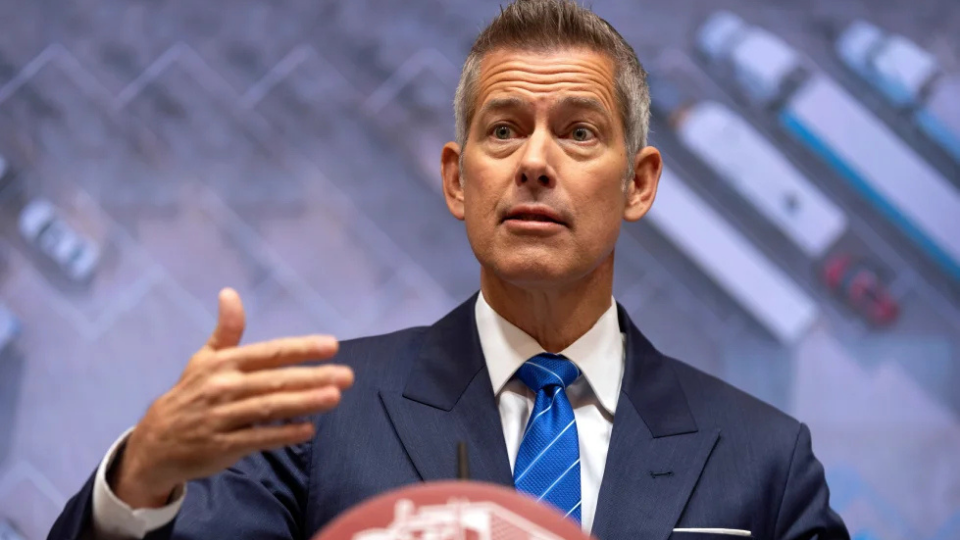
The GOP president’s continued political attacks on migrants—especially from Latin America—transmitted through Duffy, his Transportation Secretary, produced an agency edict that anyone without proper papers can’t obtain or hold a Commercial Driver’s License, or CDL.
Red states accepted Trump’s edict, issued a year ago and implemented by Duffy against what he calls “foreign drivers.” States that refused could lose federal transportation grants, Duffy threatened. For New York, that’s $73 million.
Many blue-state governors are defying Trump and Duffy, daring them to deny the money. New York Democratic Gov. Kathy Hochul isn’t. Her Department of Motor Vehicles yanked Mora’s CDL, even though it knows the Transport Workers Local 252 member awaits renewal of her green card.
The result for Yunakiel Mora and an estimated 200,000 other CDL-holders in states that kowtow to Duffy’s edict is “no job.” And that has Transport Workers Union President John Samuelsen, among others, pissed off and not just on Mora’s behalf.
He condemns the prejudice that deprives thousands of people—MTA bus drivers like Mora, subway drivers, truckers, private bus company drivers, and especially school bus drivers—of good family-supporting union jobs.
“This is another case of Kathy Hochul sticking it to working people,” Samuelsen told The Gothamist. “She wants her rich donors to think she’s fighting while dumping working people into the wood chipper. This is about whether hardworking drivers can earn a fair wage, and Hochul doesn’t give a s— about that.”
Hochul blames Duffy and, by implication, Trump for the mess. Meanwhile, Mora can’t drive buses.
But it’s not just individual drivers such as Mora who suffer from Trump’s edict and Duffy’s threat to pull federal cash from state and local transportation agencies that don’t obey Trump’s edict.
It’s union locals, their members, all the drivers they represent, and the firms and agencies—public and private—whom the locals’ contracts cover.
And it angers Debra Hagan, president of TWU Local 252, too. All of a sudden, dozens of bus drivers at four private firms, whose workers her local represents, will be out of jobs. Their CDLs were yanked, and they can’t work. Her clients and her union are scrambling, leaving customers in the lurch.
Yunakiel Mora, a native of the Dominican Republic, has been in the U.S. for almost a decade.
Hochul’s Department of Motor Vehicles took Mora’s Commercial Driver’s License (CDL) away, even though she awaits green-card recertification as a lawful permanent resident. And that’s left her scrambling for work to help feed her family. Her husband is a chef.
“They [DMV] sent a letter,” Mora told People’s World in a telephone interview. The agency is “saying they would take a little while to review my status.”
In the meantime, her CDL was pulled. She could apply for a regular driver’s license, but without a CDL, she can’t drive a city bus, a school bus, a private company bus, or a truck. So without a car, she’s going from storefront to storefront in New York, seeking any work she can find.
And she’s not alone.
State officials nationally who are obeying the Trump edict, handed down through Duffy, are banning anyone without “proper” papers from holding CDLs. A whole long page of legalese, on the federal Transportation Department website, details the ban.
One way to throw migrants out is to make sure they either have to toil in the “underground economy” and be exploited, or not hold jobs at all.
That’s what Hagan, president of TWU Local 252 for the last 12 years and holder of a CDL license herself, anticipates. What makes it doubly hard is that a CDL license is tough to win and tough to hold.
To get that CDL, drivers who are part of her local must pass 36 hours of rigorous road tests and a physical performance test, read and write fluent English, pass a drug test and pass a test showing how quickly they can turn a bus or truck on or off and—in the case of school buses—how fast they can evacuate passengers in an emergency, Hagan said in a telephone interview.
They also must re-qualify every six months if the “cargo” they’re going to carry is children going to schools or day care centers. And even after a CDL-holder passes all that, she’s often trailed on the road by a company supervisor, scrutinizing her performance.
So when a client calls up for a CDL driver, and Hagan finds her union is short thanks to Trump’s edict, everyone from the union to the driver to the kids suffers.
“By the end of June, we’ll have about 160 CDLs pulled from drivers, for just one of our companies,” she says. “That’s out of 2,500 drivers, total.”
Many of the victim drivers are migrants, again from what Trump calls “s—hole” countries. Many, like Mora, have green cards that they must periodically renew, too.
Others, like Smart-TD member Kilmar Abrego Garcia, have lived in the U.S. for years if not decades, on Temporary Protected Status, after fleeing natural catastrophes or civil or gang wars at home.
Trump’s ICE agents grabbed the Laurel, Md., resident in Tennessee, falsely charged him with being an MS-13 gang member, and shipped him off to a notorious prison in El Salvador. It took U.S. Supreme Court intervention, literally, to get him out. He’s still under ICE suspicion.
“There’s no reason given” for pulling drivers’ CDLs, if they’re here under Temporary Protected Status or have a green card, Hagan adds. “But to have a CDL removed is disastrous.”
She suspects there’s an ulterior motive behind the sudden withdrawal of CDL licenses from the migrants.
“Our local, and the international, has been looking into the grounds of people with certain visas being singled out” for having their CDLs withdrawn, Hagan says.
Hagan has been able to convince the employers whose union members lost their CDL licenses to transfer some of the workers to “temporary assignment” jobs—desk work, except in emergencies. As Driver Assistants, they can sub on a suddenly vacant route trip, but must drive very carefully.
“And there’s a $15 an hour [less] difference” between what the drivers earned under the union contracts when they had CDLs and what they earn in those desk work posts, Hagan adds. “And that’s only if the companies can place them.”
One of her drivers, Hagan said, has worked for the same transport firm for 18-1/2 years. Like Mora, after training, she too drove buses for 16-1/2 years with the CDL. Then it was yanked. Now she’s a driver assistant.
Not only does a lack of a CDL cut pay for the hurting worker, but it also cuts her hours, too, Hagan said. The worker was guaranteed six hours of daily driving at the higher CDL rate. Now she’s guaranteed 4-1/2.
Removing drivers from the road by yanking their CDLs “will especially impact the school bus industry,” whose drivers Hagan’s local represents. She calculates schools will lose 7% of their bus drivers, with the big hit coming not in New York City but on more-rural bus routes upstate and on Long Island.
But the real big hit, Hagan says, will be to the families of the drivers, and it won’t be just financial, either. Many parents—men and women—hold CDLs and work part-time driving the buses, taking special care because they transport kids.
And their driving hours coincided with the need for the buses before and after school. That lets the parents with the CDLs arrive home with or just after their own children, a boon to family ties.
Hagan knows other governors have stood up to Trump and Duffy. “Why Hochul didn’t baffles the mind,” she says.
“They’re not even offering an extension” of a driver’s CDL license “until the visa is renewed—especially for drivers who have worked a long time” driving trucks and school buses.
Those drivers are at the top of pay scales, she adds, and have first pick of routes. For the school bus drivers, that includes picking routes, by driver seniority, every summer for the upcoming school year. Now all the drivers face a financial squeeze and employment uncertainty.
Mora knows “how really hard it is, but it’s not something under my control,” she says. “I’m looking for work, applying to supermarkets and other stuff. But it’s really hard to get around because I cannot be driving.”
The one saving grace: When she gets her papers, she’ll be able to return to driving her MTA bus. She was nine months through her mandatory one-year probationary period and had an outstanding record. The MTA has promised she won’t have to start all over again.
“They said when I reapply, they’ve saved [up] my probation time.”
We hope you appreciated this article. At People’s World, we believe news and information should be free and accessible to all, but we need your help. Our journalism is free of corporate influence and paywalls because we are totally reader-supported. Only you, our readers and supporters, make this possible. If you enjoy reading People’s World and the stories we bring you, please support our work by donating or becoming a monthly sustainer today. Thank you!
CONTRIBUTOR