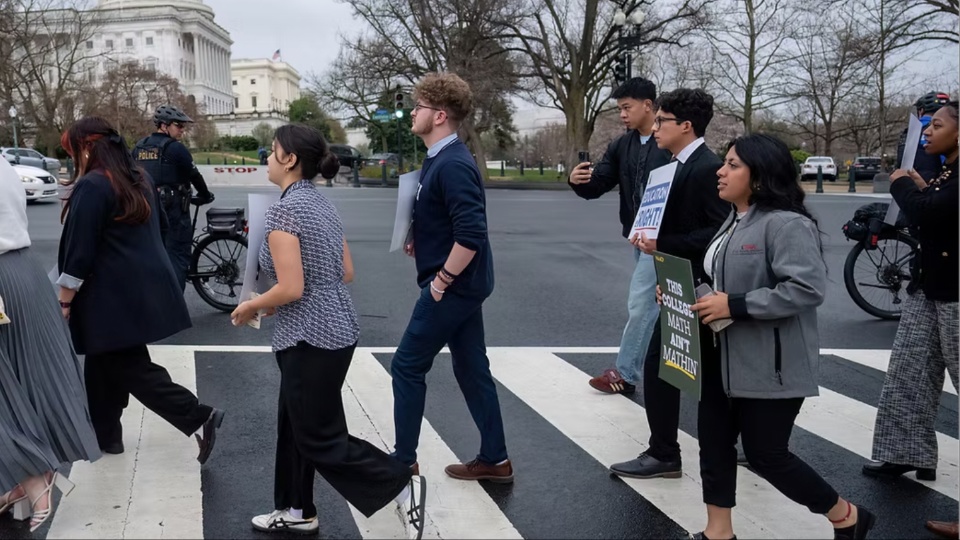
WASHINGTON—“The reality is that our opposition has a lot of money, a lot of power, a lot of momentum. And so it’s our job to ensure that all of us are clear about the assignment,” Gresia Martinez told delegates gathered in D.C. this past weekend for the United States Student Association’s 48th national grassroots legislative conference.
Martinez is executive director of United We Dream, the largest immigrant youth-led network in the country. She said student activists have to “be relentless, not seek out easy or short victories…and look at the long arc.” The good thing, she said, is they don’t have to do it alone.
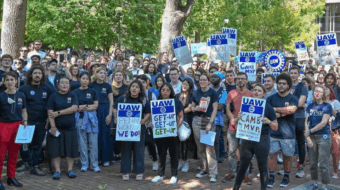
Students from 23 states, most of them participants in their campus Student Government Associations, attended the USSA meeting to strategize on how to take action on issues facing students. The agenda was filled with legislative briefings, workshops and organizer training sessions, panels with experienced organizers, and preparations for meetings with representatives.
The USSA conference was hosted and led by its executive director, Tiffany D. Loftin, who joined USSA on her campus 18 years ago. Loftin spoke to students with energy and enthusiasm, intent on inspiring and preparing them to head back to their campuses with the right tools.
Martinez made her remarks at Saturday’s “ICE vs. Everybody” panel and Q&A, where she appeared together with activists Abraham Paulos and Michael Foote. The discussion focused on “how federal immigration policy and ICE enforcement are impacting young people across the country.”
Foote, an immigration attorney and social media influencer in New York City, gave advice about working collectively, saying, “Someone is capitalizing off of you feeling lonely. Someone is capitalizing off of you feeling like you aren’t organized or that you are powerless, and that you don’t have rights…. This really is a collective. There are so many people thrusting us forward, doing this work.”
Paulos, a formerly incarcerated human rights advocate and deputy director of the Black Alliance for Just Immigration, spoke about the intersection of policing and immigration enforcement. During the Q&A, one student asked, “How does the immigration system uniquely impact Black immigrants and students from the African and Caribbean diaspora?”

Paulos responded, “The first people that were excluded from citizenship were Black and brown people, indigenous folks, and those of us that were stolen…. It’ll always come back to that. The first civil rights movement gave us the 14th Amendment… . And that 14th Amendment is essentially birthright citizenship. Anybody that’s born on this land is a U.S. citizen. So, shout out to the African-American movement for that and the Black Liberation struggle.”
The students erupted into cheers and applause.
Throughout the workshops and training sessions, attendees were energized and focused. Many students spoke about problems they were facing on their campuses, talked with each other about different strategies for expanding student rights, and collaborated with other students in their region.
Some stand-out workshops included “America’s Censored Campuses: Defending the Freedom to Learn,” “Powermapping For Real Change,” and “How Students and Workers Win Change Together.”
While the USSA has had a “largely liberal” early history, according to professor and historian Angus Johnston, in its earliest days the student union had radical roots in the 1930s in the fight against fascism leading up to World War II. Formerly known as the National Student Association, there was a consistent battle internally over whether the organization should take up “political” issues or just stick to campus organizing.
Throughout its existence, the USSA has played an essential role in providing infrastructure and funding to student-led movements, like the Student Nonviolent Coordinating Committee (SNCC) in the 1960s. By the ’70s, radicals across campuses won elected roles in the USSA, and left-leaning progressive voices became the voice for students demanding their rights. Today, the USSA has participants with a range of left voices, including Communists.
Howard University student and Young Communist League USA member David Green said he was attending the conference to expand his relationship with his own student government association and to “gain a pulse on the trajectory of student government and student organizing in general.” He hopes to gain “experience, testimony, and strategy from students across the country as best as possible.”
The students marched and rallied Monday afternoon on Capitol Hill before meeting with congressional representatives and staffers about four key issues:
- Saving the Pell Grant
The Pell Grant, which currently funds tuition costs for more than 7 million low-income students, is at risk if Congress fails to secure full funding for the next fiscal year. Current projections estimate that the program will be at a deficit by the end of the 2026 fiscal year, affecting students who will be applying for aid for upcoming academic years.
Without additional funding, maximum grants could be reduced by thousands of dollars per student. Pell Grants are under constant threat due to changing political priorities and budget crises. Many activists, in addition to requesting emergency funds, are urging for the long-term solution of moving the Pell Grant allocations from under the discretionary spending budget and instead have them be required under mandatory funding.
- Saving the Federal TRIO Programs
The Trump administration’s 2026 federal budget proposes cutting the federal TRIO programs, which provide support services to students of many different backgrounds as they apply to colleges and throughout their attendance. The TRIO Programs include support for students with disabilities, veterans, low-income students, and first generation students. They provide guidance, counseling, and other forms of hands-on support for students who need assistance.
- Saving the Department of Education
Last year, the Trump administration proposed cutting all funds for the Department of Education (DOE), a move which was stopped by Congress. Still, several of the department’s key functions were moved under different agencies with no funding or staff able to take on the tasks.
For example, management of the DOE’s Title 1 program for funding K-12 public schools and low-income districts was moved to the Department of Labor. Even with pushback, the goals of the administration to dismantle the DOE piece by piece and push families into for-profit schools haven’t changed. A robust fightback is needed to restore and protect the DOE, and students are leading the charge.
- Stopping the SAVE America Act
The SAVE America Act, which has been called a new “Jim Crow” poll tax by many of the young people attending, would require voters to provide either a passport or birth certificate as identification to be able to vote.
If passed, the bill would go into effect immediately, which would put financial and bureaucratic barriers on the 21 million voters who don’t have easy access to these documents ahead of the 2026 midterms in November.
USSA members also reported that the bill would prevent on-campus registration and would erect additional barriers for mail-in voting, which nearly half of all students rely on when attending school out of their home states.
The fight for education and for student rights is essential in the broader fight against fascism and for saving democracy. We cannot afford to leave the youth movement out of our radical struggle for a better future. Students and young workers across the country are being sidelined, but their energy and leadership will be what drives our movement forward.
We hope you appreciated this article. At People’s World, we believe news and information should be free and accessible to all, but we need your help. Our journalism is free of corporate influence and paywalls because we are totally reader-supported. Only you, our readers and supporters, make this possible. If you enjoy reading People’s World and the stories we bring you, please support our work by donating or becoming a monthly sustainer today. Thank you!
CONTRIBUTOR